The Informed Consent Fiction
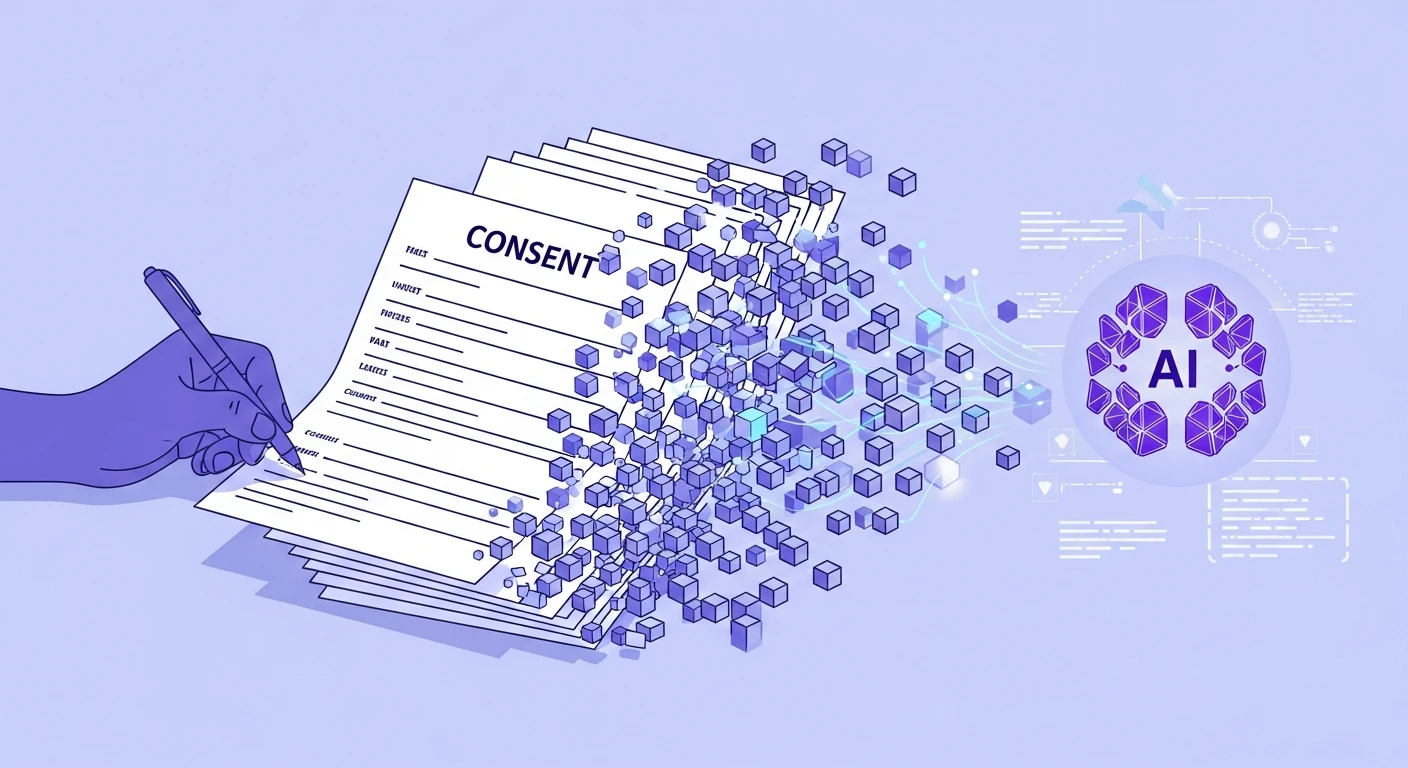
Informed consent in qualitative research rests on a simple principle: participants should understand what will happen to their data before agreeing to share it. For decades, this meant explaining that a researcher would read their transcript, identify themes, and report findings in aggregate. The consent process matched the analytical reality.
AI-assisted research has broken this match. The consent forms still exist — they have simply failed to keep pace with what the tools actually do. A participant who consents to "AI-assisted analysis" might reasonably imagine something like autocomplete: a tool that helps the researcher organize notes faster. What they almost certainly do not imagine is a system that:
- Infers emotional valence from vocal micro-patterns they cannot consciously control
- Correlates their response timing with psychological constructs
- Feeds their words into foundation models trained on data from millions of other people
- Generates interpretive labels about their cognitive and emotional states
- Stores embeddings of their responses in vector databases indefinitely
- Enables semantic similarity searches that surface their data in contexts they never anticipated
The consent form covers "analysis." The AI does surveillance dressed as science.
Why Traditional Consent Language Fails
Traditional consent language evolved for a specific analytical paradigm: human researchers reading transcripts and applying interpretive frameworks. The key privacy protection was contextual — a human analyst would read the full interview, understand the conversational context, and interpret statements within that context.
AI analysis operates differently in ways that break every assumption underlying traditional consent:
Decontextualization at scale: AI tools routinely chunk transcripts into fragments for embedding and retrieval. A participant's statement about their relationship with their manager might be stored as a vector alongside thousands of similar statements from other people, retrievable by semantic similarity regardless of the original conversational context. This is the decontextualization problem amplified from a reporting issue to a data architecture issue.
Inference beyond disclosure: When a participant shares a story about their work experience, they are disclosing what they chose to share. When an AI tool infers their stress level from vocal patterns, their engagement from response latency, or their confidence from linguistic hedging, it is extracting information the participant never chose to disclose.
Perpetual analyzability: Traditional analysis had a temporal boundary — the researcher coded the data, wrote the report, and moved on. AI-stored data remains perpetually analyzable. New models, new techniques, and new analytical questions can be applied to archived data years later, extracting insights that did not exist when consent was given.
Training data contamination: Some platforms use participant data to improve their models. A participant's unique phrasing, emotional pattern, or cognitive style might influence how the tool interprets future participants — creating a form of data leakage that no consent form addresses.
The Specificity Problem
Research ethics boards face an impossible challenge: requiring consent language specific enough to be meaningful while general enough to cover rapidly evolving tools. A consent form that accurately described every AI analytical operation would be pages long and incomprehensible to participants. A form that remains concise necessarily obscures what the tools do.
This creates what ethicists call the "consent theater" problem — a performance of informed consent that satisfies institutional requirements without achieving genuine understanding. The participant signs. The IRB approves. The researcher proceeds. And everyone involved pretends that "AI-assisted analysis" is a sufficient description of systems that perform operations participants never imagined and would likely object to if they understood.
The parallel to research democratization challenges is instructive. Just as democratized research tools can compromise rigor when users do not understand methodological constraints, democratized AI tools compromise ethics when participants do not understand analytical capabilities.
What Participants Actually Think AI Does
Pilot studies on participant understanding consistently reveal massive gaps between perceived and actual AI capabilities in research contexts:
- Most participants think "AI analysis" means faster transcription and basic categorization
- Fewer than 15% understand that emotional inference from vocal patterns is possible
- Almost none understand vector embedding storage and semantic retrieval
- Participants who are told about inference capabilities are significantly more likely to modify their responses or decline participation
This last finding is particularly troubling for research validity. If full disclosure changes participant behavior, then the current consent approach is producing data under conditions of partial deception — not intentional deception, but functional deception through omission.
The parallel to how AI governance frameworks handle transparency requirements in enterprise systems is striking. Production AI systems increasingly require explainability for affected parties — yet research AI tools often lack equivalent transparency obligations to participants.
The Withdrawal Paradox
Traditional research consent includes the right to withdraw — participants can request their data be removed from the study at any time. With AI-processed research data, withdrawal becomes technically ambiguous:
If participant data has been embedded in a vector store and used to train a clustering model, does withdrawal mean deleting the vectors? Retraining the model without their data? Both are technically possible but practically complex. If their responses influenced how the AI interpreted other participants' data, withdrawal cannot undo that influence.
This is not a hypothetical concern. As research platforms scale and participants become aware of AI capabilities, withdrawal requests will increase — and research teams will discover they cannot fully honor them with current architectures.
Toward Meaningful AI Research Consent
Resolving consent theater requires structural changes, not just better form language:
Capability-specific consent layers: Rather than blanket consent to "AI analysis," participants should consent to specific capability categories: transcription (low risk), thematic coding (moderate risk), emotional inference (high risk), model training (requires separate consent).
Demonstrative consent: Show participants what AI analysis actually produces from sample data before asking for consent. Seeing an emotional valence timeline or a psychological inference report makes the abstract concrete.
Technical withdrawal protocols: Before deploying AI tools, research teams should establish clear technical procedures for data withdrawal that account for embeddings, model influence, and derived insights. The data contracts concept from AI engineering applies directly — clear agreements about how data flows through systems and how it can be removed.
Ongoing consent for evolving capabilities: When research platforms add new AI features, previously consented participants should be re-contacted for consent to new analytical operations on their existing data.
The research community is at an inflection point. The tools have outpaced the ethics infrastructure. Participants are sharing data under consent frameworks designed for a fundamentally different analytical paradigm. Every study conducted under this gap accumulates ethical debt that will eventually come due — through participant complaints, regulatory action, or public trust erosion that damages the entire field.
Consent theater serves institutions. It does not serve participants. And research that does not serve participants has already compromised its own foundations.