The Drift Mechanism
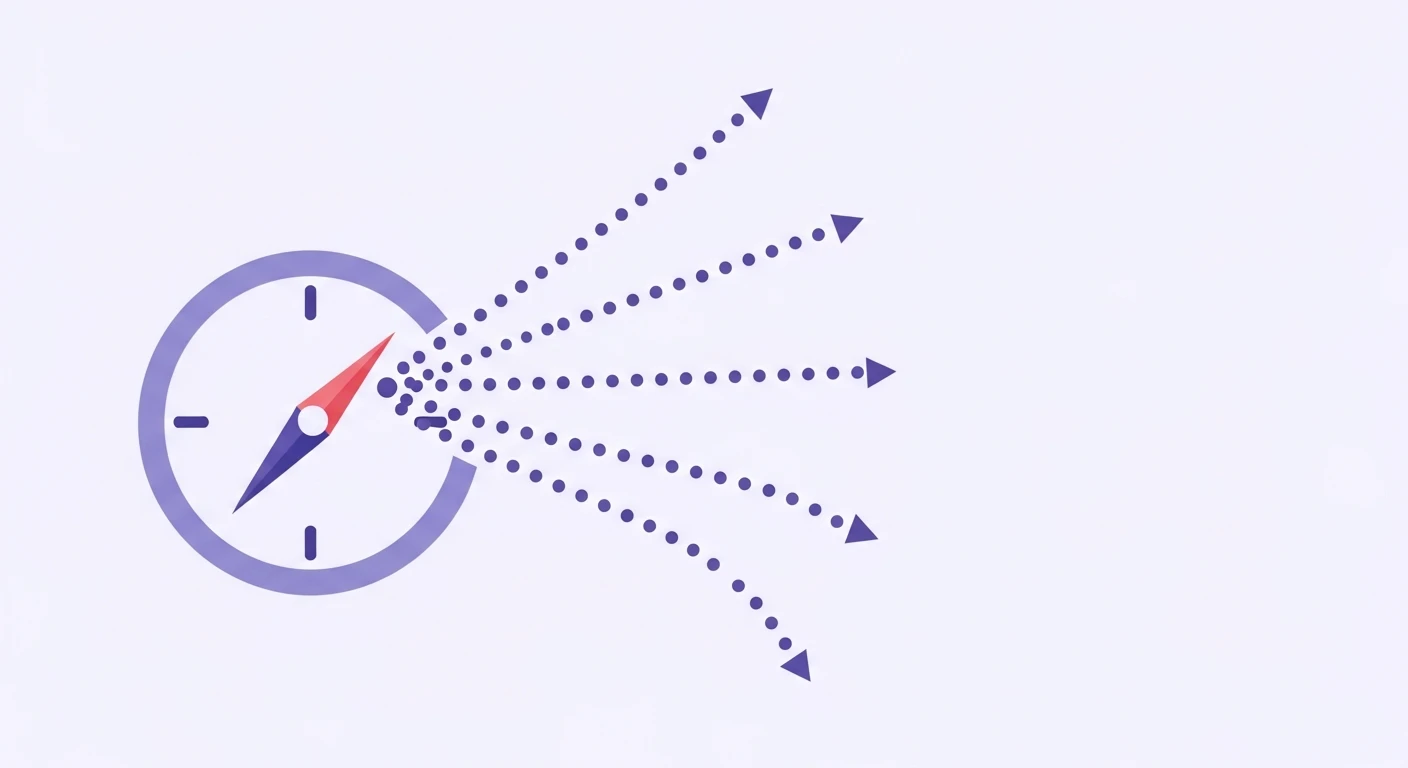
Research question drift is the gradual, often imperceptible shift between the question a study was designed to answer and the question it actually addresses. Unlike a deliberate pivot -- where the team consciously decides to change direction based on early findings -- drift happens through accumulated small decisions that each seem reasonable but collectively transport the study far from its origin.
The first interview reveals something unexpected about feature discovery. The researcher follows that thread. The second interview confirms the pattern. By the third interview, the discussion guide has subtly shifted to explore this new territory. By the eighth interview, the study is primarily about feature discovery -- but the research brief, the stakeholder expectations, and the decision framework all still reference onboarding friction.
This matters because research exists to inform specific decisions. A study justified by a decision about onboarding investment that ultimately delivers findings about feature discovery serves neither decision well: the onboarding decision lacks evidence, and the feature discovery findings lack the methodological grounding that would have come from designing for that question from the start.
How Drift Happens
Participant-Led Redirection
Participants do not know your research question. They talk about what matters to them, and what matters to them may be adjacent to -- but distinct from -- what you asked about. A participant asked about onboarding difficulty may spend most of the interview describing their ongoing struggle to find features they know exist. The conversation is rich. The data seems valuable. The researcher follows it.
Individual responsiveness to participants is good interviewing. But when every interview drifts in the same direction, the study's center of gravity shifts. The researcher is no longer studying what they set out to study -- they are studying what participants want to talk about. These are different questions with different methodological implications.
Emerging Pattern Seduction
Qualitative researchers are trained to notice patterns. When three interviews in a row surface the same unexpected theme, it feels analytically irresponsible to ignore it. The researcher adjusts probes to explore the pattern. Then adjusts the guide to systematically investigate it. Then reframes the study objectives to encompass it.
This sensitivity to emergence is a strength of qualitative methodology -- theoretical sampling and iterative design are core principles. But there is a difference between methodologically adjusting your sampling strategy based on emerging theory and unconsciously abandoning your research question because something more interesting appeared.
Stakeholder Influence Mid-Study
Stakeholders check in during a study: "How is it going? What are you hearing?" The researcher shares early patterns. The stakeholder gets excited about an unexpected theme: "Oh, that is exactly what we have been wondering about the navigation redesign!" Suddenly the research has a new, more enthusiastic audience for a question it was not designed to answer.
The researcher, wanting to deliver value, leans into the theme the stakeholder found exciting. The original question -- which may have a less engaged stakeholder audience -- gets deprioritized in real-time without explicit discussion. The study drifts toward audience demand rather than methodological design.
The Boredom Factor
Researchers are human. After twelve interviews exploring onboarding friction, the patterns may feel saturated. The researcher knows what participants will say. New themes feel fresh, intellectually stimulating, analytically promising. The drift is partially motivated by the researcher's own need for novelty -- a form of research fatigue that manifests as topic-shifting rather than quality degradation.
Consequences of Unmanaged Drift
Decision Orphaning
The original decision that justified the study -- "should we invest $500K in onboarding redesign?" -- now lacks evidence. The study was supposed to provide that evidence. It did not. The decision gets made on gut instinct, prior assumptions, or gets indefinitely postponed. The research capacity spent on the study produced no decision value for its intended purpose.
Methodological Weakness
A study designed to answer Question A but actually answering Question B has methodological gaps for Question B. The sampling strategy was designed for A. The discussion guide was designed for A. The recruitment criteria were designed for A. The findings about B emerged despite the methodology rather than because of it -- meaning they are likely less robust than they would have been in a purpose-designed study.
Trust Erosion
Stakeholders who commissioned research on onboarding and received findings on feature discovery lose trust in the research function. "I asked for X and got Y" feels like either incompetence or inattention. Even if the Y findings are valuable, the mismatch between request and delivery undermines confidence that research will answer future questions as posed.
Prioritization Debt
Drifted studies compound research prioritization debt. The original question remains unanswered but now feels "covered" because a study nominally addressed it. Proposing a new study on the original question feels redundant to stakeholders who do not understand the drift: "Did we not just study onboarding?" The question enters a dead zone -- neither answered nor available for future study.
Detection Methods
The Brief Comparison Test
At analysis, pull out the original research brief. Compare the actual research questions explored against the questions in the brief. If more than 30% of your analytical attention went to themes not in the original brief, drift has occurred. This is not inherently bad -- but it should be conscious and documented.
Discussion Guide Version Tracking
Track changes to your discussion guide across interviews. If questions were added, removed, or substantially reworded after the first few interviews, examine whether these changes represent methodological refinement (good) or topic migration (potentially problematic). Consistent addition of probes in new topic areas signals drift.
Stakeholder Expectation Audit
Before presenting findings, ask the requesting stakeholder: "What question do you expect this study to answer?" If their answer differs substantially from what your findings address, drift has created a expectation gap. Better to discover this before the presentation than during it.
Prevention Strategies
Anchor Documents
Create a one-page anchor document at study start that states: the research question, the decision it informs, and the criteria for what constitutes an answer. Pin it where you will see it -- literally above your monitor during interviews. When interesting tangents emerge, evaluate them against the anchor: does this thread serve the stated question, or is it pulling me elsewhere?
Deliberate Pivot Protocol
When you notice emerging themes that diverge from your research question, make the pivot decision explicitly rather than letting it happen through gradual drift. Call a 15-minute checkpoint:
- Is the new theme important enough to warrant its own study?
- Can we address both the original question AND the new theme within this study's design?
- If we pivot, who needs to know and what decisions are affected?
Explicit pivots are methodologically sound. Unconscious drift is not. The difference is documentation, stakeholder communication, and deliberate methodological adjustment.
Split-Study Design
When drift pressure is strong -- when participants consistently want to discuss Topic B instead of Topic A -- consider splitting: dedicate remaining interviews to the original question with adjusted probes that redirect, AND propose a follow-up study specifically designed for the emerging theme. This honors both the commitment to the original question and the analytical opportunity in the new theme.
Mid-Study Debrief With Stakeholders
At the study midpoint, debrief with the commissioning stakeholder: "Here is what we are finding so far. I notice participants are consistently raising Topic B. Our original question was about Topic A. Do you want me to stay on A, pivot to B, or address both?" This distributes the pivot decision rather than making it unilaterally.
This connects to how research debriefing practices improve methodology generally -- structured reflection prevents unconscious analytical drift by making decisions visible and deliberate.
The Governance Parallel
Just as deterministic control planes for agentic AI prevent autonomous systems from drifting beyond their authorized scope, research governance should include mechanisms that detect when a study has drifted beyond its authorized question. The detection does not require stopping the research -- it requires acknowledging the drift and making a conscious decision about whether to continue.
Practical Takeaways
- Write an anchor document for every study stating the exact question, decision, and success criteria. Reference it throughout.
- Track discussion guide changes across interviews. Cumulative probe additions in new areas signal drift.
- Compare findings to the brief before presenting. If you are delivering answers to a question nobody asked, you have drifted.
- Make pivots explicit. If a new theme emerges that warrants investigation, decide formally -- do not let it happen through gradual redirection.
- Run midpoint stakeholder checks. Brief the stakeholder on emerging themes and get explicit agreement on whether to follow them.
- Separate interesting from relevant. A fascinating theme that does not serve the study question should be documented for future study, not absorbed into the current one.
- Document drift when it happens. If you discover post-hoc that drift occurred, note it in the methodology section. Transparent drift is less damaging than hidden drift because consumers can appropriately weight the findings.
Research question drift is a natural consequence of working with live human data in iterative methodologies. The goal is not to prevent all drift -- rigid adherence to pre-set questions ignores the legitimate insights that qualitative emergence provides. The goal is to make drift visible, deliberate, and documented -- so that the study's actual contribution is clear regardless of where it ended up relative to where it started.