The Invisible Variable in Every Research Study
Every qualitative researcher controls for participant demographics, screening criteria, interview environment, and question design. Almost none of them control for when the interview happens — and this temporal variable is silently shaping their data in systematic, predictable ways.
The scheduling bias in user research is not about participant availability. It is about how the temporal context of a research session — time of day, day of week, proximity to work events, even season — shapes cognitive state, emotional availability, and narrative construction in ways that create meaningful data quality differences.
A participant interviewed at 9 AM on Monday morning is not the same informant as that same person interviewed at 4 PM on Friday. Their cognitive resources differ. Their emotional regulation capacity differs. Their relationship to the topic you are exploring differs based on whether they are looking forward into a week of work or reflecting backward on one.
This is not a minor methodological footnote. It is a systematic bias that compounds across studies and creates invisible data quality gradients that most research programs never detect.
The Cognitive Rhythm Problem
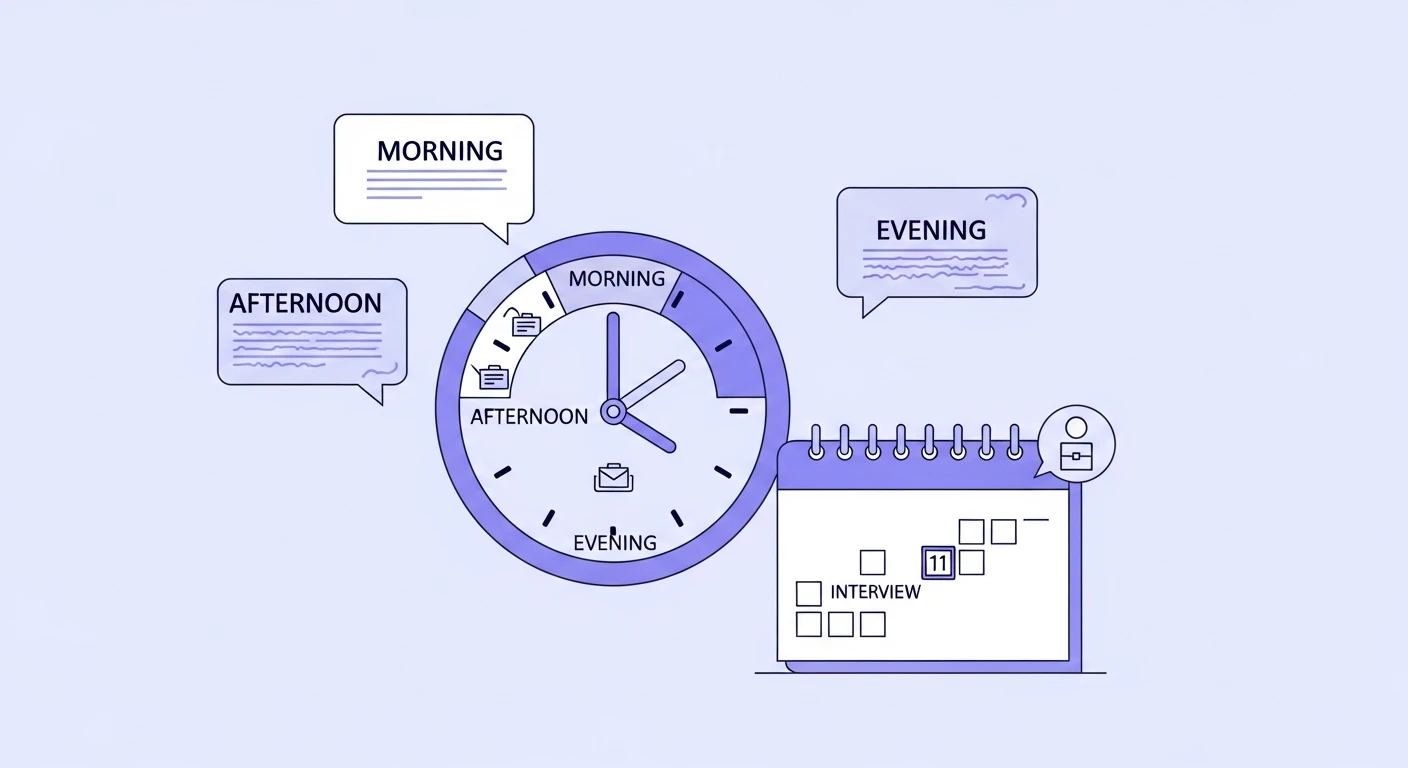
Human cognitive capacity follows predictable circadian patterns that directly affect research data quality. Morning sessions — particularly between 9 AM and 11 AM — coincide with peak analytical cognition for most adults. Participants in this window produce more structured narratives, engage more deeply with abstract questions, and generate more detailed procedural accounts.
But this peak cognition comes with a cost: morning participants also produce more socially filtered responses. Their executive function is at peak capacity, which means their ability to manage self-presentation is also maximized. They are better at constructing coherent narratives that present themselves favorably. They are more likely to edit out contradictions, smooth over confusions, and produce the kind of clean, logical accounts that feel satisfying to researchers but may not reflect actual lived experience.
Afternoon sessions — particularly the post-lunch window between 1 PM and 3 PM — produce qualitatively different data. Cognitive fatigue reduces executive filtering, which paradoxically can produce more authentic responses. Participants are less able to maintain performative narratives. They are more likely to contradict themselves, express uncertainty, and reveal the messy reality of their actual experience rather than a reconstructed version of it.
The late afternoon window — 3 PM to 5 PM — introduces a different dynamic entirely. Participants are often experiencing what researchers call "cognitive depletion" combined with temporal anxiety about remaining work obligations. This produces shorter responses, less elaboration on follow-up probes, and a tendency toward binary evaluations rather than nuanced assessments.
Day-of-Week Effects on Research Data
The day of the week creates even more pronounced effects than time of day, particularly for research about workplace tools, professional practices, or enterprise software.
Monday participants are in planning mode. They produce forward-looking narratives heavy on intention, aspiration, and ideal-state descriptions. When asked about their workflow, they describe how they plan to work rather than how they actually worked last week. Their data is contaminated by what researchers call the "fresh start effect" — a cognitive bias toward optimistic self-narratives at temporal boundaries.
Wednesday participants produce the most ecologically valid data about routine practices. They are deep enough into the work week that the "fresh start" optimism has faded, but not yet experiencing the reflective mode that Friday triggers. For research about habitual behavior, tool usage patterns, or workflow pain points, mid-week sessions produce notably richer data.
Friday participants shift into evaluative mode. They naturally assess, summarize, and pass judgment on their week. This makes them excellent informants for evaluative research — opinions about tools, satisfaction assessments, comparative judgments — but poor informants for procedural questions. They describe their week in summary form rather than granular process detail.
This day-of-week effect compounds with organizational rhythms. Participants interviewed immediately after team meetings produce data contaminated by group opinions they just heard. Those interviewed before annual reviews produce more performative accounts of their own practices. The organizational calendar shapes individual cognition in ways that show up directly in research data.
The Emotional Availability Gradient
Beyond cognitive effects, scheduling creates emotional availability gradients that shape how much genuine feeling participants bring to research conversations.
Participants scheduled during high-stress periods — sprint deadlines, quarter-end, product launches — produce qualitatively different emotional data than those in routine periods. Stress does not just add noise to data; it systematically shifts what participants are willing and able to access emotionally during an interview.
High-stress participants produce more complaints and frustration data (useful for pain point mapping) but less reflective insight about underlying causes (necessary for understanding root problems). They describe symptoms fluently but struggle to articulate systemic issues. Their data is emotionally vivid but analytically shallow.
Conversely, participants in low-stress periods produce more measured, analytical accounts. They can step back from immediate frustrations and describe patterns. But they may understate the emotional intensity of problems they have already adapted to — creating data that accurately reflects current coping but understates actual impact.
Controlling for Scheduling Bias
Most research programs treat scheduling as a purely logistical concern — filling calendar slots based on participant and researcher availability. Converting scheduling into a methodological consideration requires several shifts:
Distribute sessions across temporal windows. Instead of scheduling all interviews into a convenient two-day block, deliberately spread sessions across different days and times. This does not eliminate scheduling bias, but it prevents systematic skew from homogeneous timing.
Document temporal context in session metadata. Record not just the date but the time, day of week, and any known organizational context (proximity to deadlines, meetings, or transitions) for each session. This enables retrospective analysis of temporal patterns in your data.
Match temporal windows to research objectives. If your research goal is understanding habitual behavior, schedule mid-week sessions. If you need evaluative judgments, Friday sessions may actually serve better. If you need raw emotional data with minimal filtering, consider afternoon sessions when executive control is reduced.
Analyze timing as a variable. After completing data collection, review whether sessions at different times produced systematically different patterns. If your Monday interviews all produced aspirational data while Wednesday interviews surfaced frustrations, that is a scheduling effect, not a genuine diversity of experience.
Consider participant energy in consent and rapport. A participant who agreed to a 4 PM Friday interview is making a different commitment than one who chose 10 AM Tuesday. Their willingness to engage deeply with your questions is shaped by when they are giving you their attention.
The Compound Effect Across Studies
Scheduling bias compounds when research programs run recurring studies. If your team consistently schedules interviews on Monday mornings because that is when the conference room is available, your entire research program develops a systematic bias toward aspirational data. Over quarters and years, this creates an organizational understanding of users built primarily on how they describe their intentions rather than their actual behavior.
The solution is not methodological perfection — it is methodological awareness. Documenting temporal context, varying scheduling deliberately, and analyzing timing as a potential confound transforms an invisible bias into a manageable variable.
The clock is not neutral. The calendar is not neutral. When you listen to a participant matters as much as what you ask them — because when shapes what they are capable of telling you.