The Time Blindness of Thematic Coding
Standard thematic analysis works by fragmenting transcripts into coded segments, then reassembling those segments by theme. The process is powerful for identifying patterns across participants — but it destroys temporal information in the process. When you pull a quote about "frustration with onboarding" from minute three and another from minute forty-seven and file them in the same thematic bucket, you lose the fact that the first preceded a workaround discovery and the second followed a feature failure.
This matters because user experience is not a collection of isolated moments — it is a sequence where each moment shapes the next. The participant who discovered a workaround early approaches subsequent problems with a different cognitive frame than the participant who hit the same frustration without resolution. Thematic coding treats their frustration quotes as equivalent. Temporal bracketing reveals they are fundamentally different data points.
What Temporal Bracketing Actually Is
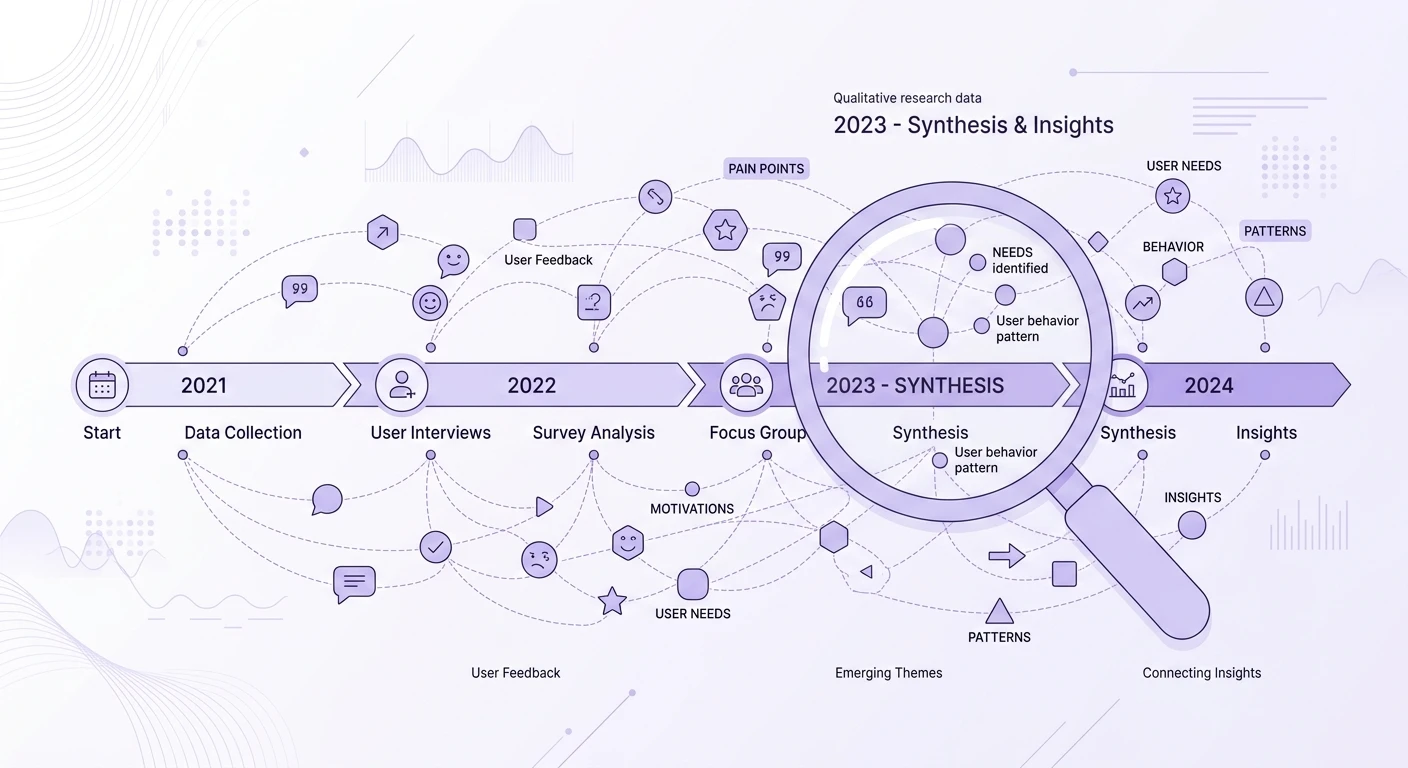
Temporal bracketing is an analytical strategy that divides qualitative data into sequential phases, then examines how patterns shift across those phases. Rather than asking "What themes appear in this data?" you ask "What themes appear in phase one, and how do they transform by phase three?"
The technique originated in organizational process research — studying how companies change over time. But it applies powerfully to UX data wherever experience unfolds sequentially: onboarding journeys, feature adoption curves, relationship evolution with a product, support escalation paths.
The brackets themselves can be defined by:
- Time intervals (first week, first month, first quarter)
- Events (before/after a feature launch, before/after a support interaction)
- Transitions (discovery → trial → adoption → advocacy)
- Participant-defined turning points ("Everything changed when I found...")
Why Sequence Creates Meaning
Consider two participants who both report satisfaction with a product. In a thematic analysis, their satisfaction quotes co-locate. But temporal bracketing reveals:
Participant A: Confusion → frustration → discovery of key feature → satisfaction
Participant B: Immediate ease → steady satisfaction → gradual delight
These are not the same experience. Participant A's satisfaction is relief-based — fragile, contingent on the workaround holding. Participant B's satisfaction is foundation-based — stable, likely to deepen. The product implications differ entirely: A needs the workaround path smoothed, B needs advanced features to grow into.
This connects to why diary studies reveal what interviews miss. Longitudinal methods naturally preserve temporal structure because data arrives in sequence. But even single-interview data contains temporal information in how participants narrate their experience — you just have to preserve it during analysis rather than coding it away.
Implementing Temporal Brackets
Step 1: Identify the temporal structure. Before coding anything, map each participant's data chronologically. For interview data, this means tracking the sequence of events as narrated (not the sequence of the interview itself). For diary studies or longitudinal data, the chronology is built into the collection.
Step 2: Define bracket boundaries. Choose boundaries that are analytically meaningful for your research question. If studying onboarding, natural brackets might be: initial encounter, first task completion, first failure, habitual use. The boundaries should emerge from the data rather than being imposed a priori.
Step 3: Code within brackets. Apply your thematic codes, but do so within each temporal bracket separately. This produces a matrix: themes × time phases. The same code might appear in multiple phases, but its meaning and context shift.
Step 4: Analyze transitions. The analytical payoff comes from examining what changes between brackets. Which themes emerge? Which disappear? Which transform in character? These transitions are your findings — they reveal process, causation, and mechanism rather than just pattern.
Temporal Patterns in UX Data
Three temporal patterns appear consistently in UX research:
The honeymoon-crash-recovery arc. Initial enthusiasm (everything is new and exciting) → reality crash (first significant friction) → recovery or abandonment. Products that support recovery with timely intervention retain users. Products that let the crash happen unsupported lose them. Standard thematic analysis would code all the friction together — temporal bracketing reveals that early friction and post-honeymoon friction require completely different interventions.
The expertise inversion. Features that delight beginners frustrate experts, and vice versa. But this is not a static segmentation — it is a temporal journey each user travels. The helpful tooltip that guided them in week one becomes the irritating interruption in month three. As research on experience sampling methods demonstrates, capturing these shifts in real-time reveals the inversion point where design needs to adapt.
The commitment escalation. Users invest more over time (data entered, workflows built, colleagues onboarded), making switching costs rise. But qualitative experience of those switching costs changes: early investment feels voluntary, late investment feels trapped. The same "I have too much data here to leave" quote means empowerment in month one and imprisonment in month twelve.
Combining With Thematic Analysis
Temporal bracketing does not replace thematic coding — it layers chronological structure on top of it. The practical workflow:
- Do initial open coding to identify themes
- Apply temporal brackets to your data
- Re-examine each theme within each bracket
- Write findings as process narratives rather than static theme descriptions
The output shifts from "Users experience frustration with feature X" to "Users experience frustration with feature X after the honeymoon period ends, typically triggered by their first complex use case, and this frustration either resolves through peer learning or escalates to support contact within one week."
The second formulation is actionable. The first is a sticky note.
AI-Assisted Temporal Analysis
Manual temporal bracketing is labor-intensive because it requires reading each transcript twice: once for thematic content and once for temporal structure. AI analysis tools can automate the structural layer — identifying temporal markers in speech ("at first," "then," "after that," "eventually"), mapping narrative chronology, and flagging transitions between phases.
This is where platforms like Qualz.ai create leverage. The AI can process temporal structure across dozens of interviews simultaneously, identifying not just individual chronologies but cross-participant patterns: "Seven of twelve participants experienced a confidence crash between days three and seven." That pattern is invisible without temporal bracketing, and impossibly time-consuming to detect manually at scale.
The approach aligns with how observability in AI systems tracks not just what happened but when and in what sequence — because sequence reveals causation that snapshot analysis cannot.
When to Use Temporal Bracketing
Temporal bracketing adds most value when:
- Your research question involves process, change, or adoption
- Participants describe experiences that unfold over time
- You suspect that context or sequence matters for interpretation
- Thematic analysis alone produces findings that feel flat or obvious
- Stakeholders need actionable timing for interventions
It adds less value when:
- Your research is purely evaluative (does this design work: yes/no)
- Data is cross-sectional with no temporal dimension
- The research question is about prevalence rather than process
For teams building sophisticated research programs — what some call the AI-native operating model for insights — temporal bracketing becomes a standard analytical tool rather than a special technique. The investment in temporal structure pays dividends every time a stakeholder asks "when should we intervene?" rather than just "what is the problem?"