The research agency model has worked the same way for decades. A client needs qualitative insights. The agency scopes the project, writes a discussion guide, recruits participants, schedules sessions, and sends trained moderators into the field. The agency bills for moderator time, analysis hours, and project management overhead. Margins come from the difference between what moderators cost and what clients will pay.
That model is under pressure from every direction.
Clients are demanding larger sample sizes. Procurement teams are benchmarking qualitative costs against quantitative alternatives. Turnaround expectations have compressed from months to weeks. And a new generation of AI-powered tools is making it possible to conduct hundreds of qualitative interviews at a fraction of the cost and time that manual moderation requires.
For agency owners and research directors reading this: the shift from manual to AI-moderated interviews is not a distant trend. It is happening now, and the agencies that move first are rewriting the competitive landscape.
The Margin Problem That Nobody Talks About
Every agency owner knows the math. A skilled qualitative moderator conducts four to six depth interviews per day before fatigue sets in. At $150 to $300 per hour for senior moderator time, a 30-interview project carries $15,000 to $30,000 in moderation costs alone, before you add recruitment, analysis, incentives, and project management.
Clients increasingly push back on these numbers. They see quantitative studies reaching thousands of respondents for similar budgets and ask why qualitative has to be so expensive. The honest answer is that manual moderation does not scale. Every additional interview requires another hour of a human moderator's time.
This creates a structural ceiling on agency margins. You can optimize recruitment. You can streamline reporting. But the core cost driver, the moderator sitting in a session asking questions and probing for depth, is irreducible under the manual model.
Agencies have responded by cutting corners. Shorter interviews. Junior moderators on senior-priced projects. Discussion guides that sacrifice depth for efficiency. These compromises erode the quality that justified the premium pricing in the first place.
What Changes With AI Moderation
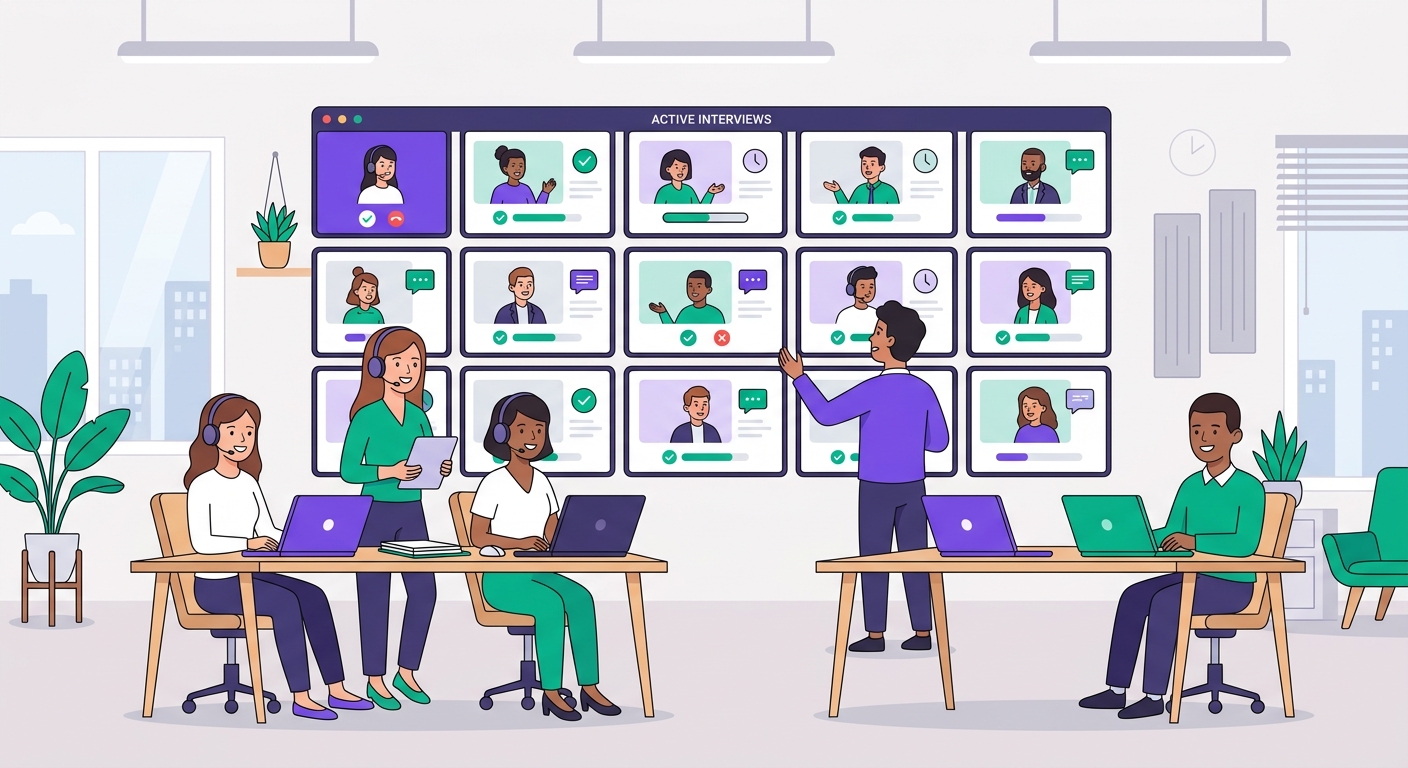
AI-moderated interviews fundamentally alter the economics of qualitative research. An AI moderator follows the discussion guide with precision, asks follow-up questions based on participant responses, probes for depth when answers are superficial, and does all of this simultaneously across as many sessions as you need.
The cost structure inverts. Instead of linear scaling where every additional interview adds proportional moderator cost, AI moderation enables logarithmic scaling. Going from 20 interviews to 200 does not require ten times the moderator budget. It requires the same AI platform, the same discussion guide, and marginally more in participant incentives.
For agencies, this is not about replacing moderators. It is about removing the bottleneck that has constrained qualitative research since the industry began.
Scale Without Headcount
The most immediate impact is capacity. An agency running manual moderation needs to either limit project scope or hire more moderators to take on larger engagements. Both options have problems. Limiting scope means turning down revenue. Hiring means fixed costs that must be covered regardless of project pipeline.
AI moderation decouples capacity from headcount. A five-person agency can field a 500-interview qualitative study with the same team that previously maxed out at 40. The team focuses on what humans do best: designing the research, crafting the discussion guide, interpreting findings, and delivering strategic recommendations. The AI handles the high-volume execution.
This is how agencies that have adopted AI tools are delivering qualitative projects 10 times faster than their manual-only competitors.
Consistent Quality at Every Interview
Here is a truth that the industry rarely acknowledges: moderator quality degrades over the course of a study. By interview 15, even experienced moderators start to lead witnesses. They begin hearing what they expect to hear. They skip probes because they think they already know the answer. They unconsciously shorten sessions because they are tired.
This is not a character flaw. It is human cognition doing what human cognition does. Fatigue, pattern-matching, and confirmation bias are unavoidable when the same person asks the same questions dozens of times.
AI moderation eliminates this problem entirely. Interview number 200 follows the discussion guide with the same precision as interview number one. Every probe fires when the criteria are met. Every follow-up question is asked without fatigue or assumption. The result is a dataset where moderator bias has been structurally removed, not just managed.
For agencies billing clients for research quality, this is a powerful differentiator. You can guarantee consistency across every interview in the study, something that no amount of moderator training can promise in manual work.
Always-On Availability Across Time Zones
Manual moderation requires coordinating three calendars: the moderator, the participant, and the project timeline. For global studies, this means scheduling sessions across time zones, paying premium rates for evening or weekend moderator availability, and losing participants who cannot find a slot that works.
AI-moderated interviews are available 24 hours a day, seven days a week. A participant in Tokyo completes their interview at 9 AM local time. A participant in London does theirs during lunch. A night-shift worker in Chicago participates at 2 AM. Nobody waits. Nobody reschedules. Nobody drops out because the available slots conflicted with their schedule.
For agencies running cross-cultural or international research, this is transformative. A multi-market study that previously required moderators in every region, often bilingual specialists commanding premium rates, can now run from a single discussion guide deployed globally with AI moderation handling the sessions in each market.
New Service Tiers That Did Not Exist Before
The strategic opportunity for agencies goes beyond cost reduction. AI moderation enables entirely new product lines that were not economically viable under the manual model.
Large-Scale Qualitative Research
Clients have always wanted qualitative depth at quantitative scale. They want to hear customer stories, understand motivations, and explore emotional responses, but across hundreds or thousands of participants rather than the 20 to 40 that manual budgets allow.
With AI moderation, agencies can offer large-scale qualitative as a standard service tier. Two hundred depth interviews with thematic analysis delivered in two weeks. Five hundred stakeholder conversations synthesized into a strategic narrative. These projects were impossible to quote profitably with manual moderation. With AI, they become a high-margin offering.
Continuous Research Programs
Instead of one-off projects, agencies can offer clients ongoing qualitative monitoring. Monthly interview waves with 50 to 100 participants, tracking how sentiment, needs, and perceptions evolve over time. The longitudinal research model that was prohibitively expensive with human moderators becomes a recurring revenue stream with AI.
Rapid-Turnaround Qual
Some decisions cannot wait six weeks for a traditional qualitative study. AI moderation enables 48-hour turnaround qualitative sprints: deploy the discussion guide on Monday, collect 50 interviews by Tuesday evening, deliver findings on Wednesday morning. Agencies that can offer this speed win the briefs that procurement teams would otherwise push toward quick-and-dirty survey alternatives.
The Competitive Pressure Is Real
The agencies reading this article fall into three groups.
The first group has already adopted AI moderation tools and is using them to win business. They are quoting larger sample sizes at lower price points. They are delivering faster. They are offering service tiers that manual-only agencies cannot match. They are growing.
The second group is evaluating AI tools and trying to figure out where they fit. They see the potential but worry about quality, client perception, and the learning curve. They are running pilots and internal tests.
The third group has decided that manual moderation is their competitive advantage and that clients will always pay a premium for human-led research. Some of these agencies are right, particularly in sensitive clinical research or C-suite executive interviews where the moderator relationship is part of the value. But for the majority of qualitative work, this position is becoming harder to defend with each passing quarter.
The pattern is familiar from every industry that has been reshaped by automation. The early adopters gain market share. The fast followers survive. The holdouts eventually face a choice between adapting or accepting a shrinking addressable market.
Agencies that do not adopt AI tools are already losing bids to competitors who can offer more interviews, faster delivery, and lower costs.
How Agencies Are Making the Transition
The agencies that have successfully integrated AI moderation share a few common patterns.
They start with the right project types. Not every study is the right candidate for AI moderation. Exploratory research with relatively structured discussion guides, large-sample studies where consistency matters, and multi-market projects with logistical complexity are ideal starting points. Sensitive topics, executive audiences, and deeply ethnographic work may still benefit from human moderators working alongside AI.
They reposition their team, not replace it. Senior moderators become discussion guide architects and insight strategists. Their deep expertise in question design and probe construction makes the AI moderation more effective, not less relevant. Junior team members shift from transcription and note-taking to analysis and client communication.
They are transparent with clients. The best agencies explain the methodology, demonstrate the quality of AI-moderated transcripts, and show clients that the depth of insight meets or exceeds traditional approaches. Most clients care about the quality of the output. When they see 200 rich interview transcripts delivered in a week, the conversation shifts from skepticism to enthusiasm.
They use the cost savings strategically. Rather than simply pocketing the margin, forward-thinking agencies reinvest in analysis depth, larger sample sizes, or additional research waves. They deliver more value per project dollar, which strengthens client relationships and increases retention.
The Window Is Open
The research agency industry is in a transition period. AI moderation tools have matured to the point where they produce research-quality data that clients trust and act on. But adoption is still early enough that agencies making the move now gain a genuine competitive advantage rather than simply keeping pace.
That window will not stay open indefinitely. As AI-moderated interviews become standard practice, the advantage shifts from "we use AI" to "we have been using AI longer and better." The agencies building that experience now are the ones that will lead the industry in three years.
The question for agency owners is not whether AI moderation will reshape qualitative research. It already is. The question is whether your agency will be the one reshaping the market or the one responding to it.
Ready to explore how AI-moderated interviews can transform your agency's capabilities? Book an information session to see how Qualz.ai helps research agencies scale qualitative work without scaling headcount.