Every qualitative researcher has experienced the moment. You are reviewing a transcript and you notice it — the respondent shifted their answer mid-sentence, pivoting from what they actually thought to what they sensed you wanted to hear. The nod you gave. The way you leaned forward when they mentioned a certain feature. The follow-up question that signaled your hypothesis.
This is moderator bias, and it is the most persistent, least-addressed threat to qualitative research validity.
Unlike sampling error or poorly designed discussion guides, moderator bias operates below conscious awareness. It cannot be eliminated through training alone. And its effects compound across every interview in a study, systematically skewing your dataset in ways that no amount of careful analysis can correct after the fact.
The question is not whether moderator bias exists — decades of research confirm it does. The question is what to do about it without abandoning the depth and richness that make qualitative research valuable in the first place.
The Science of Moderator Influence
The research on interviewer effects is extensive, stretching back to the 1950s, and the findings are consistent: the person asking the questions fundamentally shapes the answers they receive.
Social Desirability Bias
Social desirability bias — the tendency for respondents to give answers they believe will be viewed favorably — is the most well-documented form of moderator influence. A landmark meta-analysis by Tourangeau and Yan (2007) found that sensitive questions administered by human interviewers produced significantly more socially desirable responses than identical questions administered through self-completion methods.
The effect is not small. Studies on health behaviors have found that respondents underreport alcohol consumption by 30-40% in face-to-face interviews compared to anonymous methods (Krumpal, 2013). Research on product satisfaction shows that customers overstate positive sentiment by 15-25% when speaking directly to a researcher who they perceive as affiliated with the brand.
For UX research and customer experience studies, this means your interview data likely overstates satisfaction, understates frustration, and misrepresents actual usage patterns.
Demand Characteristics
In 1962, psychologist Martin Orne introduced the concept of demand characteristics — cues in an experimental setting that communicate the researcher's hypothesis to participants. Participants, wanting to be "good subjects," unconsciously adjust their behavior to confirm what they think the researcher expects.
In qualitative interviews, demand characteristics are everywhere:
- Question framing. "How helpful was this feature?" presupposes helpfulness. "Tell me about your experience with this feature" does not.
- Verbal reinforcement. "That's interesting" or "great point" after certain responses teaches participants which answers the moderator values.
- Follow-up patterns. Asking deeper follow-ups on certain topics but not others signals which themes the moderator considers important.
- Nonverbal cues. Eye contact, nodding, posture shifts, and facial expressions provide continuous feedback that participants read and respond to.
Harris and Rosenthal's (2005) meta-analysis on interpersonal expectancy effects found that researchers' expectations influenced participant behavior in 345 of 464 studies examined. The effect was not confined to laboratory settings — field interviews showed comparable influence patterns.
Confirmation Bias in Follow-Up Questions
Perhaps the most insidious form of moderator bias operates through follow-up questions. Researchers tend to probe more deeply on responses that align with their existing hypotheses and accept surface-level answers on topics that contradict their expectations.
Nickerson (1998) documented this pattern extensively in his review of confirmation bias, showing that even trained researchers with explicit instructions to be neutral systematically asked more follow-up questions, used more encouraging language, and spent more time exploring responses that confirmed their working theories.
In a typical sixty-minute qualitative interview, a moderator makes hundreds of micro-decisions about when to probe, when to redirect, and when to move on. Each decision is a potential vector for bias. And because these decisions happen in real time, they cannot be reliably audited or corrected.
The Cumulative Cost to Research Quality
Moderator bias does not just affect individual responses. It creates systematic distortions that cascade through your entire research operation.
Data Integrity
When respondents calibrate their answers to moderator cues, the resulting data reflects a collaboration between researcher and participant rather than the participant's authentic perspective. This is not a minor validity concern — it undermines the foundational premise of qualitative research: that we are capturing what people actually think, feel, and do.
A study by Mays and Pope (2000) in the BMJ estimated that interviewer effects account for between 10% and 40% of variance in qualitative health research data. Similar estimates have been reported in market research contexts, where interviewer rotation studies show significant divergence in findings depending on which moderator conducted the interviews.
Compounding Across Studies
Organizations that conduct ongoing research — quarterly brand tracking, continuous discovery interviews, recurring customer satisfaction studies — face a compounding problem. If the same moderator or small team of moderators conducts interviews over time, their biases become embedded in the organization's understanding of its customers.
Themes that the moderator finds interesting get explored in depth. Topics the moderator finds uncomfortable or unimportant get glossed over. Over months and years, the organization's qualitative knowledge base becomes a reflection of the moderator's lens, not the customer's reality.
Decision-Making Consequences
Research exists to inform decisions. When moderator bias distorts research findings, it distorts the decisions those findings support. Product teams build features that address stated preferences (biased by social desirability) rather than actual needs. CX teams focus on problems that emerged through moderator-guided exploration rather than organic participant reporting. Insights leaders present recommendations based on data that was unknowingly shaped by the research instrument itself.
The financial impact is difficult to quantify precisely, but the directional evidence is clear: organizations that rely on biased qualitative data make systematically worse product and experience decisions. Every interview that produces distorted insights compounds into misallocated resources across the product development lifecycle.
Why Training Alone Cannot Solve This
The standard industry response to moderator bias is training. Teach moderators to use neutral language. Train them to maintain consistent nonverbal behavior. Remind them to follow the discussion guide rather than their instincts.
Training helps. But it does not solve the problem, for three reasons.
Unconscious Processes Resist Conscious Control
The fundamental challenge is that much of moderator bias operates through automatic cognitive processes that are not accessible to conscious monitoring. You cannot maintain neutral body language through willpower alone for sixty minutes while simultaneously managing rapport, tracking themes, monitoring time, and formulating follow-up questions.
Bargh and Chartrand's (1999) research on the "unbearable automaticity of being" demonstrated that the vast majority of social behavior — including the interpersonal signaling that drives moderator bias — occurs outside conscious awareness and control. Training can address the conscious, deliberate aspects of moderator behavior, but the automatic processes that drive much of the bias remain stubbornly resistant to intervention.
Cognitive Load Degrades Discipline
Even when moderators are consciously maintaining neutral behavior, cognitive load erodes their ability to sustain it. By the sixth interview of the day, or the fortieth minute of a complex discussion, the mental resources required for active bias management are depleted.
Kahneman's dual-process theory explains why: maintaining a neutral demeanor while conducting a substantive interview requires System 2 (deliberate, controlled) processing, but System 2 has limited capacity. As it depletes, System 1 (automatic, intuitive) takes over, and with it come the unconscious biases that training was supposed to suppress.
The Observer Cannot Observe Themselves
Even the most self-aware moderator cannot fully monitor their own influence on the conversation. You cannot see your own facial expressions. You cannot hear the subtle tonal shifts in your voice. You cannot objectively assess whether your follow-up patterns are balanced or biased.
Back-room observation and post-interview debriefs help, but they catch only the most overt instances of moderator influence. The subtle, continuous stream of micro-signals that shapes respondent behavior is largely invisible to both the moderator and their observers.
How AI-Assisted Interviews Change the Equation
AI-assisted interviewing does not replace the human elements that make qualitative research valuable — empathy, contextual understanding, and the ability to explore unexpected themes. What it does is remove the specific mechanisms through which moderator bias operates.
No Social Presence, No Social Desirability Pressure
The social desirability effect depends on the respondent perceiving a social audience — a human who will judge their answers. When the interviewer is an AI system, this social pressure diminishes significantly.
Research by Pickard et al. (2016) found that participants disclosed more sensitive information to computer-mediated interviewers than to human interviewers, even when the questions and overall experience were otherwise identical. Participants reported feeling less judged, less concerned about impression management, and more willing to share negative or socially undesirable experiences.
For UX research, this means respondents are more likely to honestly report that they found a product confusing, that they use workarounds, or that they prefer a competitor. For CX research, it means customers are more willing to describe genuine frustrations without softening their language to avoid seeming difficult.
Consistent Follow-Up Patterns
An AI interviewer applies the same probing logic to every response, regardless of whether the response aligns with any hypothesis. It does not unconsciously probe deeper on interesting answers and skim past inconvenient ones. It does not ask warmer follow-ups when it hears what it expects.
This consistency does not mean rigidity. Modern AI interview systems, including Qualz.ai's interview platform, use dynamic follow-up logic that adapts to respondent answers while maintaining consistent depth and neutrality across all topics. The AI explores unexpected themes with the same thoroughness as anticipated ones — something human moderators consistently fail to do.
No Nonverbal Leakage
Text-based and voice-based AI interviews eliminate the nonverbal channel entirely. There are no facial expressions to read, no body language to interpret, no tonal variations to decode. Respondents answer based on the questions themselves, not on a complex social signal environment.
This is particularly valuable for sensitive topics — pricing perceptions, competitive usage, unmet needs, and satisfaction with specific team members or processes. These are precisely the areas where nonverbal moderator cues have the most distorting effect and where honest responses have the most strategic value.
Scalable Neutrality
A human moderator's bias profile varies by time of day, interview number, personal mood, and relationship with the research topic. The first interview of a study often produces different data patterns than the fifteenth — not because respondents differ, but because the moderator's behavior shifts.
AI-assisted interviews maintain identical neutrality whether it is the first interview or the five hundredth. This scalable consistency means that variance in your data reflects actual differences between respondents, not differences in moderator state. The audit trail for every interview decision is transparent and reviewable, something no human moderator can provide.
Addressing the Objections
The most common objection to AI-assisted interviews is that they sacrifice the human connection that makes qualitative research work. This deserves a serious response.
"AI Cannot Build Rapport"
Rapport in qualitative research serves a specific function: it creates psychological safety so that respondents feel comfortable sharing honest, detailed responses. The assumption has been that rapport requires a human connection.
But the evidence suggests otherwise. When respondents report feeling "more comfortable" with AI interviewers on sensitive topics, they are describing rapport — just achieved through a different mechanism. Instead of building trust through interpersonal warmth, the AI creates safety through the absence of judgment. Both paths lead to the same outcome: respondents who share more openly.
"AI Will Miss Important Nonverbal Cues"
This is true and it matters. A respondent who says "it was fine" while grimacing conveys different information than one who says "it was fine" with a genuine smile. AI text-based interviews do not capture this.
However, this objection conflates two things: information loss (real but bounded) and bias introduction (systematic and compounding). The question is not whether AI interviews capture everything a human moderator would — they do not. The question is whether the data they capture is more or less accurate. On the dimension of respondent honesty, the evidence strongly favors AI-assisted approaches.
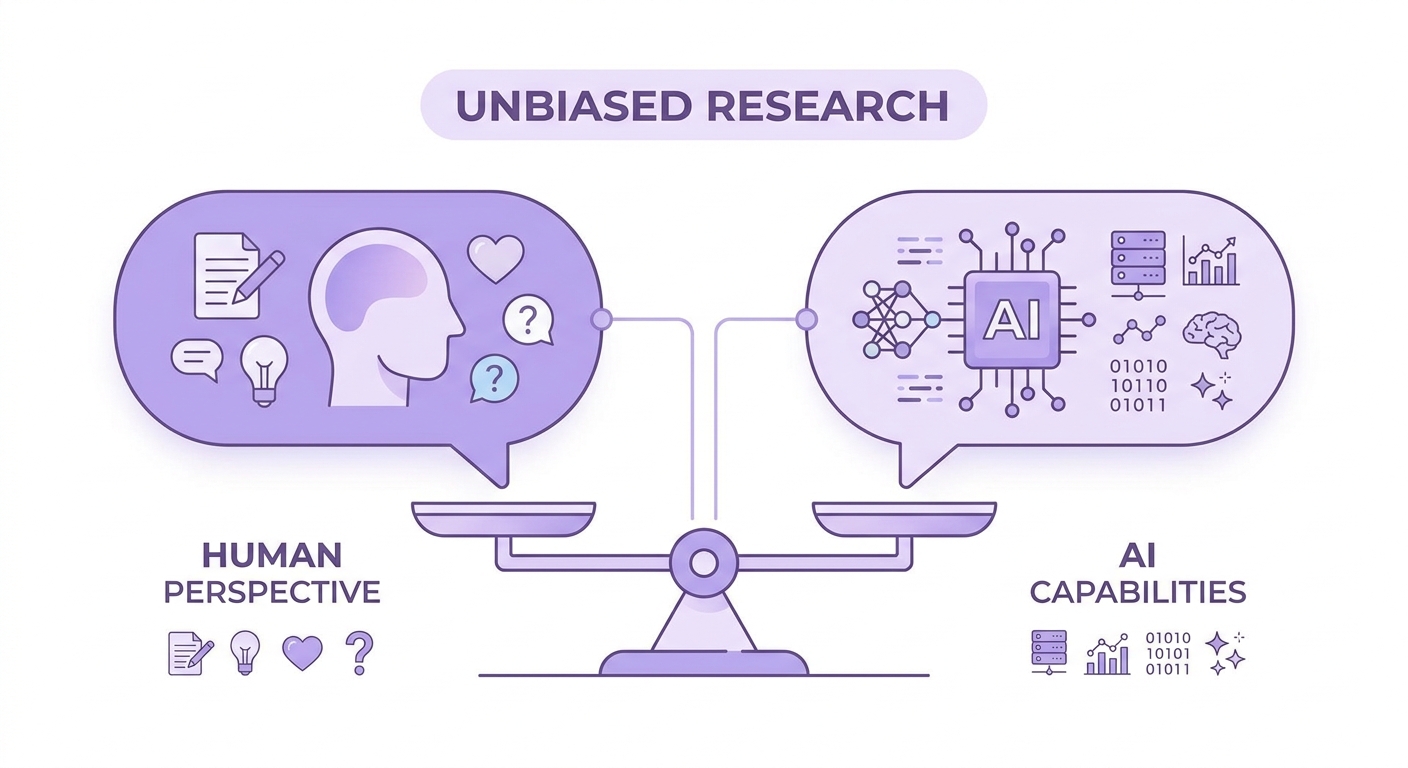
The optimal approach is not AI-only or human-only. It is a hybrid model where AI handles the bias-prone data collection and human researchers handle the contextual interpretation that requires social and emotional intelligence.
"Our Moderators Are Well-Trained"
They may be. But training addresses conscious behavior, and the most impactful forms of moderator bias are unconscious. The best surgeon in the world still uses sterile instruments rather than relying on clean hands. The best moderator in the world still introduces bias through mechanisms that training cannot reach.
This is not a criticism of moderators — it is a recognition of human cognitive architecture. We are social creatures. We signal and read signals constantly. In a research context, this feature becomes a bug.
Implementing AI-Assisted Interviews Without Losing Depth
Moving to AI-assisted interviews does not mean abandoning human judgment. It means deploying human judgment where it adds the most value and removing it where it introduces the most risk.
Phase 1: Design With Humans
Human researchers design the interview guide, define the research questions, identify the topics that need exploration, and establish the probing logic. This is where domain expertise, strategic thinking, and research methodology matter most. These are distinctly human strengths.
Phase 2: Collect With AI
The AI conducts the interviews, maintaining consistent neutrality, probing evenly across all topics, and creating an environment where respondents feel safe sharing honest perspectives. Every interview follows the same structural logic while adapting dynamically to individual responses.
Phase 3: Analyze With Both
Human researchers review AI-generated transcripts and analysis, applying contextual judgment, emotional intelligence, and strategic framing. The AI handles systematic pattern detection across the full corpus — something human analysts cannot do at scale — while humans evaluate the significance and implications of those patterns.
This hybrid model gives you the best of both approaches: the depth and adaptability that qualitative research requires, combined with the neutrality and consistency that valid data demands.
The Data Integrity Imperative
Research teams invest significant resources in sampling methodology, discussion guide design, analysis frameworks, and reporting standards. All of that investment is undermined if the data collection instrument itself — the moderator — is systematically biasing the data.
Moderator bias is not a minor methodological footnote. It is a fundamental threat to the validity of every moderated qualitative study. The research community has known this for decades. What has changed is that we now have a practical alternative that addresses the core mechanisms through which this bias operates.
AI-assisted interviews are not anti-human. They are pro-validity. They free human researchers to focus on the parts of the research process where human judgment is irreplaceable — design, interpretation, and strategic application — while removing human influence from the part where it causes the most harm.
The organizations that adopt this approach will not just produce better research. They will make better decisions, build better products, and understand their customers more accurately than competitors who continue to rely on research instruments that systematically distort the signal they are trying to capture.
Reducing moderator bias also has implications for how organizations manage the cost and efficiency of their research operations. When your data collection is more reliable, you need fewer studies to reach confidence, and every research dollar works harder.
The research is clear: moderator bias is real, significant, and resistant to training-based solutions. Qualz.ai provides AI-assisted interview capabilities that maintain conversational depth while eliminating the unconscious cues that compromise respondent honesty. If your organization depends on qualitative insights to drive decisions, the integrity of your data collection method is not optional — it is foundational.