The Feedback You Trust Most Comes From the Users You Understand Least
Every research panel develops a core. A handful of participants respond within minutes, write paragraph-length answers, volunteer for follow-ups, and seem genuinely delighted to be asked. Researchers love them -- they are articulate, reliable, and generous with detail. Over time, without anyone deciding this, the core starts to shape the findings. Their pet frustrations become "top themes." Their feature wishes become roadmap candidates. Their vocabulary becomes how the team talks about users.
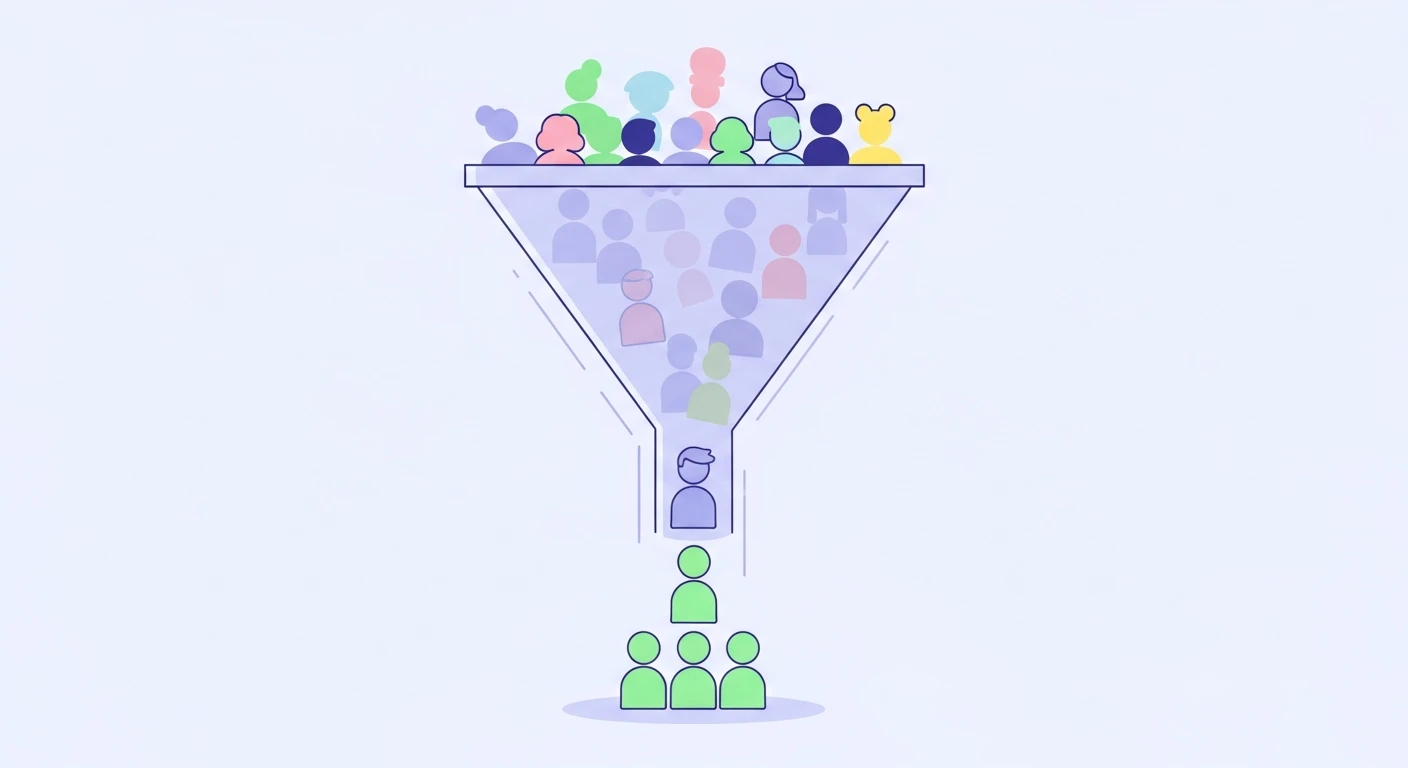
And here is the trap: the very traits that make someone a great panelist -- high engagement, articulacy, eagerness to be heard -- are the traits that make them least representative of the silent majority who use your product and never say a word. You are not hearing from your users. You are hearing from the small, self-selected slice of them that likes talking to researchers.
Why the Loud and the Typical Are Different People
Engagement is not randomly distributed. The people who over-participate in research tend to share a cluster of characteristics: strong opinions, high product involvement, a self-image as a "power user," and often a specific grievance they want addressed. None of that is bad. But it means the vocal minority is systematically skewed toward the extremes of the very distribution you are trying to understand.
This is a close cousin of the survivorship problem in unmoderated studies, where the people who finish are not the people who represent your users. Here the filtering happens at the other end -- not who drops out, but who leans in -- and it produces the same distortion: a sample defined by a trait correlated with the outcome you care about. It compounds over time as those eager voices get invited back, hardening into the panel professionalization curve where your best-behaved participants give the worst data.
Three Ways the Vocal Minority Steers You Wrong
1. Agenda capture. The loudest participants do not just answer your questions -- they reframe them. A power user's obsession with an advanced setting becomes the thing everyone probes, while the onboarding confusion of a silent novice never surfaces because no silent novice is in the room. The research agenda drifts toward what the vocal minority already cares about.
2. Intensity misread as prevalence. A vividly articulated complaint from three engaged panelists feels weightier than a shrug from thirty quiet ones -- but weight of expression is not frequency of experience. This is the counting trap inverted: theme intensity gets mistaken for theme importance. The feature nobody mentions may be the one silently failing for most of your base.
3. Articulacy bias in synthesis. When you write up findings, quotable participants dominate the deck. The silent majority has no quotes because it said little -- so it becomes invisible in the readout, the same highlight-reel dynamic where the most vivid clips overwrite the full picture. Your report ends up being a portrait of your most expressive users, presented as a portrait of all of them.
Why Behavioral Data Does Not Automatically Save You
"Just triangulate with analytics" is the usual answer, and it helps -- but only if you actually weight behavior against voice. The failure mode is subtle: teams collect behavioral data and then still let the vocal panel narrate what it means. The silent majority's clicks get interpreted through the loud minority's framing.
The fix is to treat the silent majority as a first-class source rather than a background hum. Real integration means letting behavior contradict voice and taking the contradiction seriously -- exactly the discipline missing when studies get stacked without it, the insight-stacking problem that produces contradictory evidence piles instead of a coherent read.
The Engineering Parallel: Loud Signals Are Not the Whole System
Enterprise AI teams learned a version of this lesson the hard way. A production system can look healthy because its noisiest components are reporting loudly and positively -- while the failures that matter happen silently, in the paths nobody is watching. The discipline that catches this is observability that instruments the quiet paths, not just the ones that announce themselves. Research needs the same instinct: the absence of complaint is not evidence of satisfaction, and the loudest signal is rarely the most representative one.
There is a governance angle too. When a vocal minority sets the agenda, the resulting decisions inherit a bias nobody explicitly chose -- an unexamined selection effect baked into the pipeline. The enterprise answer to that is enforcing explicit contracts about what data is allowed to drive a decision, the same principle behind data contracts that stop incompatible inputs from silently shaping downstream outputs. A research program deserves the same guardrail: an explicit rule about how much weight self-selected voice is allowed to carry.
How to Hear the Silent Majority
Cap participation. Rotate panelists out after a fixed number of studies. The freshness of newly recruited participants beats the polish of veterans, and rotation structurally limits agenda capture.
Recruit for silence, deliberately. Actively sample low-engagement users -- the ones who never respond to the first email. They are harder to reach precisely because they are the majority you are missing. Their reluctance is data.
Weight behavior over volume in synthesis. Before a complaint becomes a theme, ask how many users the behavioral data says are actually affected -- not how loudly the panel voiced it. Let the quiet clicks outvote the loud quotes when they disagree.
Instrument the non-response. Treat who did not participate, who abandoned mid-study, and who declined as findings in their own right. Non-participation has a shape, and that shape is often more representative than anything your eager core will tell you.
Separate intensity from prevalence in reporting. Report how strongly something was expressed and how widely it was experienced as two different numbers. Collapsing them is how a vocal minority's obsession becomes a company's roadmap.
The Takeaway
Your most engaged panelists are a gift and a liability in the same breath. They will give you the richest quotes, the sharpest complaints, and the most confident direction -- toward a product optimized for people who are nothing like the silent majority paying your bills. The users who never speak up are not absent from your data because they have nothing to say. They are absent because your research listens hardest to whoever talks loudest. Fixing that is not about muting the vocal minority. It is about building a program that can hear a silence and treat it as signal.
Qualz.ai lets you weight what participants do against what they say, surface the themes your quiet users never voiced, and keep the loudest voice in the room from quietly becoming the only one that counts.