
Photo elicitation is a qualitative interview method that uses photographs to prompt the conversation, so people don't have to rely on memory alone. The questions you ask around the photo draw out what it means to them.
Say you make work shoes for nurses, and you want to know why they replace them. Ask "what do you want from a work shoe?" and you'll probably hear "comfort" and "durability". True, but general.
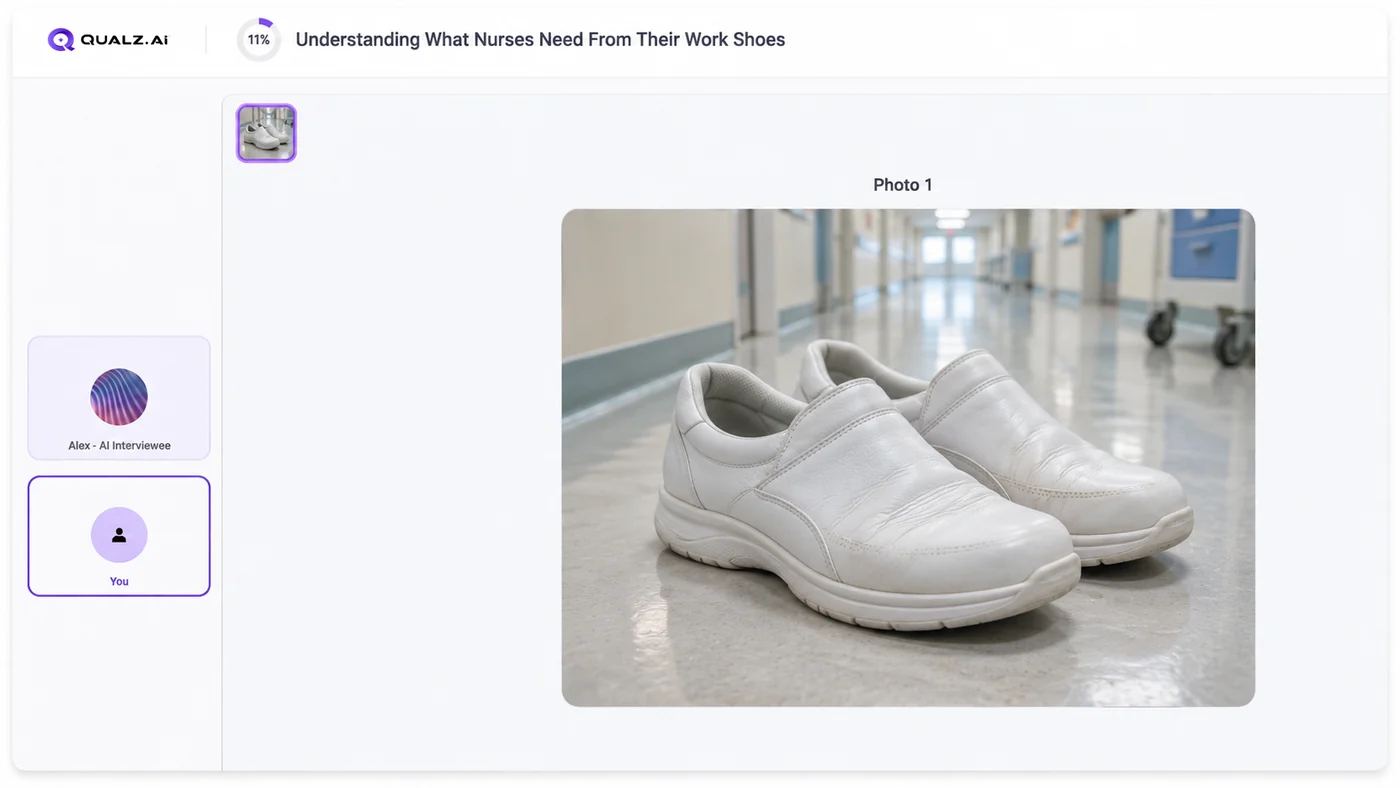
Now show a nurse a photo of a well-used pair and say, "Tell me the story of this photograph." You might hear about the floors, the long shifts, and the day those shoes stopped being worth the money.
The idea goes back to the 1950s. In 1957, John Collier compared interviews with and without photographs, and the photo interviews were longer and more detailed. We've also looked at what nurses need from their work shoes in this case study with JobsToBeOk.org. For the wider method, see our guide to photo elicitation.
Photo elicitation interview questions, with examples
Start broad, then move toward meaning. Here's how that sounds with the photo of the shoes:
| Stage | Question to ask |
|---|---|
| Open | "Tell me the story of this photograph." |
| Describe | "What do you see in this photo?" |
| Look closer | "What else is happening here?" "What is outside the frame?" |
| Connect | "How does this relate to your work?" |
| Ask why | "Why do you think it ended up like this?" |
| Feelings | "How do you feel looking at this photo now?" |
| Look ahead | "What would you want this to look like in a year?" |
| Close | "Looking at all these photos together, what story do they tell?" |
Several of these are adapted from the CDC journal's guidance on photo-elicitation interviews and a University of Brighton question list.
Should you use your own photos or the participant's?
In researcher-driven photo elicitation, you choose the photos, so everyone reacts to the same image. Choose carefully, because your choice and order of photos can shape what you hear (Church and Quilter, 2021).
In participant-generated, or auto-driven, photo elicitation, people take their own photos first. The CDC journal's guidance reports richer, more detailed discussion when people talked about their own photographs than about staff photographs. Here you can add "How were you feeling when you took this photo?" and "How do you think people may interpret it?"
Photo elicitation vs photovoice
Photo elicitation focuses on the interview itself. Photovoice is a wider, action-oriented research strategy, usually run in groups. Every photovoice study uses a form of photo elicitation, but not every photo elicitation study is photovoice.
Before you show a photo
Tell participants in advance how their photographs may be used. If they're taking the photos, agree rules on photographing other people, including respecting anyone's right to refuse. Some teams simply ask participants not to photograph people at all.
How do you analyze photo elicitation interviews?
Analyze mainly the transcript, not the pictures on their own. Number each photo so every part of the transcript links back to the photo it's about, then code it as you would any qualitative interview. Our thematic analysis guide walks through the steps.
How Qualz.ai supports photo elicitation interviews
In Qualz.ai, you attach your photos to specific questions or topics in your interview guide, and the AI moderator handles the timing. It introduces each photo, shows it just before asking that question, and checks the participant can see it.
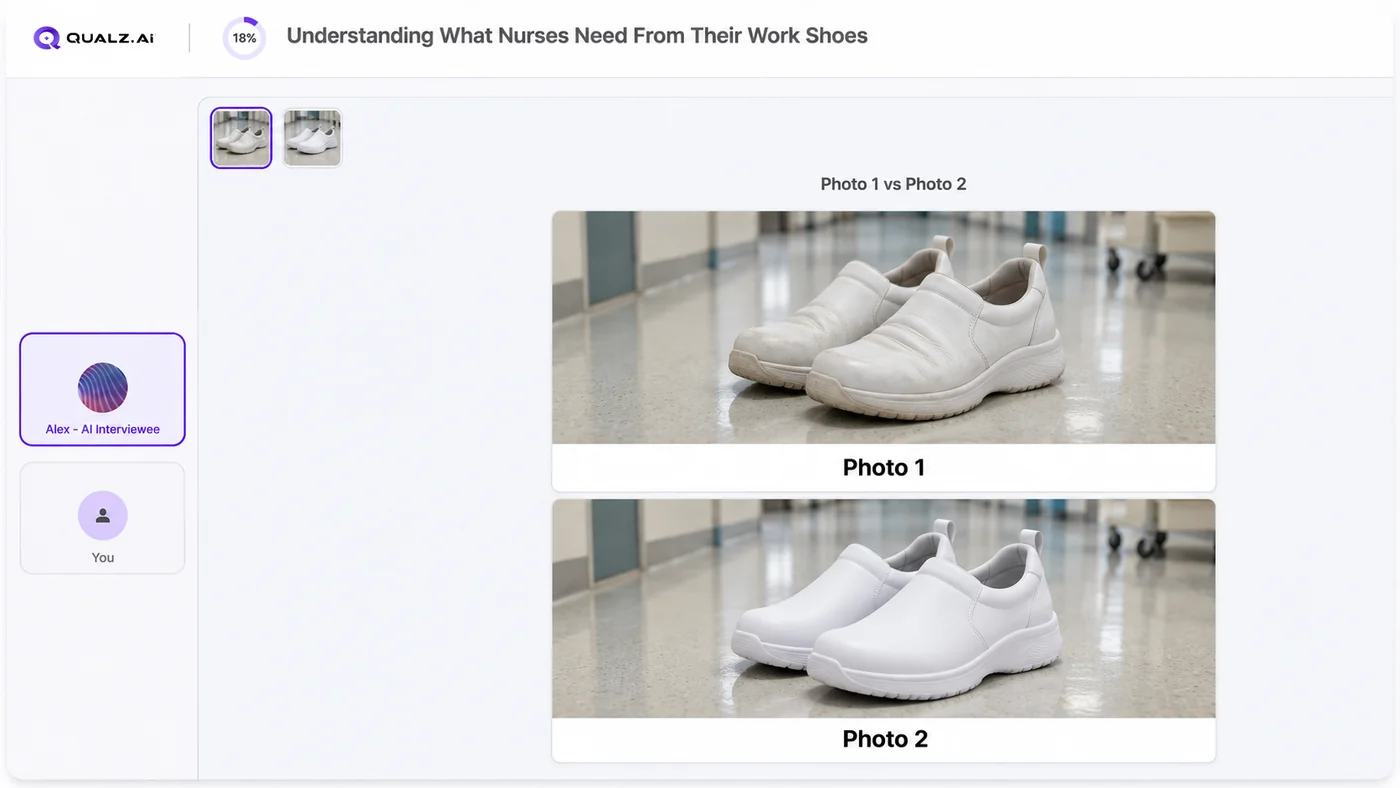
Each photo has a description participants never see, where you tell the moderator what it shows and what you want to learn. To compare two photos, combine them into one comparison image. Before you go live, open the preview link and take the interview yourself, as a participant would, to check each photo appears at the right moment.
The photos come from you. Participants can't upload their own during an interview, so this suits researcher-driven studies.
Planning a study like this? Our team can help you plan your photos and set up comparisons.
Frequently asked questions about photo elicitation
What is photo elicitation?
It's a qualitative interview method that uses photographs to prompt discussion. Either the researcher or the participant can provide the photos.
Can you do photo elicitation interviews online?
Yes. You can share your screen, send photos ahead of time, or use an AI-moderated interview that shows each photo on screen.
How is photo elicitation different from visual elicitation?
Photo elicitation uses photographs. Visual elicitation is broader, and can also use diagrams, maps and other visuals.
How many photos should you use in one interview?
Our stimulus guide suggests 3 to 6 images in a 15-minute interview.
Ready to run your own photo elicitation interviews?
Book a call and we'll go through your photos and questions with you.