The Validation Problem Nobody Anticipated
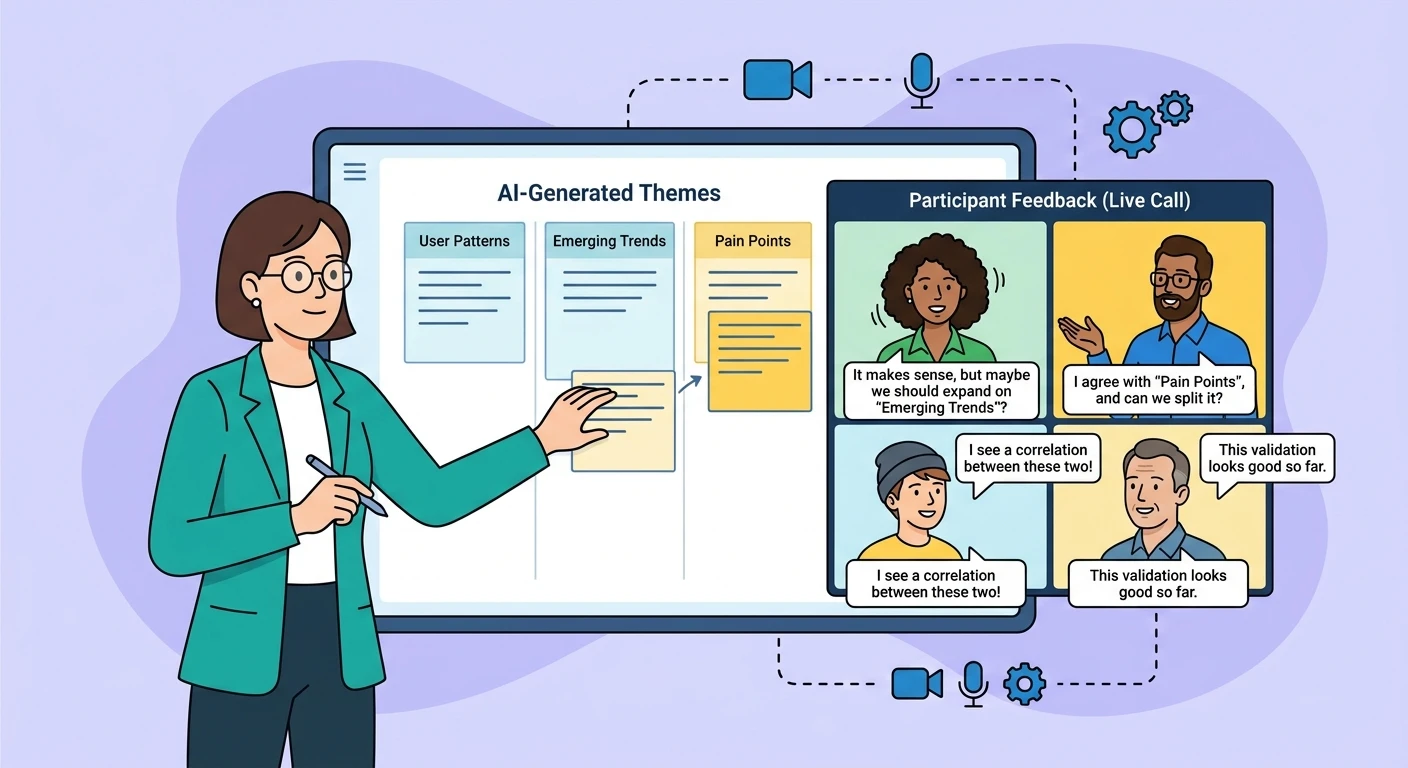
Member checking — returning findings to participants for verification — is one of qualitative research's oldest credibility strategies. The logic is straightforward: the people who generated the data are best positioned to confirm whether your interpretation accurately represents their experience.
But this logic assumed a specific analytical process: a human researcher reads transcripts, develops interpretive codes, constructs themes through iterative engagement with the data, and then presents those themes to participants for confirmation. The researcher's themes emerge from prolonged immersion in participant voices.
AI-generated themes emerge from pattern recognition across token sequences. They may be accurate. They may even capture patterns that human analysts would miss. But they are produced through a fundamentally different process — and that difference matters for validation.
When you ask a participant to validate an AI-generated theme, you are asking them to confirm an interpretation that no human mind constructed. The theme did not emerge from empathetic engagement with their story. It emerged from statistical regularities across multiple stories. Participants are validating a machine's pattern recognition, not a researcher's understanding.
This is not inherently problematic — but it requires adapted protocols that acknowledge the difference.
Why Traditional Member Checking Fails With AI Themes
The abstraction gap. AI-generated themes tend toward higher abstraction than human-generated themes at the same analytical stage. A human researcher might develop an initial theme like "frustration with onboarding complexity" — concrete, close to the data, recognizable to participants. An AI might generate "cognitive load barriers in initial system interaction" — accurate but abstracted beyond participant vocabulary. Participants cannot validate language they would never use to describe their own experience.
The confidence problem. When a human researcher presents themes, they can explain their reasoning: "I noticed that you and several other participants described similar moments of confusion during setup. I grouped these as..." This narrative makes the interpretive logic transparent. AI cannot explain its reasoning in terms participants understand. "The model identified statistical co-occurrence patterns in your transcript segments" is technically accurate and communicatively useless.
The completeness illusion. AI-generated thematic structures often appear comprehensive — every data point is coded, every theme is populated. This creates an illusion that the analysis is complete, making participants less likely to identify gaps. Human-generated themes are visibly incomplete at early stages, which paradoxically invites more productive participant feedback: "You missed the part about..."
The social desirability amplification. Participants already tend to agree with researchers' interpretations out of politeness or deference (the observer effect in research operates even in validation sessions). When themes are presented as "AI-identified patterns," some participants defer even more — assuming the machine must be right because it processed the data "objectively." Others reject themes reflexively because they distrust AI involvement. Neither response produces valid feedback.
An Adapted Protocol for AI-Assisted Member Checking
Here is a framework that preserves member checking's credibility function while accounting for AI-generated themes:
Step 1: Translate AI Themes Into Participant Language
Before presenting any AI-generated theme to participants, translate it into language that mirrors how participants actually spoke about the topic. This is not dumbing down — it is re-grounding abstract patterns in concrete experience.
Compare:
- AI output: "Temporal misalignment between user expectation and system response cadence"
- Participant language: "The system felt slow — not in loading time, but in how long it took to give me what I actually needed"
The translation preserves the insight while making it validatable. Participants can confirm or challenge the second formulation. They cannot meaningfully engage with the first.
Step 2: Present Themes as Questions, Not Conclusions
Rather than stating "We found that..." and asking participants to confirm, frame AI-generated themes as interpretive hypotheses:
"Based on our analysis, it seems like [theme description]. Does this match your experience? What would you add, change, or challenge about this interpretation?"
This framing reduces acquiescence bias and positions participants as experts on their own experience rather than validators of machine output. It also connects to the progressive disclosure approach in interview design — building depth gradually rather than front-loading conclusions.
Step 3: Include Negative Cases Explicitly
AI-generated themes represent dominant patterns. But qualitative research's richness often lies in exceptions. During member checking, explicitly surface cases where the AI's theme did NOT apply:
"Most participants described [theme]. But your experience seemed different in [specific way]. Can you help me understand whether you see yourself as an exception to this pattern or whether the pattern itself needs revision?"
This prevents member checking from becoming mere confirmation of majority patterns at the expense of minority experiences.
Step 4: Validate the Relationships, Not Just the Themes
AI systems often identify relationships between themes — causal claims, temporal sequences, conditional dependencies. These relational claims are where AI analysis is most likely to produce artifacts (correlations that are not meaningful in context).
Ask participants specifically about relationships: "Our analysis suggests that [theme A] tends to lead to [theme B]. Does that sequence match your experience, or is the relationship different from how you lived it?"
Step 5: Document Participant Modifications
When participants challenge or modify AI-generated themes during checking, document these modifications as methodologically significant. They represent not just data corrections but epistemological corrections — places where human contextual knowledge overrides machine pattern recognition.
Track the modification rate. If participants modify more than 30-40% of AI-generated themes during member checking, your AI analytical configuration likely needs adjustment — the machine is finding patterns that do not resonate with lived experience.
When Member Checking Adds the Most Value
Member checking is not equally valuable across all types of AI-assisted analysis:
High value: When AI generates interpretive themes (what experiences mean to participants). Here, participant validation is essential because meaning is subjective and AI cannot access it directly.
Moderate value: When AI identifies behavioral patterns (what participants did). Participants can confirm behavioral accuracy but may have limited insight into patterns across participants they cannot observe.
Lower value: When AI identifies structural patterns (how data elements relate formally). These are analytical constructions that participants are not positioned to evaluate — they can confirm their individual contribution but not the cross-participant structure.
This connects to the broader question of how AI reshapes qualitative analysis — different analytical functions require different validation approaches.
The Timing Question
When in the AI-assisted analytical process should member checking occur?
Too early (immediately after AI generates initial codes): The analysis is too raw and fragmentary for participants to evaluate meaningfully. They see disconnected labels rather than coherent interpretations.
Too late (after final thematic structure is polished): The analysis feels too finished to modify. Participants provide surface confirmations rather than substantive engagement. The research synthesis debt has already crystallized.
Optimal timing: After AI-generated themes have been reviewed and translated by the human researcher but before the final analytical structure is set. Participants engage with coherent interpretations that remain genuinely open to modification.
This optimal window is narrow — typically after the researcher's first pass through AI outputs but before writing begins. Building member checking into your project timeline at this specific point requires planning, not afterthought.
Group Versus Individual Member Checking
Traditional methodology debates whether member checking is better conducted individually or in groups. AI-assisted analysis adds a new dimension to this debate:
Individual checking allows each participant to evaluate whether AI themes represent their personal experience without social influence. This is ideal for sensitive topics or when you suspect the AI may have created majority-dominant themes that erase minority experiences.
Group checking allows participants to collectively evaluate whether AI-identified patterns ring true as shared experiences. This is powerful for confirming cross-cutting themes but risks groupthink — especially the conformity dynamics that plague focus groups.
A pragmatic approach: conduct individual checking for personally sensitive themes and group checking for structural or organizational themes. Let the nature of the theme determine the validation format.
Documenting the Process for Credibility
Your methods section should describe your adapted member checking protocol with specificity:
- How AI-generated themes were translated for participant review
- What format the checking took (written, verbal, synchronous, asynchronous)
- How participant feedback was incorporated into the final analysis
- What modification rate was observed and how you interpreted it
- Whether any themes were substantially revised or dropped based on participant feedback
This documentation serves the broader methodological transparency that AI-assisted research demands. Reviewers and readers need to evaluate not just your findings but your validation process.
The Efficiency Argument
One practical advantage of AI-assisted analysis: it can make member checking more feasible by reducing the time between data collection and theme generation. Traditional qualitative analysis might take weeks or months before themes are ready for checking — by which time participants have forgotten contextual details that would inform their feedback.
AI can generate initial themes within days of data collection, enabling member checking while participant memory is still fresh. This temporal advantage should not be squandered by skipping validation — it should be leveraged to make validation more effective.
Building It Into Your Workflow
For teams using AI-assisted qualitative analysis regularly:
- Budget time for translation — converting AI outputs to participant-accessible language is real analytical work, not a formatting task
- Build checking into your project timeline at the optimal point — after researcher review, before final structure
- Create templates for different validation formats (individual written, individual verbal, group session)
- Track modification rates across projects to calibrate your AI analytical configurations over time
- Use participant feedback to improve your prompts and parameters — if participants consistently reject certain types of AI-generated themes, your configuration needs tuning
Platforms like Qualz.ai that maintain the full analytical audit trail make this process significantly more manageable — every AI-generated theme can be traced back to its supporting data, making translation and validation more grounded.
Want to build rigorous member checking into your AI-assisted research workflow? Book an information session to see how Qualz.ai supports transparent, validated qualitative analysis.