The Incentive Arms Race Nobody Talks About
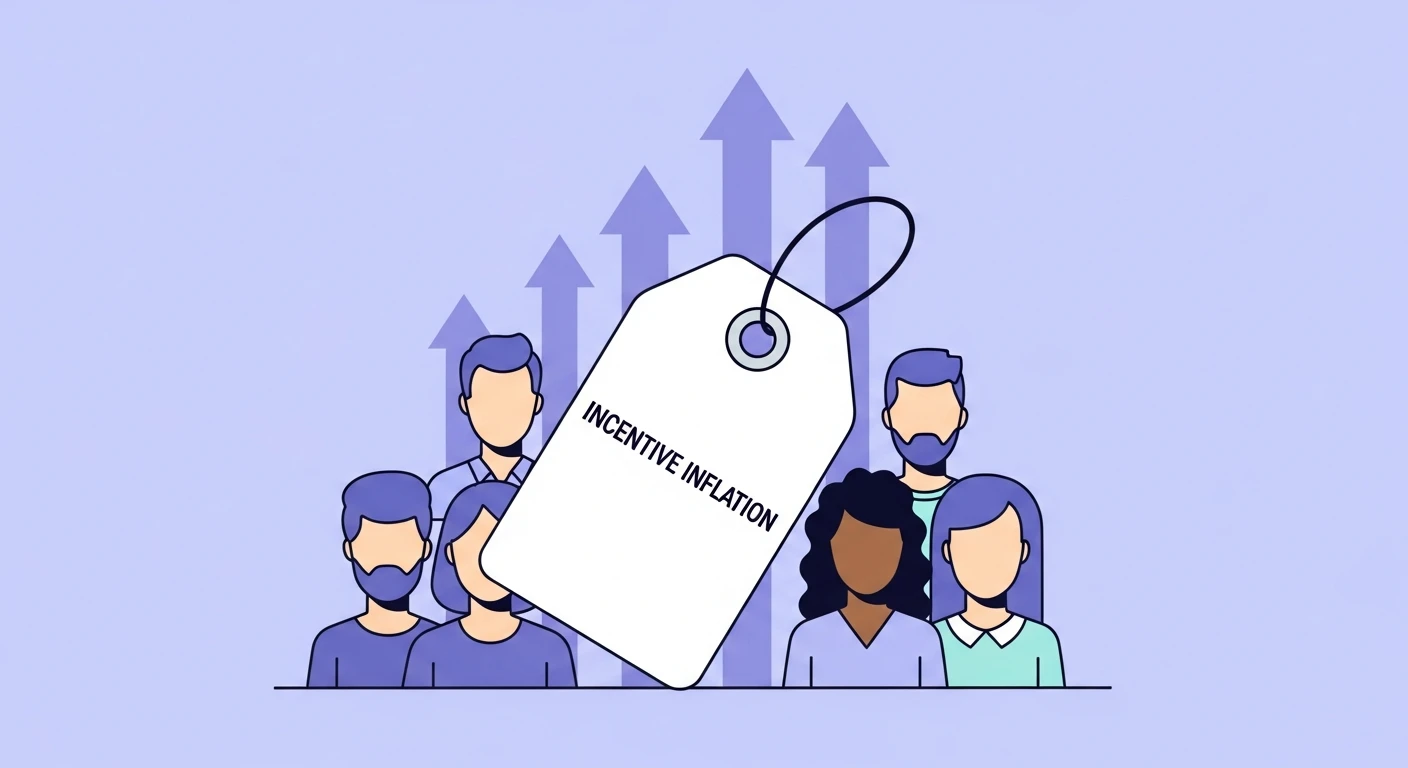
In 2023, a 60-minute qualitative interview typically compensated participants $75-100. By mid-2026, the going rate for the same session is $150-200, with specialized audiences commanding $300-500. Incentives have inflated faster than any other line item in research budgets.
But here is the uncomfortable truth: data quality has not improved proportionally. In many cases, it has declined. Teams are paying significantly more and getting less honest, less thoughtful, less authentic responses.
The reason is structural. Rising incentives have created a participant economy — a class of semi-professional respondents who optimize for qualifying into studies rather than providing genuine insights. They learn what screeners are looking for, craft responses that pass eligibility filters, and deliver polished but shallow interview performances.
How Professional Respondents Game the System
The professionalization of research participation follows a predictable pattern. Participants who complete one study get invited to panels. Panels send frequent opportunities. Participants learn which demographic profiles are in demand. They adjust their screener responses accordingly.
This creates what researchers call the "panel conditioning effect" — participants who have done dozens of studies develop a sophisticated understanding of what researchers want to hear. They provide articulate, structured responses that sound insightful but lack the messy authenticity of genuine user experience. As we explored in our analysis of research panel fatigue and participant conditioning, these conditioned participants actively distort your findings.
The financial incentive compounds this problem. When participation pays $200/hour, the motivation shifts from "I want to help improve this product" to "I want to qualify for as many studies as possible." The participant's primary task becomes maintaining eligibility, not providing truthful feedback.
The Data Quality Indicators You Are Missing
Most teams measure recruitment success by fill rates and no-show rates. These operational metrics mask the quality problem entirely. A fully-recruited study with zero no-shows can still produce garbage data if every participant is a professional respondent.
Better quality indicators include:
Response latency patterns. Genuine participants pause, think, and sometimes struggle to articulate experiences. Professional respondents deliver immediate, polished answers — a signal that they are performing rather than reflecting.
Contradiction frequency. Real users contradict themselves because lived experience is messy. Professional respondents maintain suspiciously consistent narratives because they are constructing a character, not reporting reality. The ability to detect contradictions as valuable signals becomes crucial for separating authentic from performed data.
Specificity depth. Genuine participants provide idiosyncratic details — the specific Tuesday when something went wrong, the exact workaround they invented. Professional respondents speak in generalities because they are pattern-matching to what "a user" would say rather than reporting what actually happened.
Emotional incongruence. When someone describes a frustrating experience with flat affect and structured language, they are likely narrating rather than recalling. Real frustration sounds different from described frustration.
The Structural Forces Driving Incentive Inflation
Several forces converge to push incentives upward without corresponding quality improvement:
Panel consolidation. A small number of panel providers serve the majority of qualitative research demand. Their participant pools overlap significantly. The same 50,000 "active qualitative participants" are being recycled across hundreds of studies monthly.
Remote research expansion. The shift to remote methods expanded the theoretical participant pool but concentrated actual participation among people with flexible schedules, reliable internet, and comfort with video calls — a self-selecting group that skews toward professional respondents.
Shortened timelines. When teams need participants within 48 hours, they default to panel providers with pre-screened pools. Speed selects for availability, and the most available participants are those who have made research participation a regular income source.
Competitive bidding. Multiple research teams targeting similar demographics bid against each other for the same panel participants. This is classic demand-driven inflation — more buyers chasing the same supply.
What AI-Assisted Screening Can Actually Detect
Traditional screeners use closed-ended questions that professional respondents have learned to game. AI-assisted screening introduces open-ended verification that is significantly harder to fake.
For example, instead of asking "Do you use project management software daily?" (yes/no, easily gamed), an AI screener might ask "Walk me through what happened the last time you missed a deadline on a project." The response reveals whether someone genuinely uses project management tools in a way that no checkbox can.
This approach connects to the broader principle of adaptive interviewing that maintains engagement and authenticity — using AI not to replace human judgment but to create verification layers that professional respondents cannot easily circumvent.
Breaking the Cycle: Alternative Incentive Models
The solution is not simply paying more or paying less. It requires rethinking what incentives are designed to achieve.
Value-aligned incentives. Instead of flat cash payments, offer incentives that attract genuinely interested participants: early access to features, influence over product direction, charitable donations in their name. People motivated by these incentives are less likely to be professional respondents.
Graduated compensation. Pay a base rate for participation but add quality bonuses based on response depth and specificity. This shifts the optimization target from "qualify and show up" to "provide genuine, detailed responses."
Intercept recruitment. Recruit participants at the point of actual product use rather than from panels. Users who just completed a workflow are both fresh and authentic — they cannot fake the experience they literally just had.
Relationship-based panels. Build proprietary participant pools with ongoing relationships rather than relying on shared panel providers. The research on building repositories that teams actually use applies equally to participant repositories.
The Enterprise Impact Nobody Quantifies
When a $500M product organization makes roadmap decisions based on research conducted with professional respondents, the downstream cost dwarfs any savings from cheaper recruitment. Features built for performed needs rather than real needs fail in market. Strategic pivots based on constructed narratives waste quarters of development effort.
The hidden cost of unanalyzed qualitative data gets attention, but the hidden cost of analyzed-but-inauthentic data is arguably worse — because teams believe they have evidence when they actually have theater.
As enterprises scale their research operations, the incentive inflation problem compounds. More studies means more panel dependency, which means more professional respondents, which means more decisions built on increasingly artificial data. The principles of AI governance in enterprise contexts apply here too — you need systematic quality controls, not just more volume.
A Framework for Incentive Strategy
Rather than defaulting to "market rate" incentives, research teams should design incentive strategies based on:
- Audience authenticity risk — How likely is your target demographic to contain professional respondents? Enterprise executives are low risk; "general consumers who use mobile apps" are extremely high risk.
- Verification feasibility — Can you independently confirm that participants match your criteria? API logs, purchase histories, and usage data provide ground truth that screeners cannot.
- Response authenticity signals — Build quality detection into your analysis pipeline. Flag interviews where contradiction rates are unusually low, specificity is absent, or response latency patterns suggest rehearsed answers.
- Recruitment channel diversity — Never source 100% of participants from a single panel. Mix intercept recruitment, community sourcing, customer lists, and panel providers to ensure demographic and motivational diversity.
The participant economy will not fix itself. The financial incentives for professionalization are too strong. Research teams must actively engineer against this trend or accept that their qualitative data is increasingly contaminated by people telling them what they want to hear — for the right price.