The Trend That Only Exists on the Slide
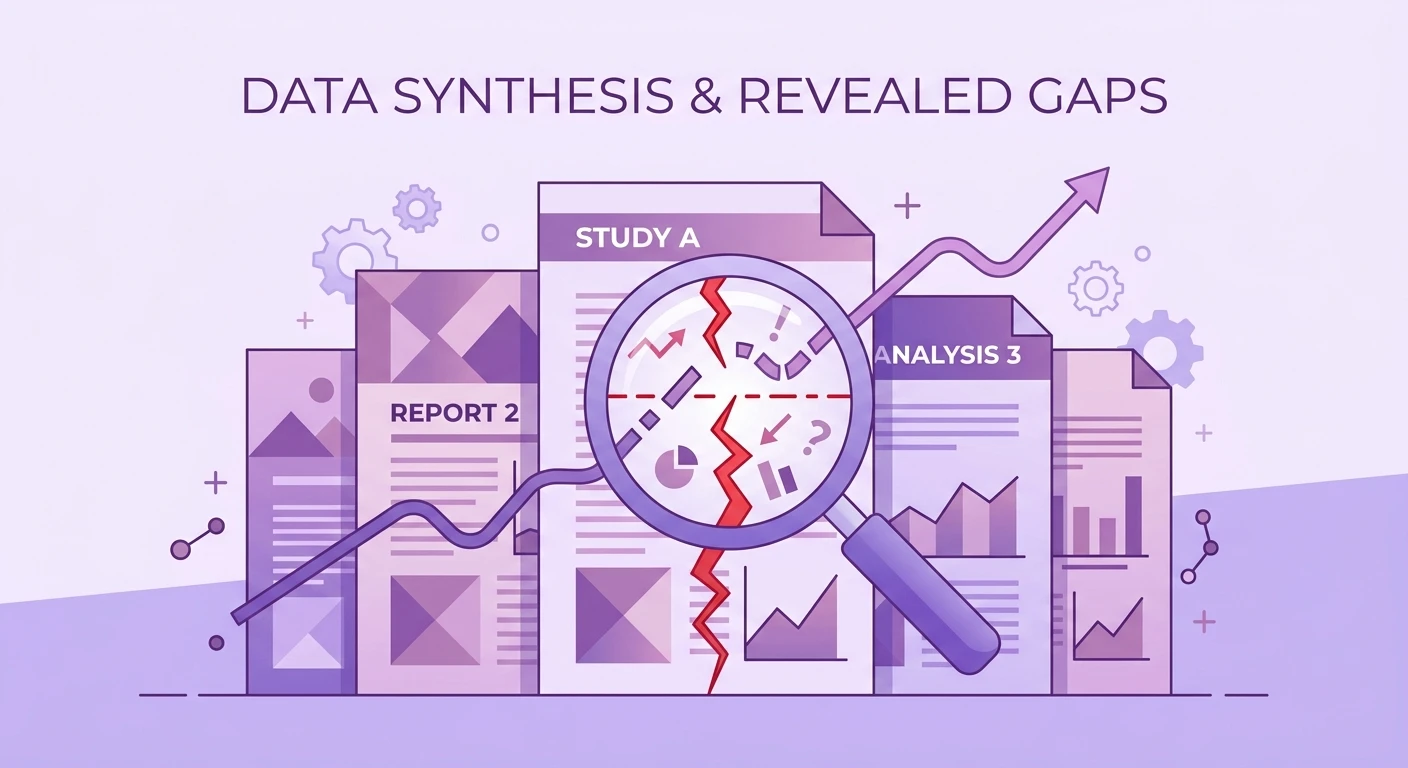
An insights team pulls twelve studies from the past year -- interviews, unmoderated tests, a diary study, a couple of surveys -- and synthesizes them into a single narrative: "Users increasingly want simplicity over power." It lands well. Leadership nods. A roadmap shifts. And the conclusion is an artifact. No single study found that trend. It emerged only when findings from incomparable studies were laid end to end and read as if they were measuring the same thing over time. They were not.
This is the aggregation illusion: the appearance of a coherent, directional pattern that exists only because heterogeneous findings were combined as though they were homogeneous. The more studies you stack, the more authoritative the synthesis looks -- and the more room there is for the pattern to be a property of your stacking rather than your users.
Why Combining Studies Isn't the Same as Combining Data
Quantitative meta-analysis has decades of hard-won machinery for combining studies: effect sizes, weighting, heterogeneity tests, corrections for study design. Qualitative meta-synthesis usually has none of that. Findings get combined by narrative -- someone reads across the reports and writes the throughline. That process has no built-in check for whether the studies are even commensurable.
And usually they are not. Study A asked power users about an advanced workflow. Study B tested first-run onboarding with novices. Study C was a satisfaction survey. Declaring that they collectively show a "shift toward simplicity" ignores that each measured a different population doing a different thing for a different reason. This is insight stacking without integration, which creates contradictory evidence piles dressed up as consensus. Real integration requires that the studies be talking about the same thing; stacking just requires that they be in the same folder.
The Three Mechanisms Behind the Illusion
1. Population drift masquerading as change over time. When studies run months apart with different recruits, any difference between them gets read as a temporal trend. But you did not observe the same people changing -- you observed different people. The apparent movement is a sampling difference wearing a timeline as a costume, and it compounds when tight recruiting makes each study internally homogeneous, the screener precision trap producing false saturation repeated study after study.
2. Question framing collapse. Different studies asked their questions differently, and framing shapes answers. Aggregating across them silently averages away the fact that the responses were reactions to different prompts. The synthesis reports what "users think" when what you actually have is what users said in response to a dozen incompatible framings -- some of which smuggled the conclusion in, the assumption smuggling problem in leading questions.
3. Availability-weighted memory. The synthesizer does not weight all twelve studies equally. The recent, the vivid, and the first-mentioned dominate -- the recency weighting trap reshaping how earlier work is remembered and the availability cascade making the first insight the one everyone repeats. The "trend" is partly a map of what was easiest to recall.
Why AI Meta-Synthesis Amplifies Every One of These
The obvious fix -- feed all twelve reports to an LLM and ask for the throughline -- makes the illusion worse, not better, because the model is optimized to produce exactly the smooth, confident narrative that the aggregation illusion consists of.
An LLM handed heterogeneous reports has no native sense of commensurability. It will not stop to ask whether Study A and Study B are even about the same population; it will find the connective tissue because finding connective tissue is what it does. It manufactures consensus your studies never collectively reached, and it does so fluently enough that the seams disappear. Worse, it can confabulate a coherence that was never in the underlying data -- generating a trend statement that no source study supports but that reads as a faithful summary.
This is fundamentally a traceability problem, and it is where enterprise AI discipline has something to teach research. Production AI systems that make consequential claims are increasingly expected to show their work -- the audit trails and explainability that make enterprise AI outputs defensible. A meta-synthesis claim deserves the same standard: every trend statement should trace back to specific findings in specific studies, with their populations and framings attached. When the synthesis cannot produce that lineage, the claim is not evidence -- it is narrative.
The Governance Angle: Treat Synthesis Inputs Like a Pipeline
The deeper fix borrows from data engineering. Combining outputs from incompatible sources is a known failure mode in AI pipelines, and the discipline that prevents it is enforcing contracts at the boundaries -- the data contracts that keep AI pipelines from silently merging incompatible inputs. Research synthesis needs its own version of a contract: before two studies are combined, they should be checked for compatibility on population, method, question framing, and time window. If they fail the check, they do not get stacked -- or they get stacked with an explicit caveat that survives into the readout.
The same principle that governs whether AI systems can be trusted across an organization -- the governance frameworks that make AI outputs accountable at scale -- applies to whether a synthesis can be trusted across a leadership team. Ungoverned aggregation produces confident nonsense in both domains.
How to Synthesize Without Manufacturing Trends
- Establish commensurability first. Before combining, write down what each study measured, of whom, and how. If you cannot state that two studies are comparable on those axes, do not merge their findings into a single claim.
- Preserve provenance to the sentence level. Every synthesized statement should carry pointers to its source studies. If a trend cannot name its sources and their populations, it is a hypothesis, not a finding.
- Separate cross-sectional from longitudinal claims. Different-people-at-different-times can never establish change over time. Reserve "trend" and "shift" language for cases where you actually observed the same population twice, the domain of proper longitudinal qualitative research.
- Hunt the disconfirming study. For every proposed trend, find the study that contradicts it and explain why it does not count -- or admit that it does. This is negative case analysis applied to synthesis, not just coding.
- Triangulate deliberately, don't average accidentally. Combining methods to converge on a decision is powerful when done on purpose -- research triangulation for product decisions. Averaging incomparable studies because they were in the same quarter is not triangulation. It is noise with a narrative.
The Bottom Line
Meta-synthesis is where research earns its strategic seat -- and where it most quietly betrays it. The instinct to roll everything up into one clean story is exactly the instinct that manufactures trends out of sampling artifacts, framing differences, and memory bias. The discipline is boring and it works: check commensurability, preserve provenance, and refuse to let the aggregate say more than its parts can support. Your least exciting synthesis is usually your most honest one.
Qualz.ai keeps findings traceable to their source studies -- populations, framings, and all -- so cross-study synthesis rests on evidence you can actually follow, not trends that only exist on the slide. See how Qualz.ai supports defensible synthesis.