The Reason Arrives Before the Explanation Does
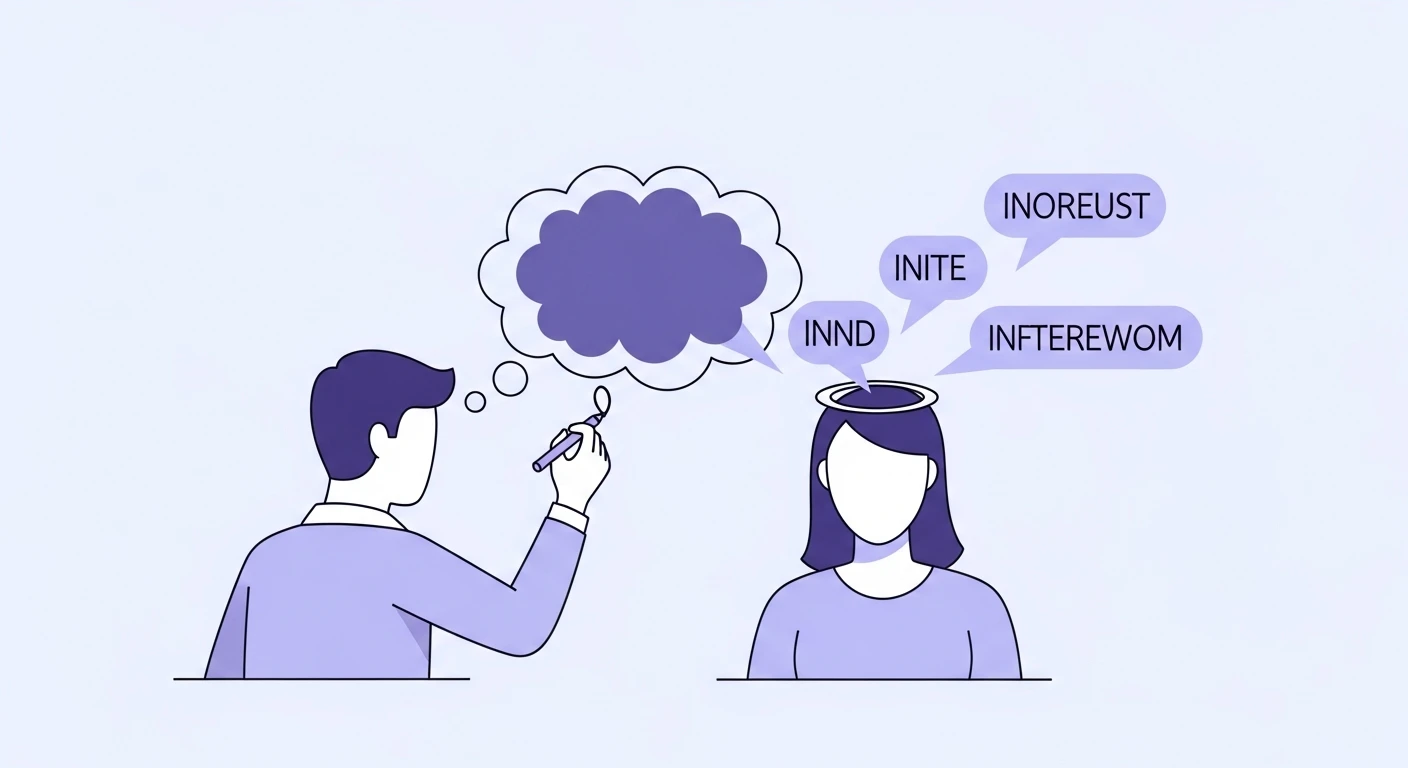
A participant says, "I stopped using the weekly report and just started checking the dashboard every morning instead." In the half-second before they say another word, something has already happened in your head: you have decided why. Maybe the report was too slow. Maybe they preferred the visual. Maybe they wanted real-time data. Whatever it is, you now have a hypothesis, and it feels less like a hypothesis than like comprehension. You understood them. Except you did not -- you predicted them, and prediction and understanding are not the same act.
This is the assumed motive trap. The interviewer infers the reason behind a behavior faster than the participant can articulate it, and then -- crucially -- stops treating the reason as an open question. Everything that follows is subtly bent toward confirming the motive you already assigned. You did not ask why they switched. You asked, "So the report was too slow?" and they said "yeah, kind of," and you wrote down that the report was too slow, and a fiction became a finding.
Why Your Assumed Motive Is Almost Always Wrong in an Interesting Way
The assumed motive is not random. It is drawn from your model of the product, your prior interviews, and your own preferences as a user. That is exactly what makes it dangerous: it is plausible. A wildly wrong guess would get corrected, because the participant would push back. A plausible guess gets ratified, because the participant -- who often cannot fully articulate their own reasons and is happy to be helped -- accepts your framing as close enough.
The motive you assign is usually a rationalization the participant would never have generated unprompted. Real behavior is driven by habit, friction, mood, and context far more than by the clean instrumental reasons researchers love. When you supply the clean reason, the participant frequently adopts it, because it sounds better than "I don't really know, I just drifted into it." This is the same underlying mechanism behind the narrative coherence bias, where participants construct logical, tidy stories out of experiences that were actually chaotic and unreasoned -- except here you are not just waiting for the tidy story, you are handing it to them.
The Trap Hides Inside the Follow-Up
The assumed motive does its real damage in the second question. Once you have a candidate reason, your probing goes asymmetric: you dig hard into the evidence that supports your assumed motive and skim past the parts that would contradict it. You are not doing this consciously. You are doing what everyone does when they have a hypothesis, which is precisely why the asymmetric probing problem -- digging deeper into expected answers and skating past surprising ones -- is one of the most corrosive habits in qualitative work. The assumed motive is the seed; asymmetric probing is how it grows into a false certainty.
Notice the shape of the questions. "So the report was too slow?" is a closed, leading, confirmation-seeking question. It offers the participant a motive and asks them to agree. Compare it to "walk me through the morning you switched" -- which offers nothing and asks them to reconstruct. The first question tests your guess. The second question makes your guess unnecessary. The entire discipline of good motive elicitation is the discipline of asking the second kind of question even when the first kind is screaming to be asked.
How to Keep the Why in the Participant's Hands
The fix is not to stop forming hypotheses -- you cannot, and you should not want to. The fix is to hold the hypothesis silently and refuse to let it drive your questions. Concretely:
- Separate the what from the why, out loud, in your own head. When a participant reports a behavior, explicitly note: I know what they did, I do not yet know why. The naming creates a beat of hesitation that interrupts the reflex to supply the reason.
- Ask for the episode, not the explanation. "Tell me about the last time you did that" pulls a concrete memory that carries its own reasons, rather than asking the participant to theorize about themselves. Concrete beats abstract because asking for specific episodes unlocks real experience while abstract questions produce performative, invented answers.
- Never offer a motive in a yes/no frame. Kill "was it because X?" Replace it with "what was going on there?" A motive you offer is a motive you will get back, laundered as the participant's own.
- Treat agreement as a warning, not a confirmation. When a participant readily agrees with a reason you supplied, that is the moment to slow down, not speed up. Easy agreement is the signature of a manufactured motive.
The Machine Version of the Same Trap
This is not only a human failing. AI interview and analysis tools do it too, and at scale. A model summarizing a transcript will confidently attach a reason to a behavior the participant never explained, because generating a plausible causal link is exactly what language models are optimized to do. The defense is the same one that serious AI engineering teams apply to production systems: the reasoning has to be traceable back to actual evidence, not smoothly generated on top of it, which is why structured output engineering in production LLM systems insists that a system's claims stay anchored to their sources rather than confabulating the connective tissue. A summary that says "the user switched because the report was too slow" should be forced to point at the words where the user said so -- and when it cannot, the motive should be flagged as inferred, not reported as fact.
The deepest version of the discipline is this: a motive you did not hear is a motive you do not have. It does not matter how obvious it seems, how well it fits your model, or how quickly the participant agreed when you offered it. Until the reason came out of their mouth, unprompted and specific, the why is still an open question -- and the entire value of talking to a real human instead of guessing is that you get to leave it open long enough for the real answer to surface.
Bringing It Into Your Practice
The next interview you run, try a single constraint: for the first half of the session, you are not allowed to offer a reason for anything. You can ask what happened, when, where, and what else -- but not why, and never "was it because." It will feel slower and less clever. You will resist it. And you will walk away with motives that belong to your participants instead of to you.
Qualz.ai is built to help teams catch exactly this class of contamination -- surfacing where a stated reason traces back to the participant's own words versus where it was introduced by the interviewer or invented by a summary. If you want your findings to reflect what users actually meant rather than what your team assumed, book a demo and see how motive traceability changes what your research can defend.