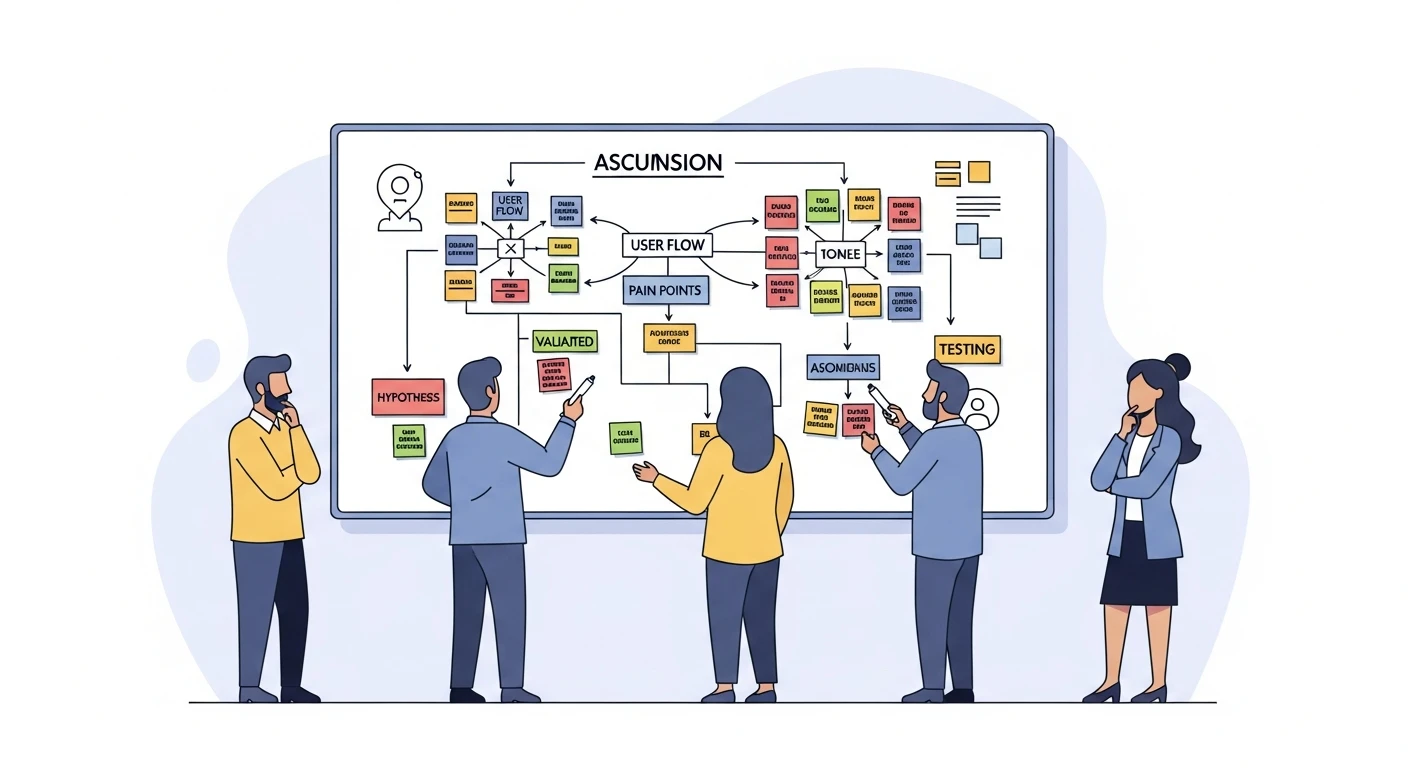
The Invisible Architecture of Research Studies
Every research study has a hidden blueprint that predates its research plan. Before you write interview questions, before you define screener criteria, before you choose a methodology, your team already holds a dense web of beliefs about users, problems, and solutions. These assumptions silently shape every downstream decision: who you recruit, what you ask, which signals you notice, and which findings feel credible.
The problem is not that teams have assumptions. Assumptions are inevitable and often well-informed. The problem is that unexamined assumptions masquerade as research questions. A team that believes power users will reject a simplified interface does not design research to test that belief — they design research that confirms it, usually without realizing the study was structured around a predetermined conclusion.
An assumption audit is the practice of deliberately surfacing, documenting, and categorizing team beliefs before research design begins. It transforms hidden premises into testable hypotheses and reveals where genuine uncertainty exists versus where the team has already made up its mind.
Why Assumptions Compound Into Research Design Flaws
Unexamined assumptions do not just create single points of failure. They compound through the research design process:
Recruitment filtering. A team that assumes their product is primarily used by technical managers will write screeners that filter for technical managers. The study then confirms the assumption because non-technical users were excluded from the sample by design. This is not bad research practice on the surface — the screener looks reasonable — but it is circular reasoning embedded in methodology.
Question framing. Assumptions about user problems shape how questions are phrased. A team that believes onboarding friction drives churn will ask about onboarding experience. They may never discover that the real churn driver is inadequate team collaboration features because their questions never opened that territory.
Signal interpretation. When participants say something that aligns with team assumptions, it gets coded as a finding. When they say something that contradicts assumptions, it gets coded as an edge case or attributed to the participant not being representative. This is not conscious bias — it is the natural result of interpretation patterns that operate on prior beliefs.
The cumulative effect is research that feels rigorous but functions as elaborate confirmation. The team invested time, budget, and analytical effort to arrive exactly where they started — with higher confidence in beliefs that were never genuinely tested.
Running an Assumption Audit
An effective assumption audit happens in three phases: elicitation, categorization, and prioritization.
Phase 1: Elicitation. Gather the cross-functional team — product, design, engineering, and any stakeholders who will consume the research. Ask each person to independently list what they believe to be true about: the target users, the problems those users face, how users currently solve those problems, what users would value in a solution, and what would cause users to reject a solution.
Independent listing is critical. Group discussions produce social conformity where junior team members defer to senior voices and contrarian beliefs go unspoken. Written individual submissions produce a richer, more honest assumption landscape. The dynamics that plague focus groups apply equally to internal team workshops unless you structure against them.
Phase 2: Categorization. Once collected, sort assumptions into four buckets:
- Known facts — beliefs supported by existing data (analytics, prior research, market data)
- Informed hypotheses — beliefs based on experience but not directly validated
- Untested assumptions — beliefs the team holds with confidence but has never examined
- Conflicting beliefs — areas where team members disagree
The last two categories are where research creates the most value. Known facts do not need new research. Informed hypotheses may need validation but are lower risk. Untested assumptions and internal conflicts represent genuine knowledge gaps where research investment produces the highest return.
Phase 3: Prioritization. Not every assumption warrants research. Prioritize by two dimensions: confidence (how certain is the team?) and consequence (what decisions depend on this assumption?). High-consequence, low-confidence assumptions are your primary research targets. High-consequence, high-confidence assumptions are worth testing when resources allow — these are where teams are most surprised by contradictory findings.
From Assumptions to Research Questions
The audit transforms your research design process. Instead of starting with broad exploratory questions or narrow validation tasks, you start with specific testable propositions. Each priority assumption becomes a research question:
- Assumption: "Enterprise buyers need ROI calculators before they will schedule a demo"
- Research question: "What information do enterprise buyers seek before committing to a sales conversation, and at what stage does quantification become relevant?"
Notice the research question is deliberately broader than the assumption. This prevents the study from becoming a yes-or-no validation exercise. The question opens space for the assumption to be confirmed, contradicted, or revealed as an oversimplification of a more nuanced reality.
This approach aligns with how expert interviewers structure depth — starting wide enough to allow unexpected findings while maintaining enough focus to produce actionable evidence.
The Organizational Benefits Beyond Better Research
Assumption audits produce value beyond improved study design:
Stakeholder alignment. When team members see their beliefs written alongside contradicting beliefs from colleagues, the need for research becomes self-evident. You spend less time justifying research investment because the audit reveals genuine uncertainty that the team cannot resolve through discussion alone.
Research prioritization. Product teams often struggle to decide what to research next. The assumption audit provides a principled framework: research the beliefs that carry the highest consequence and lowest confidence. This prevents research programs from drifting toward whatever feels interesting or whatever the loudest stakeholder demands.
Faster synthesis. When you know what assumptions the study was designed to test, synthesis has clear anchors. Instead of open-ended thematic analysis that produces dozens of potential findings, you can directly address whether specific beliefs held, broke, or needed refinement. This connects directly to how teams build shared understanding from research — the assumptions provide the scaffolding that makes findings immediately actionable.
Institutional learning. Documented assumptions create a record of what the team believed at each decision point. Over time, this reveals patterns: which types of assumptions consistently prove wrong, which team members have the most calibrated instincts, and where the organization systematically overestimates its understanding of users.
Common Failure Modes
Assumption audits fail when they become performative rather than functional:
Too many assumptions, no prioritization. A list of 50 assumptions without clear ranking produces paralysis. Limit the final research-driving set to 3-5 core assumptions that the study must address.
Treating the audit as a one-time exercise. Assumptions evolve as research reveals new information. Revisit and update the assumption map after each study. What you believed before study one should differ from what you believe before study two.
Conflating assumption mapping with assumption elimination. The goal is not to have zero assumptions. The goal is to know which assumptions you are operating on and to have deliberately chosen which ones to test. Even after research, you will still hold assumptions — they will simply be better-informed ones.
Skipping the conflict surfacing. The most valuable assumptions to research are those where the team disagrees. If your audit process does not create psychological safety for dissent, it will produce a sanitized consensus view that misses the real uncertainties. The principles that make collaborative analysis sessions effective — structured disagreement with resolution protocols — apply equally here.
Integrating Audits Into Continuous Discovery
For teams running continuous discovery programs, the assumption audit becomes a living artifact rather than a project kickoff exercise. Each week, as the team makes product decisions, new assumptions accumulate. A lightweight weekly practice — five minutes documenting "what are we assuming this week that we have not verified?" — keeps the assumption inventory current.
This transforms continuous discovery from a rhythm of interviews into a rhythm of deliberate uncertainty reduction. Each study targets the highest-priority assumptions from the current inventory. Each finding updates the inventory. The result is a research program that is always working on what matters most rather than following a predetermined schedule of topics.
The assumption audit is not a revolution in research methodology. It is a simple structural practice that prevents the most common and most expensive failure mode in applied research: studying what you already know instead of what you need to learn.