The Report That Changed Nothing
You've seen it happen. A researcher spends weeks conducting interviews, synthesizing findings, and crafting a compelling presentation. Stakeholders nod along during the readout. Someone says "this is really valuable." Then nothing changes. The roadmap stays the same. The same assumptions persist. Three months later, someone commissions new research on the same question.
This isn't a delivery problem. It's a sensemaking problem.
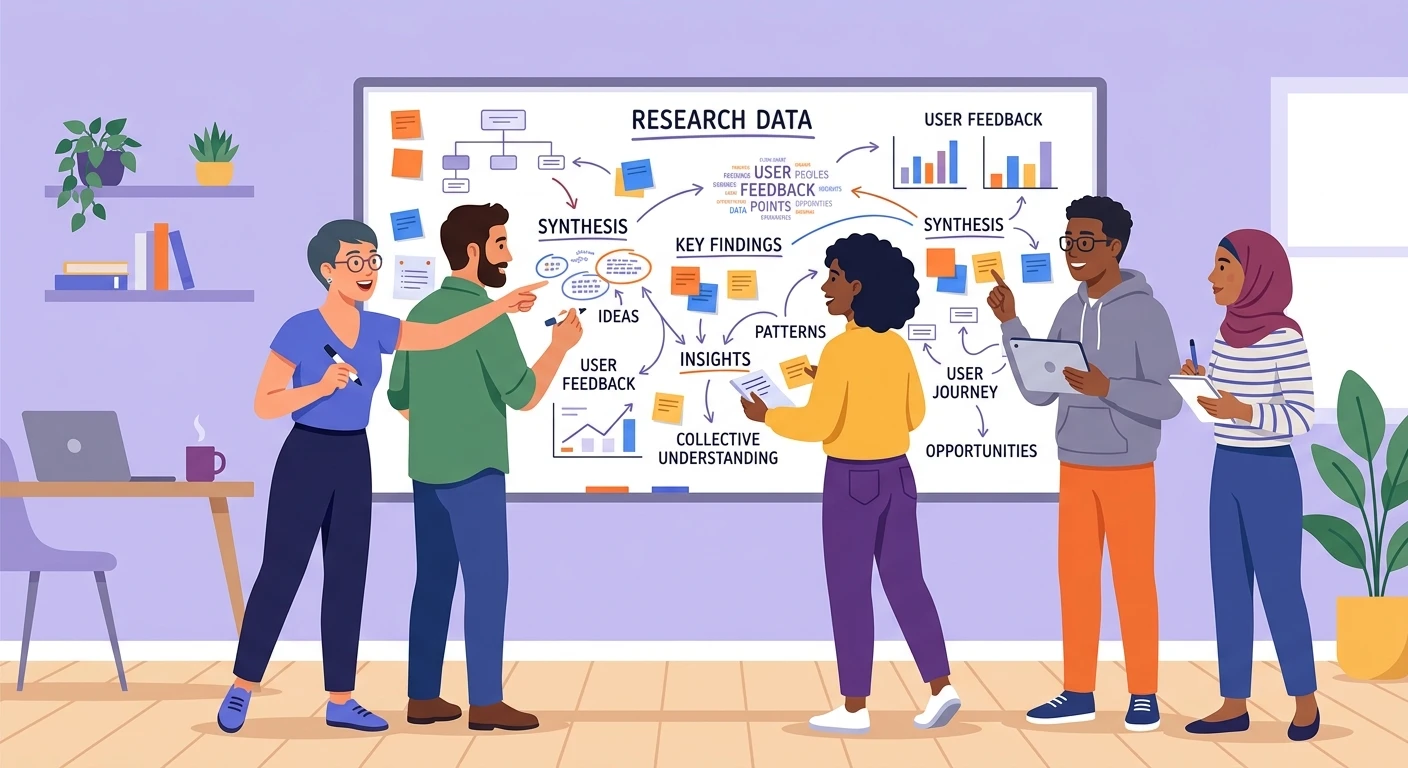
Sensemaking — the process by which groups collectively interpret ambiguous information and create shared meaning — is fundamentally different from information transfer. You can transfer findings in a deck. You cannot transfer understanding. Understanding has to be constructed collectively, through dialogue, negotiation, and the integration of new evidence with existing mental models.
Most research operations optimize for delivery: How fast can we get findings to stakeholders? How polished is the report? How clear are the recommendations? But delivery without sensemaking is like shipping code without deploying it. The work is technically complete but functionally useless.
Why Individual Comprehension Isn't Enough
Research shows that organizational decision-making depends not on what individuals know, but on what groups believe they collectively know. This distinction matters enormously for UX researchers.
Consider: A product manager reads your research report and genuinely understands it. They believe users struggle with the onboarding flow. But their engineering lead hasn't read the report. Their designer has a different interpretation. Their VP has a pet theory about onboarding that contradicts your findings. The PM's individual understanding cannot override the team's collective mental model.
This is why presenting research findings effectively requires more than clear communication — it requires facilitated sensemaking that builds shared interpretation across the decision-making group.
The sensemaking gap is the distance between "the researcher understands" and "the team collectively understands well enough to act." Most research programs measure only delivery, so the gap remains invisible until decisions don't change.
The Three Failure Modes
1. The Translation Problem
Researchers think in themes, patterns, and participant narratives. Product teams think in features, sprints, and metrics. The translation between these frames isn't just linguistic — it's epistemological. When a researcher says "participants expressed anxiety about data ownership," the product team hears "add a privacy settings page." The nuance — that the anxiety is relational, not functional — gets lost because the team lacks the interpretive framework to hold it.
2. The Timing Problem
Sensemaking requires cognitive availability. Teams in execution mode — heads-down building against sprint commitments — literally cannot engage in the kind of reflective, integrative thinking that sensemaking demands. Delivering research during execution phases is like trying to fight recency bias — the immediate always overwhelms the important.
The window for sensemaking is narrow: during planning cycles, at inflection points, when existing assumptions visibly fail. Research delivered outside these windows gets acknowledged but not absorbed.
3. The Authority Problem
In many organizations, research findings compete with other forms of knowledge — executive intuition, sales anecdotes, analytics dashboards. Without collective sensemaking, there's no mechanism for the group to weigh these competing inputs. The loudest or most senior voice wins by default.
This is why research democratization without sensemaking infrastructure can actually make things worse — more people have access to findings, but no shared process for making sense of them together.
Building Sensemaking Into Your Research Process
Replace Readouts With Interpretation Sessions
Stop presenting findings as finished products. Instead, present raw patterns and facilitate collective interpretation. Show the team three contradictory participant quotes and ask: "What do you make of this?" Surface the tension rather than resolving it for them.
This feels uncomfortable because researchers are trained to synthesize. But premature synthesis robs teams of the cognitive work that builds understanding. Let them struggle with the ambiguity. Guide the process, but don't hand them conclusions.
Create Boundary Objects
Boundary objects — artifacts that sit between different knowledge communities and are interpreted differently by each — are sensemaking infrastructure. Journey maps, service blueprints, and experience models work as boundary objects because they're visually accessible to multiple disciplines while remaining rich enough to support deep interpretation.
The key is that boundary objects are living documents, not deliverables. They get annotated, contested, and revised as the team's collective understanding evolves. A journey map pinned to a wall and argued over weekly does more sensemaking work than a hundred-page research report read once.
Time-Box the Sensemaking Window
Explicitly schedule sensemaking time. After research delivery, block 2-3 sessions where the cross-functional team works through implications together. Frame these not as "research review" but as "strategy workshops informed by new evidence."
This approach works because it separates information transfer (async, efficient) from collective interpretation (synchronous, necessarily slow). Let people read the findings ahead of time. Use the synchronous time exclusively for making sense together.
Measure Shared Understanding, Not Delivery
Instead of tracking "research reports delivered" or "stakeholders attended readout," measure whether teams can articulate research implications in their own words. Can the engineer explain why the current approach doesn't work? Can the PM connect the research finding to a specific roadmap decision? Can the designer point to the evidence behind their latest iteration?
This connects directly to measuring research program impact — if your metrics focus only on output (studies completed, reports delivered), you're measuring production, not impact.
The Role of AI in Closing the Sensemaking Gap
AI tools are excellent at information retrieval and pattern detection. They can surface relevant past findings during planning discussions, identify contradictions between new evidence and existing assumptions, and generate provocative questions that force collective interpretation.
But AI cannot do sensemaking for a team. Sensemaking is inherently social — it requires negotiation, perspective-taking, and the integration of diverse mental models. What AI can do is reduce the friction that prevents sensemaking from happening: finding relevant evidence faster, summarizing conflicting data points, and generating frameworks that structure group discussion.
The organizations getting this right use AI to accelerate analysis while preserving human interpretation. They automate the retrieval and pattern-matching but keep the meaning-making collaborative and synchronous.
The Organizational Design Implication
If sensemaking requires collective interpretation, then research impact is partly a function of organizational design. Teams that sit together, share context, and have regular touchpoints for integrating new information will absorb research findings faster than distributed teams communicating primarily through documents.
This doesn't mean co-location is required. It means that research operations need to include sensemaking rituals — regular, protected time where cross-functional groups collectively interpret evidence and update their shared mental models.
The research team's job isn't just to produce knowledge. It's to facilitate the organizational sensemaking that turns knowledge into action.
What You Can Do Monday Morning
- Take your next research deliverable and split it: async reading for information transfer, synchronous session for collective interpretation
- In your interpretation session, present tensions and contradictions rather than resolved conclusions
- Ask each attendee to write down — before group discussion — what they think the finding means for their work
- Track whether decisions in the following sprint reference research evidence
- Iterate on the format based on whether shared understanding actually formed
The sensemaking gap is the most expensive problem in research operations because it turns completed research into organizational waste. Closing it doesn't require more research — it requires different rituals around the research you already do.