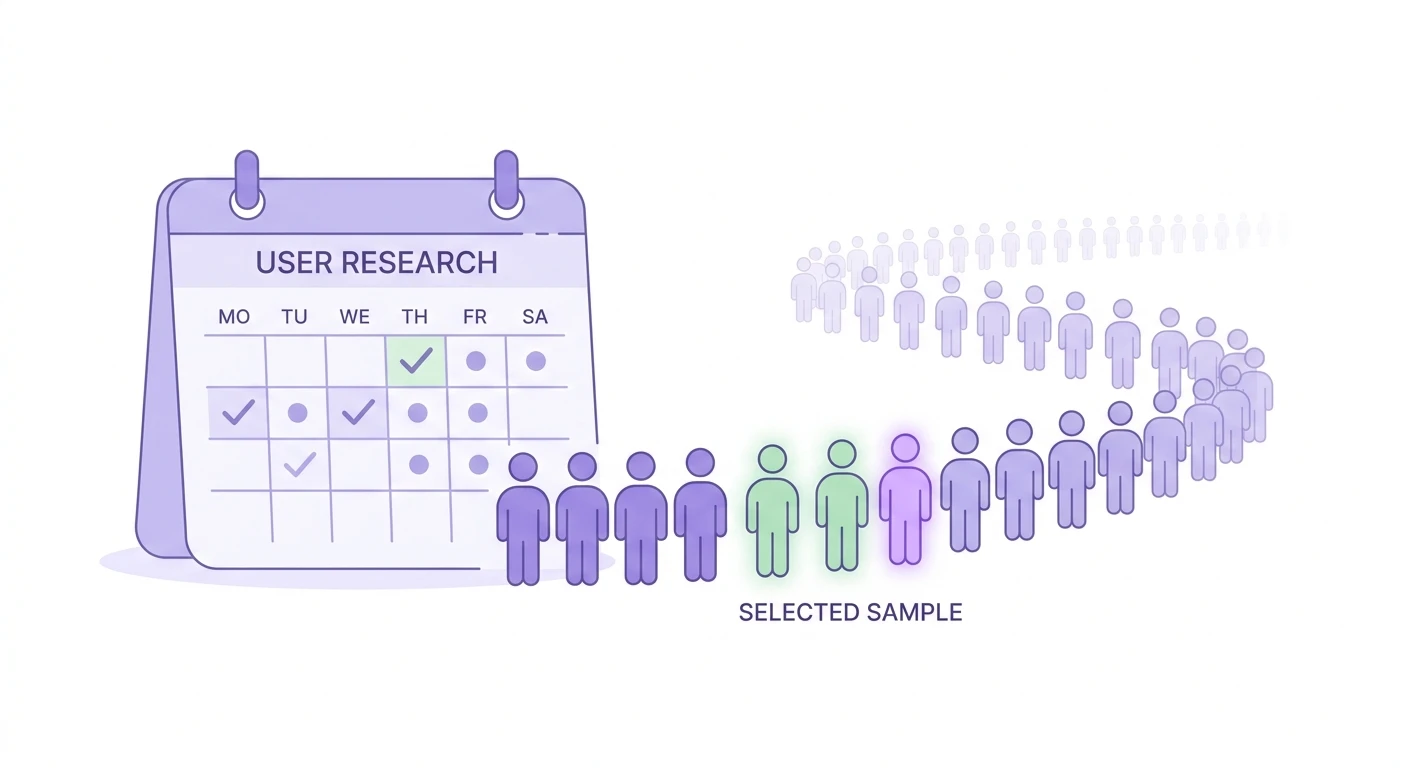
The Sample Your Calendar Chose For You
You opened ten interview slots for a study and they filled in two days. It felt like a win -- fast recruitment, no chasing, a full schedule. But look at who actually booked. The first slots went to the people who could book them: participants with flexible calendars, few competing obligations, and enough enthusiasm to respond the moment your invite landed. The people you most needed to hear from -- the busy power user, the skeptical churned customer, the shift worker whose day does not bend around a video call -- never made it onto the calendar at all.
The availability sampling trap is the systematic bias introduced when you let scheduling convenience, rather than sampling design, decide who ends up in your study. The calendar is not neutral. It selects for a specific kind of person, and that person is quietly overrepresented in every finding you produce.
Why Availability Is Not Random
The seductive assumption is that whoever books first is just a random draw from your qualified pool. They are not. Availability correlates with real, decision-relevant traits.
Flexible schedules cluster with particular life situations: remote work, part-time employment, retirement, or roles with slack in them. Eagerness to participate correlates with strong feelings about your product -- often positive, sometimes performatively so. Speed of response correlates with how much attention someone has to spare, which is inversely related to how busy and engaged they are elsewhere. None of these are the trait you were sampling on. They ride along invisibly, and they shape the data.
This is a close cousin of the recruitment velocity trap, where the fastest panel fills quietly skew your sample. Velocity and availability are two faces of the same problem: speed of recruitment is not free, and the price is paid in representativeness.
The Users You Never See
The most damaging part of availability sampling is not who shows up -- it is who never does. The person who wanted to participate but could not find a slot that fit their week simply drops out of your frame entirely, and they leave no trace in your data. You cannot see the shape of the sample you failed to recruit.
This overlaps directly with the silent segment problem, where the users who never participate end up deciding your roadmap by their absence. Availability sampling is one of the mechanisms that creates silent segments: the busiest, most constrained users self-select out not because they lack opinions, but because your scheduling model assumed a flexibility they do not have.
It also compounds with dropout. The participant who books a slot at the edge of their capacity is exactly the one most likely to cancel or no-show later, which is the attrition blindspot in action -- the people who leave your study take their data with them. Availability bias front-loads your sample with the convenient; attrition then strips out even the marginal cases that did make it in.
How the Trap Hides
Availability sampling is hard to catch because every surface signal looks healthy. Recruitment was fast. The schedule filled. Participants showed up and gave rich, articulate answers. Nothing in the study readout says "this sample was selected by the calendar." The bias is upstream of everything you actually observe, so it never appears in the transcript or the analysis.
There is a structural parallel here to how invisible skew corrupts AI systems. As the team at bigyan.dev described in The Feature Freshness Gap, where an agent reasons over stale features without ever knowing it, the danger is not a loud failure but a silent one -- the system produces confident output over quietly compromised inputs. Availability sampling is the qualitative version: confident findings built on a sample the calendar pre-filtered.
The Counter-Practice: Design Scheduling as Sampling
The fix is to treat scheduling as part of your sampling design, not a logistics afterthought.
Start by widening the slot geometry before recruitment opens. If every slot you offer is a weekday mid-afternoon video call, you have already selected against everyone whose day does not have a free mid-afternoon. Offer early mornings, evenings, and weekend windows -- and offer asynchronous options for people who cannot do live sessions at all.
Then watch the fill order as data. If your first-booked participants cluster on one profile -- all flexible, all enthusiastic, all in the same time zone -- treat that as a warning that availability is doing your sampling for you. Hold back slots for the segments you most need and recruit into them deliberately rather than letting the calendar clear itself.
Finally, track who declined or could not find a slot, not just who booked. That declined-and-unscheduled list is the closest visible proxy you have for the sample availability is erasing.
Practical Takeaways
- Offer slots across the full week and day, including off-hours and async. Narrow slot geometry is silent selection. Widen it before recruitment opens.
- Read your fill order as a bias signal. If the first bookings all share a profile, availability is choosing your sample. Reserve capacity for harder-to-reach segments.
- Recruit into segments, not into slots. Assign target quotas per segment and fill against them deliberately rather than first-come, first-served.
- Track declines and unscheduled interest. The people who wanted in but could not book are your best visible clue to the sample you are missing.
- Separate "fast to recruit" from "representative." A full schedule in two days is a logistics result, not a sampling result. Judge the sample on who is in it, not how quickly it filled.
If your team wants to run studies where the sample reflects your users rather than your calendar, book a session with the Qualz team to walk through how to make scheduling part of your sampling design.