Your research team just wrapped a 12-market consumer healthcare study. You have 96 interview transcripts across eight languages. The transcription vendor delivered files in varying quality -- some verbatim, some cleaned up, some with speaker labels and some without. Your compliance team needs PII scrubbed before anyone on the analysis team can even open the files. Your translation vendor quotes three weeks and a five-figure budget to get everything into English for coding.
This is the reality of global qualitative research, and it has been the reality for decades. The tools changed -- tape recorders became digital recorders became Zoom recordings -- but the workflow bottleneck stayed the same. Transcription, translation, PII redaction, and analysis remain separate steps, handled by separate vendors, on separate timelines, with separate quality concerns.
AI is collapsing these steps into a single integrated workflow. Not someday. Now. But the transition raises legitimate questions about accuracy, compliance, and analytical rigor that practitioners need to evaluate carefully.
The Multi-Language Transcript Problem
Anyone who has run qualitative research across more than two or three languages knows that the challenge is not just translation. It is the compounding of quality issues across every step of the pipeline.
Transcription quality varies by language. Automatic speech recognition performs differently across languages, dialects, and acoustic conditions. A transcript that is 95% accurate in American English might be 85% accurate in Hindi or 80% accurate in Cantonese, depending on the model, the audio quality, and the speaker's dialect. These accuracy gaps compound downstream -- a mistranscribed word becomes a mistranslated phrase becomes a miscoded theme.
Translation introduces its own distortions. Qualitative research depends on nuance -- the specific words a participant chooses, the hedging language they use, the cultural idioms that signal emotional intensity or social desirability. Literal translation strips these signals. Culturally fluent translation preserves them but requires translators who understand both the source culture and qualitative research methodology. Those translators are expensive and scarce.
Then there is the coordination overhead. Managing transcription vendors for eight languages, translation vendors for seven language pairs, and quality reviewers for each output creates a project management burden that often exceeds the analysis work itself. Research managers spend more time trafficking files between vendors than they spend thinking about what the data means.
This pipeline -- transcribe, translate, review, redact, then finally analyze -- typically adds four to eight weeks to a global qualitative project before anyone writes a single line of code or identifies a single theme. For organizations running continuous discovery programs, this latency makes multi-language qualitative research functionally impossible within agile product cycles.
Enhanced Transcription: Beyond Speech-to-Text
The first step AI transforms is transcription itself. Modern AI transcription is not just faster speech-to-text. It is enhanced transcription that addresses the quality problems researchers actually face.
Speaker diarization and attribution. AI models now reliably separate speakers in multi-party recordings and maintain consistent speaker labels across an entire session. This matters for qualitative analysis because who said what is as important as what was said. A theme that emerges from moderator prompting is analytically different from one that surfaces spontaneously.
Acoustic context preservation. Advanced transcription captures paralinguistic features -- pauses, laughter, overlapping speech, changes in speaking pace -- that carry meaning in qualitative data. A participant who pauses for five seconds before answering a question about brand loyalty is communicating something different from one who answers immediately. Traditional transcription vendors either ignore these signals or charge premium rates for verbatim transcription that includes them.
Multi-language model quality. The gap between English and non-English transcription accuracy is narrowing rapidly. Current-generation multilingual models trained on diverse language data produce research-grade transcripts in 30+ languages without requiring language-specific vendor relationships. This does not mean accuracy is identical across all languages -- it is not, and researchers should validate quality for specific language-dialect combinations. But the baseline has shifted from "unusable without heavy manual correction" to "reliable with spot-checking" for most major research languages.
The practical impact is that transcription stops being a separate project phase with its own timeline and budget. It becomes a near-real-time step that happens as recordings are ingested, producing analysis-ready transcripts in hours rather than weeks.
Translation and Cross-Language Analysis
Translation in qualitative research is not the same problem as general-purpose translation. The requirements are specific: preserve participant voice, maintain cultural context, flag idioms and culturally specific references, and produce output that supports thematic coding across languages.
AI-powered translation for research addresses these requirements differently than consumer translation tools. Research-grade translation preserves the participant's register -- formal versus informal speech, technical vocabulary versus colloquial description, hedging and uncertainty markers. A participant who says "maa, thik hai, kaam chal raha hai" in Hindi is communicating a specific attitude (resigned acceptance, making do) that "yes, it's fine, work is going on" does not fully capture. Research translation needs to flag these gaps.
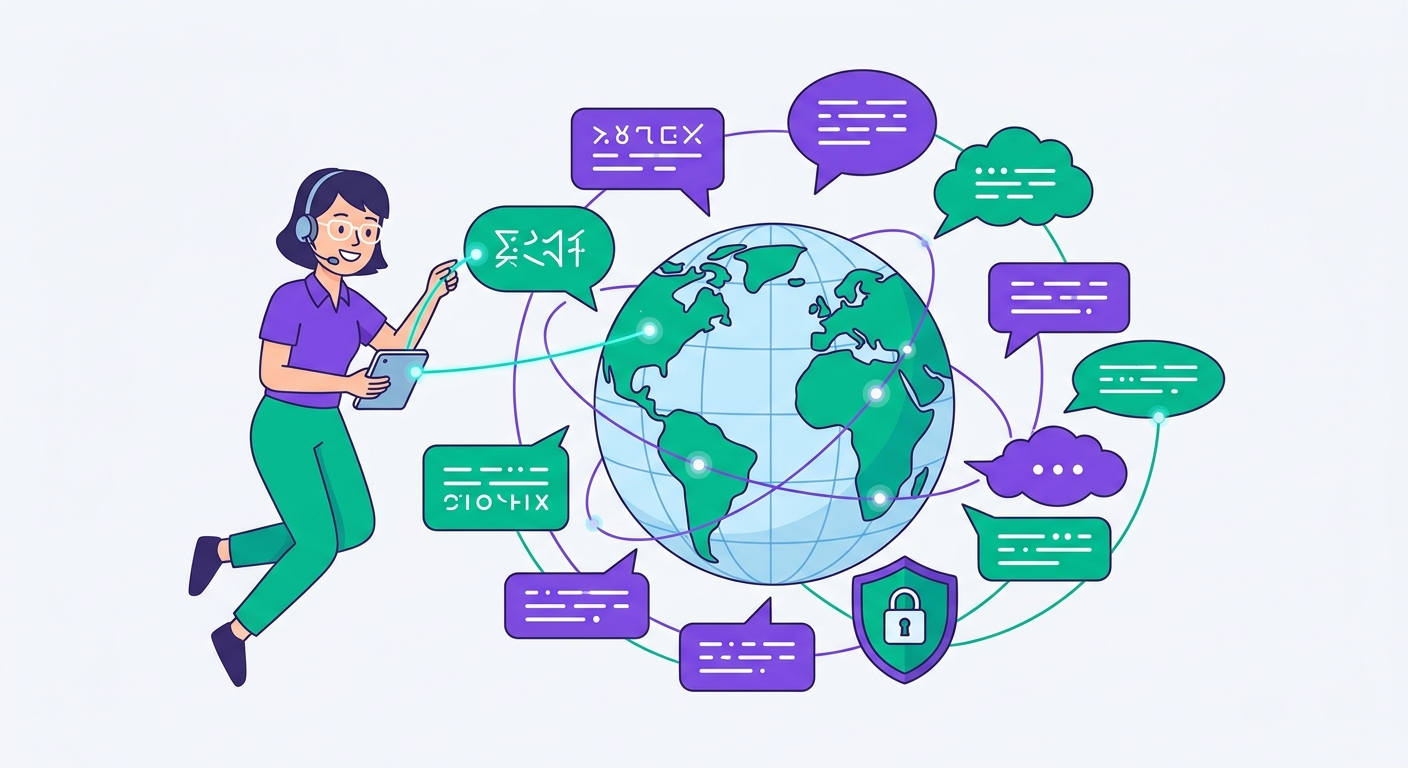
But the more transformative capability is cross-language analysis without requiring everything to be translated into a single language first. Traditional workflows force all data into one analysis language because human coders cannot work across eight languages simultaneously. AI analysis tools can process transcripts in their original languages, identify thematic patterns across the full multilingual dataset, and surface findings with supporting quotes in both the original language and translation.
This preserves analytical fidelity that translation-first workflows destroy. When you translate everything to English before coding, you lose the ability to verify whether a theme genuinely exists in the source language or is an artifact of translation choices. Cross-language analysis that works on original-language data and provides translations as a reference layer maintains that verification capability.
For teams conducting cross-cultural qualitative research, this is a fundamental shift. The analysis is no longer filtered through the lens of a single language. Cultural and linguistic nuance that translation would flatten remains accessible throughout the analytical process.
PII Redaction: Compliance Without Compromise
PII redaction in qualitative data is a different problem than PII redaction in structured data. In a database, personally identifiable information lives in defined fields -- name, email, phone number, address. In a qualitative transcript, PII is woven into natural language. A participant mentions their doctor by name, describes the intersection where they live, references their child's school, names their employer, mentions a specific medical condition alongside enough demographic detail to be identifying.
Manual PII redaction of qualitative transcripts is slow, expensive, and error-prone. A trained redactor processing verbatim transcripts typically handles 15 to 20 transcript-hours per week. For a 96-transcript global study, that is five to six weeks of full-time redaction work. And manual redaction misses things -- indirect identifiers, contextual combinations that become identifying, cultural references that a redactor unfamiliar with the source culture does not recognize as identifying.
AI-powered PII redaction for qualitative data operates at two levels that matter for research compliance:
Generic redaction replaces identified PII with category markers. "Dr. Sarah Chen at Memorial Hospital" becomes "[HEALTHCARE_PROVIDER] at [FACILITY_NAME]." This level is appropriate for most research contexts where the analysis team needs to understand the type of entity referenced but does not need the specific identity. It preserves the analytical value of the data -- you can still code themes about healthcare provider relationships -- while removing the compliance risk.
Masked redaction replaces PII with realistic but fictional substitutes. "Dr. Sarah Chen at Memorial Hospital" becomes "Dr. Priya Sharma at Riverside Medical Center." This level is appropriate when the analysis team needs the transcript to read naturally for contextual understanding, or when data will be shared with stakeholders who need to engage with the narrative but should not have access to real identities. The substitutions are consistent within a transcript -- the same fictional name is used every time the real person is referenced -- maintaining narrative coherence.
Both levels handle the challenge that makes qualitative PII redaction harder than structured data redaction: indirect identification. AI models trained on qualitative data recognize that a combination of "works at the only pharmacy in [small town name]" plus "has three children under five" plus "moved here from [country]" may be identifying even though no single element constitutes PII in isolation. This combinatorial identification risk is what human redactors most frequently miss, especially when fatigued from processing large transcript volumes.
For organizations operating under GDPR and other data protection frameworks, AI-powered redaction provides an auditable, consistent, and scalable approach to compliance that manual processes cannot match. Every redaction decision is logged, the same rules apply to every transcript, and the process does not degrade with volume.
Cross-Language Thematic Analysis at Scale
The ultimate promise of AI in multi-language qualitative research is not faster transcription or cheaper translation. It is the ability to conduct thematic analysis across languages at a scale and speed that was previously impossible.
Consider the consumer healthcare study with 96 transcripts across eight languages. In a traditional workflow, after transcription, translation, and PII redaction, a team of three to four qualitative analysts would spend four to six weeks coding themes, reconciling codebooks across analysts, and synthesizing findings. The total project timeline from last interview to final report: ten to fourteen weeks.
With an AI-native workflow, transcription, translation, and PII redaction happen within days of the interviews completing. Cross-language thematic analysis begins immediately on the redacted, original-language transcripts. The AI identifies candidate themes across the full dataset, surfaces supporting evidence in both original language and translation, and produces a preliminary thematic structure that human analysts review, refine, and interpret. The timeline from last interview to preliminary findings: one to two weeks. From preliminary findings to final report: another two to three weeks of human interpretive work.
This is not about replacing qualitative analysts. The interpretive work -- deciding what themes matter, how they connect to business strategy, what recommendations they support -- remains human work. What changes is that analysts spend their time on interpretation rather than on the mechanical labor of reading, coding, and cross-referencing hundreds of transcript pages.
The analytical quality also improves in specific ways. AI coding is consistent -- it applies the same coding logic to transcript 96 that it applied to transcript 1, without fatigue effects or drift. It catches patterns that span language boundaries -- a theme that appears in Japanese and Portuguese transcripts but not in the English transcripts would be invisible in a translation-first workflow where the English transcripts are coded first and establish the initial codebook. Cross-language analysis surfaces these patterns because it processes all languages simultaneously.
Teams already using AI for qualitative data analysis on single-language projects will find that multi-language analysis is not a fundamentally different capability. It is the same analytical engine operating on a linguistically diverse dataset, with translation and cultural context as additional analytical layers rather than separate preprocessing steps.
Evaluating Translation Accuracy for Research
Legitimate concerns about AI translation accuracy deserve direct engagement. Researchers should not accept AI translation on faith any more than they would accept human translation without quality checks.
The practical approach is validation sampling. For each language in your study, have a bilingual researcher review a sample of AI-translated passages -- particularly passages that contain culturally specific content, emotional language, or technical terminology. Compare the AI translation against the original for meaning preservation, register accuracy, and cultural nuance retention. Document the error rate and error types for each language.
In our experience working with global research teams, AI translation accuracy for research purposes -- meaning preservation of analytical significance, not literary perfection -- exceeds 90% for most major research languages and exceeds 95% for well-resourced languages like Spanish, French, German, Japanese, and Mandarin. The remaining errors tend to cluster around culturally specific idioms and domain-specific terminology, which are precisely the elements that bilingual reviewers catch efficiently in a validation pass.
The key comparison is not AI translation versus perfect human translation. It is AI translation with validation sampling versus the realistic alternative: human translation under budget pressure, often performed by translators without qualitative research expertise, delivered on tight timelines with limited quality review. In that realistic comparison, AI translation with systematic validation frequently produces higher-quality output for research purposes.
Building a Multi-Language Research Workflow
For teams ready to move beyond the transcribe-translate-redact-then-analyze pipeline, the workflow shift is less about technology adoption and more about process redesign.
Start by collapsing the sequential steps. Transcription, translation, and PII redaction should happen in parallel or as an integrated pipeline, not as separate project phases with handoffs between vendors. This alone typically saves three to four weeks on a multi-market study.
Establish language-specific quality baselines. Validate transcription and translation quality for each language you research frequently, document the known limitations, and build your quality review process around those specific gaps rather than reviewing everything at the same depth.
Invest in cross-language codebook development. When your analysis operates across languages natively, your codebook needs to accommodate concepts that exist in some languages but not others. This is an analytical skill that improves with practice -- and it produces richer findings than forcing all data through a single-language analytical lens.
Maintain human interpretive control. AI handles the mechanical labor of transcription, translation, redaction, and initial coding. Human researchers make the analytical decisions: which themes matter, how they connect, what recommendations they support. This division of labor is where the future of qualitative research at scale is heading.
For teams running multi-language qualitative research and spending weeks on preprocessing before analysis begins, book an information session to see how Qualz handles transcription, translation, PII redaction, and cross-language analysis as an integrated workflow. Bring a multilingual dataset and we will walk through the pipeline on your own data.