Every survey researcher has a dirty secret. Those open-ended questions at the end of the survey — "Please explain your response," "Is there anything else you would like to share," "What suggestions do you have for improvement" — produce data that mostly goes unanalyzed.
Not because the data is unimportant. Open-ended responses frequently contain the most valuable insights in the entire survey. The participant who writes three sentences explaining why they rated their experience a 3 out of 5 is telling you something that the Likert scale cannot capture. The respondent who ignores the structured questions and uses the open text field to describe a problem you did not think to ask about is handing you information that could reshape your understanding of the phenomenon.
The data goes unanalyzed because analyzing it properly is prohibitively labor-intensive. A survey with 500 respondents and three open-ended questions produces 1,500 text responses. Coding those responses manually — reading each one, assigning thematic codes, tracking patterns, synthesizing across questions — takes 40-80 hours of focused analytical work. For a survey with 2,000 respondents, the math becomes absurd.
So researchers make compromises. They read through the responses and cherry-pick illustrative quotes. They run word frequency counts and generate word clouds that look scientific but reveal almost nothing. They code a random sample and extrapolate. Or they simply report the quantitative findings and mention that "open-ended responses were consistent with the quantitative results" — a claim that is usually untested.
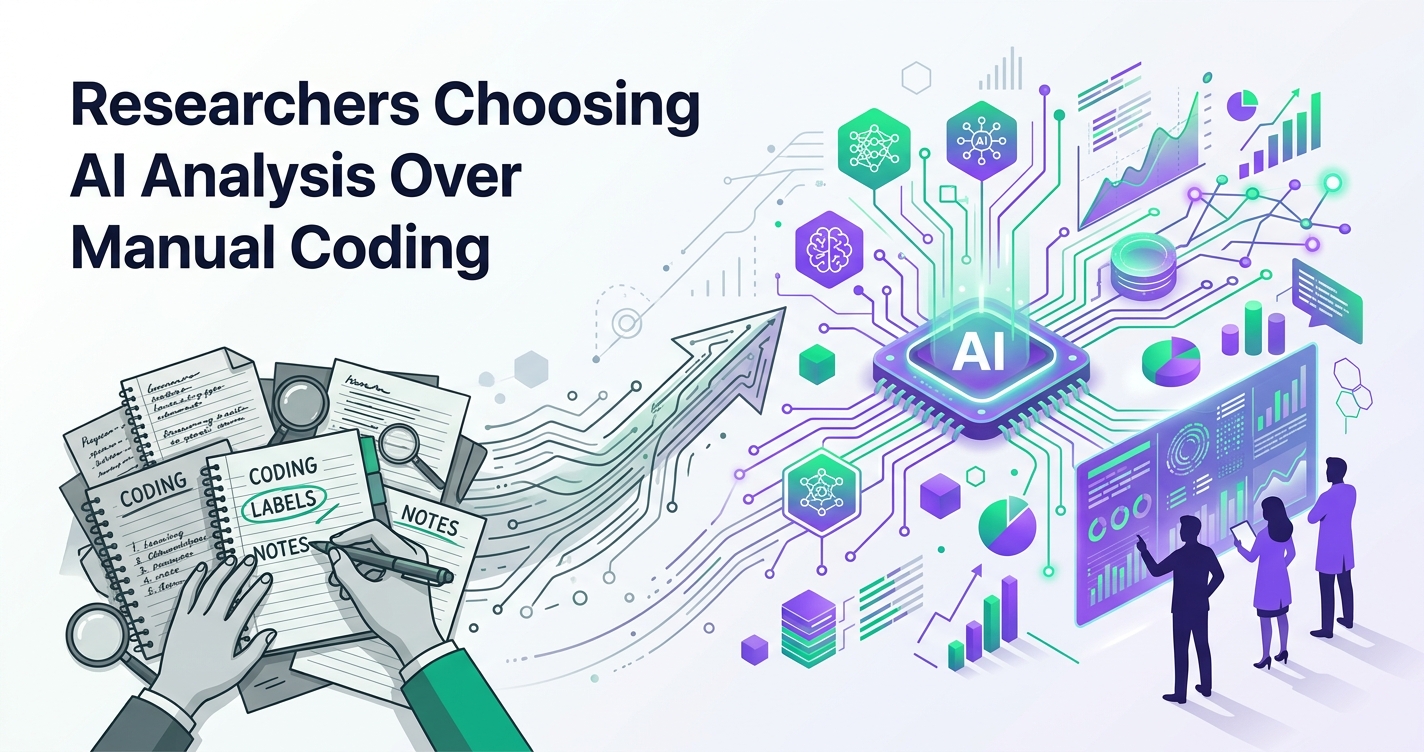
AI-powered analysis eliminates the need for these compromises. It codes every response, systematically, at a fraction of the time and cost of manual approaches.
What Open-Ended Survey Data Actually Contains
To understand why proper analysis of open-ended responses matters, consider what this data typically reveals that structured questions miss.
Explanatory context. A satisfaction survey shows that 34% of users rated the onboarding experience as "poor." The open-ended responses reveal that the dissatisfaction clusters around three specific issues: confusing terminology in step 3, a broken link in the welcome email, and unclear expectations about time commitment. The quantitative data identifies a problem. The qualitative data identifies solutions.
Unanticipated themes. Structured survey questions can only measure what you thought to ask about. Open-ended responses surface issues that were not on your radar. A product feedback survey might reveal that users are repurposing the tool in ways the design team never intended — information that could drive the next product roadmap.
Emotional intensity. Likert scales flatten experience into numbers. A rating of "1" could mean mild disappointment or genuine outrage. Open-ended responses carry tone, emphasis, and emotional weight that inform how urgently a finding should be acted upon.
Subgroup differences. When analyzed properly, open-ended responses reveal how different populations experience the same phenomenon differently. First-generation college students describe academic advising in fundamentally different terms than students whose parents attended college. These differences are invisible in aggregate quantitative scores.
All of this insight is available in the data. The only question is whether anyone analyzes it.
Why Manual Coding Fails for Survey Data
Manual qualitative coding was developed for interview transcripts — 15-30 documents of 5,000-10,000 words each. It works reasonably well at that scale. Survey data presents a fundamentally different challenge.
Volume overwhelms human capacity. A 1,000-respondent survey with four open-ended questions produces 4,000 individual text responses. Even if each response averages only 30 words, that is 120,000 words of text to code. At a manual coding rate of approximately 2,000 words per hour for short-text responses, the coding alone takes 60 hours. Most research teams simply do not have that time.
Short responses resist traditional coding. Interview transcripts contain extended narratives that lend themselves to passage-level coding. Survey responses are typically 1-3 sentences. They require a different coding approach — one that captures the core meaning of brief statements rather than segmenting long passages. Manual coders trained on interview data often struggle with this shift.
Cross-question synthesis is manually intractable. The most valuable analysis of open-ended survey data looks at patterns across questions: how does what a respondent said about their experience relate to what they said about their suggestions for improvement? Tracking these cross-question patterns across hundreds of respondents is a cognitive task that exceeds human working memory. Researchers end up analyzing each question in isolation, missing the relational insights.
Traditional alternatives are superficial. The most common approaches to open-ended survey analysis — word clouds, frequency counts, and keyword searches — share a fundamental flaw: they treat text as a collection of words rather than as meaningful statements. A word cloud of customer feedback might show that "wait" and "time" are frequent terms, but it cannot distinguish between "the wait time was reasonable" and "the wait time was unacceptable." These approaches create the appearance of analysis without the substance.
The result is that most open-ended survey data receives either no analysis or inadequate analysis. Researchers and organizations are collecting qualitative data, paying for it in survey length and respondent burden, and then leaving most of its value on the table. The hidden cost of unanalyzed qualitative data compounds across every survey cycle.
How AI Analysis Transforms Survey Data
AI-powered qualitative analysis handles survey data in a way that is fundamentally different from both manual coding and traditional text analytics. Here is what the process looks like.
Systematic Theme Extraction
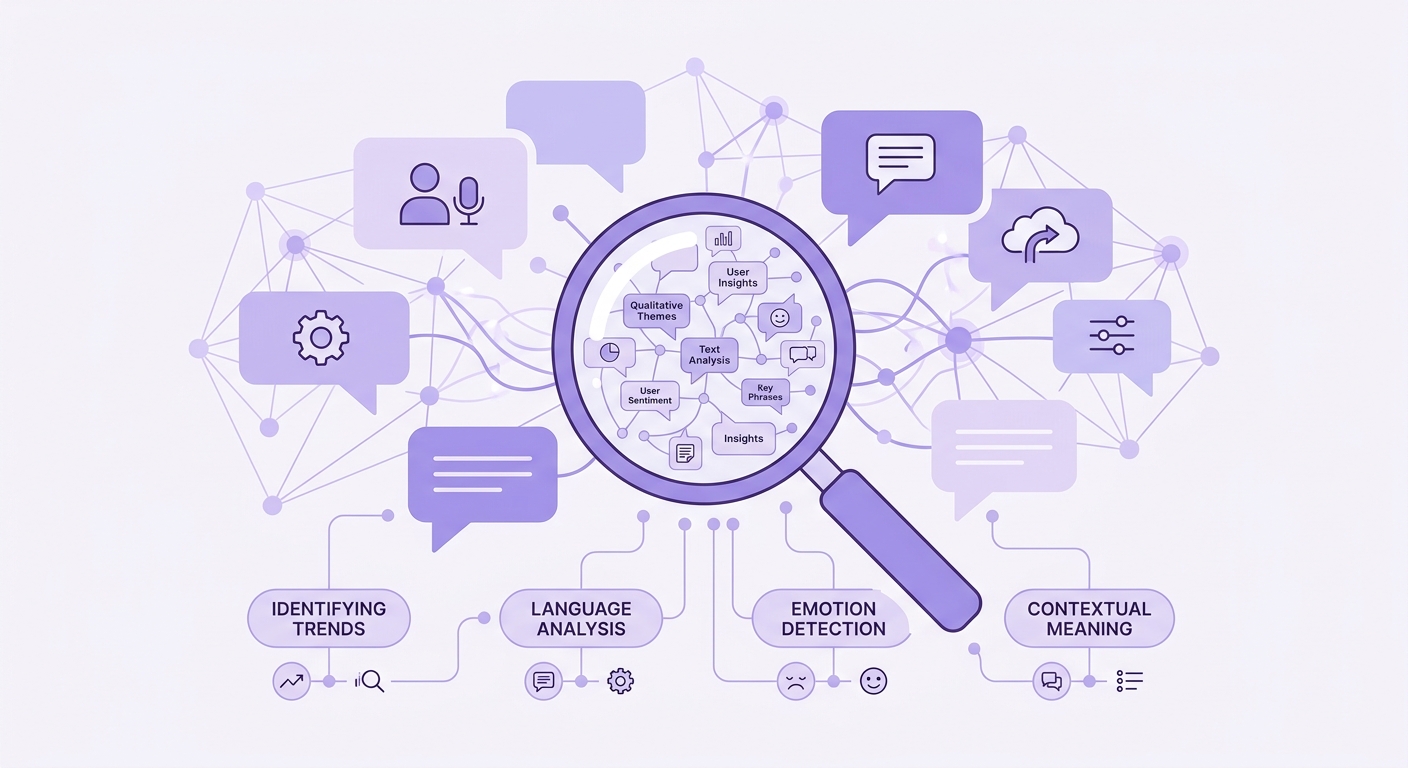
The AI reads every open-ended response in the dataset — all 1,500 or 4,000 or 10,000 of them — and identifies thematic patterns. Not keyword frequencies, but semantic themes: what are respondents actually talking about, and how do related responses cluster together?
For a customer experience survey, the AI might identify themes like "onboarding confusion," "feature discovery," "support responsiveness," "pricing perception," and "competitor comparison." Each theme is defined by the meaning of the responses, not by shared keywords. A response saying "I had no idea how to get started" and a response saying "the setup process needs better documentation" are recognized as expressing the same theme, even though they share no significant words.
This thematic extraction is exhaustive. Every response is assigned to one or more themes. No data is left uncoded. And the themes emerge from the data itself rather than being imposed by a predetermined codebook, making this an inductive approach that aligns with established qualitative methodology.
Sentiment and Intensity Patterns
Beyond thematic coding, AI analysis captures the emotional dimension of responses. This goes well beyond simple positive/negative sentiment classification.
The system identifies intensity — distinguishing between mild satisfaction and enthusiastic advocacy, between minor frustration and genuine anger. It recognizes ambivalence — responses that contain both positive and negative elements. And it maps sentiment against themes, showing that respondents are generally positive about the product's core functionality but consistently negative about the billing experience.
This sentiment mapping provides the emotional context that quantitative satisfaction scores flatten out. When you can show that 85% of negative open-ended responses cluster around two specific themes, and that the emotional intensity of those responses is significantly higher than other negative feedback, you have actionable intelligence that a satisfaction score alone cannot provide.
Cross-Question Synthesis
This is where AI analysis provides capabilities that manual coding cannot practically match. The system analyzes relationships between responses across different open-ended questions within the same survey.
A respondent who describes a frustrating onboarding experience in Question 3 and suggests "better tutorials" in Question 7 is expressing a coherent narrative. A respondent who praises the product in Question 3 but writes "I would not recommend it to a colleague" in Question 7 is revealing a disconnect that warrants investigation. These cross-question patterns are invisible when each question is analyzed in isolation.
For academic researchers conducting survey-based studies, this cross-question synthesis is particularly powerful. It transforms a collection of discrete response sets into an integrated qualitative dataset where each respondent's full narrative is preserved and analyzed.
Subgroup Comparisons
When survey data includes demographic or segmentation variables, AI analysis can compare thematic patterns across subgroups. How do themes differ between first-time users and experienced users? Between respondents in different geographic regions? Between those who gave high satisfaction scores and those who gave low ones?
These comparisons, which would require separate manual coding passes for each subgroup, happen simultaneously in AI analysis. The result is a rich, multidimensional picture of how different populations experience and describe the same phenomenon — exactly the kind of analysis that produces publishable findings in academic research and actionable insights in applied research.
Practical Comparison: AI vs. Traditional Approaches
For researchers evaluating whether to adopt AI analysis for their survey data, here is how it compares against the common alternatives.
AI analysis vs. manual coding: AI is faster by an order of magnitude (hours vs. weeks) and more consistent (no coder fatigue or drift). Manual coding offers more researcher control over individual coding decisions but cannot match AI's exhaustiveness at survey scale. The optimal approach: use AI for initial systematic coding, then apply researcher judgment to refine and interpret.
AI analysis vs. word clouds and frequency counts: There is no comparison. Word clouds are visualization tools, not analytical methods. They cannot distinguish meaning, identify themes, or track patterns across respondents. AI analysis does all of these things. If you are currently relying on word clouds for open-ended survey data, you are leaving the vast majority of insight untouched.
AI analysis vs. hand-coding in Excel: Many researchers code open-ended responses in spreadsheets — reading each response, typing a code in an adjacent column, then using pivot tables to count code frequencies. This approach is systematic but painfully slow and limited to single-question analysis. AI analysis produces richer coding, handles cross-question synthesis, and scales to any dataset size.
AI analysis vs. text analytics software: Traditional text analytics tools (keyword extraction, topic modeling, NLP-based classification) are more sophisticated than word clouds but still operate at the word and phrase level rather than the meaning level. AI-powered qualitative analysis understands semantic content, handles negation and context, and produces thematic structures that align with how qualitative researchers think about data.
What This Means for Research Design
When open-ended survey data can be analyzed properly, it changes how researchers design surveys.
More open-ended questions, strategically placed. Instead of limiting open text fields to avoid creating unanalyzable data, researchers can include open-ended questions wherever qualitative depth would add value. After each scale item, after each section, and as standalone exploratory questions.
Genuine mixed methods within a single instrument. A survey can serve as both a quantitative and qualitative data collection tool when the open-ended responses receive real analysis. This creates opportunities for mixed-methods research designs that are more integrated and more efficient than traditional separate-instrument approaches.
Larger samples become qualitatively analyzable. A survey of 5,000 respondents no longer means choosing between quantitative analysis of the full sample and qualitative analysis of a subsample. AI-powered coding makes it feasible to analyze all open-ended responses from the full sample, producing qualitative findings with the same representativeness as the quantitative results.
Longitudinal comparison becomes practical. When an annual survey produces thousands of open-ended responses each year, AI analysis can systematically compare themes across waves — tracking how the qualitative landscape shifts over time. This kind of longitudinal qualitative analysis is essentially impossible with manual methods at survey scale.
Getting Started
If you have survey data with open-ended responses that have not been fully analyzed — or that were analyzed with word clouds and gut feelings — AI-powered analysis can extract the insights that are already sitting in your data.
The starting point is straightforward. Upload your response data. Let the AI identify themes, patterns, and sentiment across the full dataset. Review the results against your own reading of the data. Refine the thematic structure based on your research knowledge. Use the synthesized findings to complement your quantitative analysis.
For academic researchers, the analytical outputs — coded responses, thematic hierarchies, cross-question patterns, subgroup comparisons — translate directly into publication-ready findings sections. For applied researchers, the same outputs inform strategic decisions, program improvements, and stakeholder reports.
Book an information session to see how AI analysis handles open-ended survey data at your scale. Bring a dataset if you have one — the most convincing demonstration is seeing your own data analyzed.
The open-ended questions in your surveys were designed to capture what structured questions cannot. It is time to actually analyze what your respondents told you.