Every researcher who has analyzed open-ended survey responses knows the frustration. Someone writes "the onboarding process was confusing" and you want to ask: which part? What did you try first? What would have helped? But the survey has already moved on to the next question. The moment of potential insight evaporates because the instrument was not designed to follow up.
This is the fundamental limitation of static surveys. They collect breadth efficiently but sacrifice depth by design. Every respondent answers the same questions in the same order regardless of what they say. The person who mentions a critical usability issue gets the same next question as the person who says everything was fine. The survey treats every response as equal because it cannot distinguish between a routine answer and one that deserves exploration.
Traditional interviews solve this problem — a skilled interviewer follows interesting threads, probes vague answers, and adapts the conversation based on what the participant reveals. But interviews do not scale. You can survey 1,000 people or interview 20. You cannot do both. Until now.
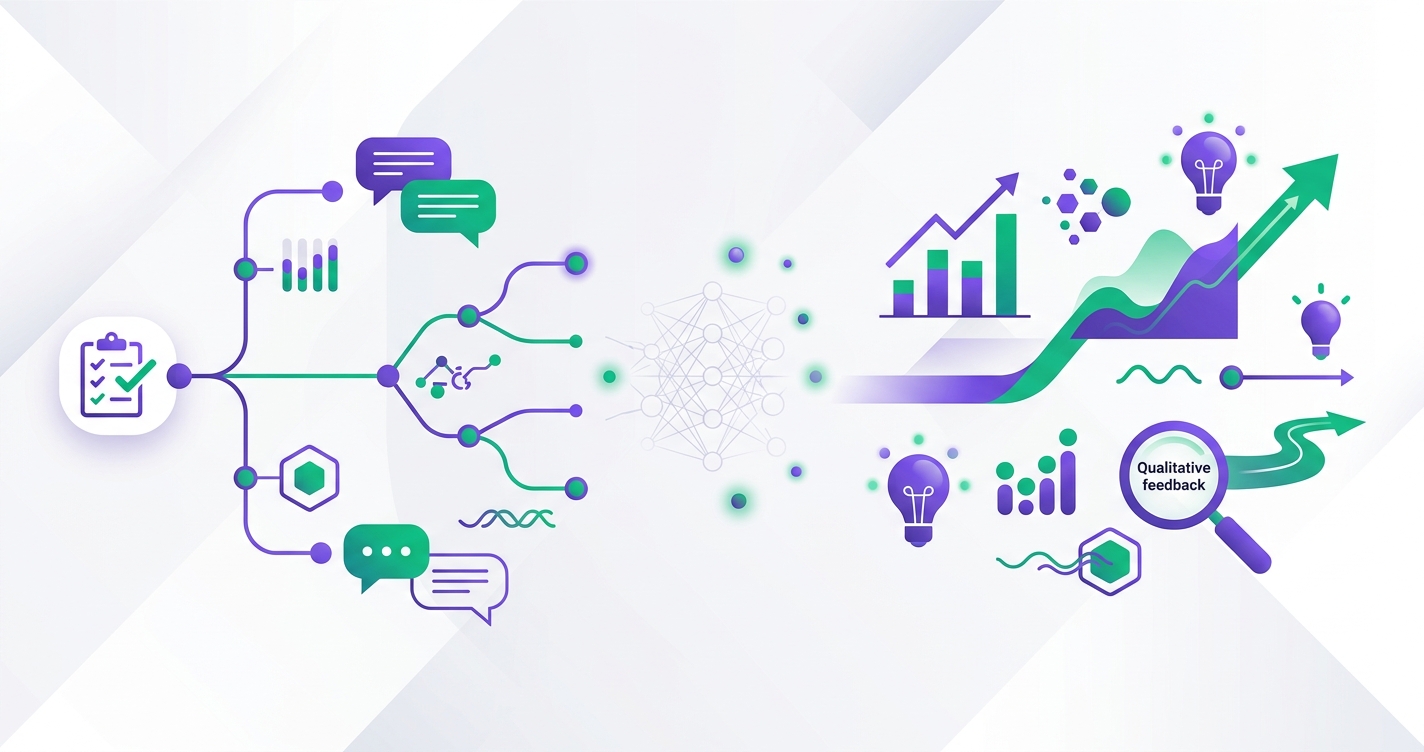
AI-powered dynamic surveys occupy the space between these two methods. They combine the scalability and asynchronous convenience of surveys with the adaptive, follow-up capability of interviews. The result is a research instrument that reaches hundreds or thousands of participants while treating each conversation as a unique path through your research questions.
What Makes a Survey "Dynamic"
A dynamic survey is not just a survey with branching logic. Branching logic — skip patterns, conditional questions, routing based on multiple-choice answers — has existed for decades. It is useful but limited because the branches are predefined by the researcher. You can route someone who selects "dissatisfied" to a different question than someone who selects "satisfied," but you cannot adapt to the substance of a free-text response.
AI-powered dynamic surveys go further. They read and interpret each response in real time, then generate contextually relevant follow-up questions. The difference is fundamental:
Static survey with branching logic: "How satisfied are you with our product?" → If dissatisfied → "What aspects were you most dissatisfied with?" (predetermined)
Dynamic AI survey: "Tell me about your experience with our product." → Respondent writes about struggling with data export → AI follows up: "You mentioned difficulty with data export. Can you walk me through what you were trying to export and where the process broke down?" → Respondent explains the specific workflow → AI probes: "How did you work around this? Did you find an alternative approach or was this a blocker?"
The dynamic survey does not just categorize the response — it engages with its content. Each participant's experience generates a unique conversational path through the research topic. The result is qualitative depth at quantitative scale.
This approach builds on the fundamental insight that dynamic surveys outperform static ones in both participant engagement and data quality — but the design process requires a different mindset than traditional survey construction.
Designing Your First Dynamic Survey
Step 1: Define Your Research Questions, Not Your Survey Questions
This is the most important shift in thinking. In traditional survey design, you write the exact questions participants will see. In dynamic survey design, you define the research questions you want answered and the topics you want explored — then configure the AI to pursue those topics through natural conversation.
Start by listing 3-5 core research questions. For example, a UX research study might have:
- What is the user's current workflow for [task]?
- Where do they experience friction or frustration?
- What workarounds have they developed?
- What would their ideal solution look like?
- What has prevented them from adopting alternatives?
These research questions become the AI's conversational objectives — not a fixed sequence of prompts, but a set of topics the system ensures it covers while allowing the conversation to flow naturally.
Step 2: Write Opening Prompts That Invite Narrative
The opening question in a dynamic survey matters more than in a static survey because it sets the conversational tone. Participants need to understand that this is not a checkbox exercise — their responses will be engaged with.
Weak opening: "Rate your satisfaction with our onboarding process on a scale of 1-10."
Strong opening: "Think back to your first week using our platform. Walk me through what that experience was like — what went smoothly and where you got stuck."
The strong opening invites narrative. It gives the participant permission to tell a story rather than select a category. The AI then has rich material to follow up on. This approach aligns with the broader shift from structured interrogation to conversational research that is reshaping qualitative methodology.
Step 3: Configure Follow-Up Depth and Boundaries
Dynamic surveys need guardrails. Without configuration, the AI might probe endlessly on one topic while neglecting others, or follow tangential threads that are interesting but irrelevant to your research questions.
Key configuration decisions:
Maximum follow-ups per topic: How many probing questions should the AI ask before moving on? Two to three follow-ups per topic is usually sufficient to extract meaningful detail without fatiguing participants.
Required topics: Which research questions must be covered in every conversation? Mark these as required to ensure the AI does not get so absorbed in one interesting thread that it skips a core topic.
Depth triggers: What kinds of responses should prompt deeper probing? Configure the AI to recognize mentions of workarounds, emotional language, comparisons to alternatives, or specific feature references as signals to probe further.
Boundary conditions: What topics should the AI not pursue? If your research is focused on product experience, you may want to prevent the AI from following threads about pricing, competitor comparisons, or other areas that are outside scope or commercially sensitive.
Step 4: Calibrate Length and Participant Experience
Participant fatigue is real, and dynamic surveys carry a unique risk: because the conversation adapts, engaged participants may receive more follow-ups than disengaged ones. This can create a perverse incentive where the most thoughtful respondents have the longest experience.
Design for a target completion time of 8-15 minutes. This is long enough to achieve meaningful depth but short enough to maintain quality responses. Configure the AI to monitor conversation length and begin wrapping up after the target time, even if not all topics have been exhausted.
Consider signaling progress to participants: "I have two more areas I would like to explore with you" helps them calibrate their effort. This transparency improves response quality in the final sections of the conversation.
Step 5: Pilot With a Small Sample
Before deploying at scale, run your dynamic survey with 10-15 participants from your target population. Review the transcripts for:
- Follow-up quality: Are the AI's probing questions relevant and natural? Do they feel like a conversation or an interrogation?
- Topic coverage: Is the AI successfully covering all required research questions? Is it spending too long on any one topic?
- Participant experience: Do participants engage deeply or give short answers? Do any drop off at specific points?
- Data quality: Are the responses producing the kind of insight you need to answer your research questions?
Adjust your configuration based on the pilot. Refine opening questions, recalibrate follow-up depth, and tune boundary conditions. This iteration step is where the difference between a mediocre dynamic survey and an excellent one is determined.
Deploying at Scale
Once your pilot confirms the design, deployment is straightforward but requires attention to a few scale-specific considerations.
Distribution Strategy
Dynamic surveys can be distributed through the same channels as static surveys — email, in-app prompts, SMS, QR codes, social media. But the framing matters more. A link that says "Take our 5-minute survey" sets different expectations than "Share your experience in a brief conversation about [topic]."
The conversational framing increases engagement because it signals that responses will be individually acknowledged rather than aggregated into a spreadsheet. Participants who understand that their specific answers will generate follow-ups tend to provide richer initial responses.
Sample Management
At scale, you need to monitor response rates and completion rates in real time. Dynamic surveys typically see higher completion rates than static surveys — participants who start a conversation tend to finish it because the adaptive format feels more engaging than a fixed question list. But monitor for segments with lower engagement and adjust distribution messaging if needed.
If your research requires specific demographic or segment quotas, build screening into the early conversation rather than using a separate screener survey. The AI can naturally establish relevant participant characteristics through conversational questions before transitioning to the research topics.
Parallel Deployment Across Segments
One of the most powerful aspects of dynamic surveys is the ability to deploy tailored versions across multiple segments simultaneously. A market research firm studying product perception can deploy:
- A version for current customers that probes usage patterns and satisfaction
- A version for churned customers that explores reasons for leaving
- A version for prospects that investigates awareness and consideration factors
- A version for competitor users that examines comparative experience
Each version shares the same core research questions but adapts its conversational approach, language, and follow-up logic to the segment. The data flows into a unified analysis where cross-segment comparison becomes possible — exactly the kind of analysis that turns open-ended responses into structured insight at scale.
Analyzing Dynamic Survey Data
Dynamic surveys produce conversational transcripts, not tabular data. This is a feature, not a bug — but it requires an analytical approach different from traditional survey analysis.
Automated Thematic Analysis
AI-powered analysis platforms can process hundreds of dynamic survey transcripts simultaneously, applying multi-lens analysis that examines the data through multiple theoretical frameworks. A single dataset might be analyzed through a Jobs-to-Be-Done lens, a sentiment and emotion lens, and a narrative arc lens — each producing different but complementary insights.
This multi-lens approach is particularly powerful with dynamic survey data because the adaptive follow-ups produce richer material than static survey responses. When a participant has been probed on their workaround for a product limitation, the resulting transcript contains enough detail for the AI to accurately classify the underlying job-to-be-done, the emotional intensity of the frustration, and the narrative structure of the experience.
Quantifying Qualitative Patterns
With sufficient sample size — and dynamic surveys easily reach hundreds of participants — qualitative patterns become quantifiable. You can report that "73% of enterprise users described data export as a friction point, with 41% developing manual workarounds involving spreadsheet reformatting" rather than "several participants mentioned challenges with data export."
This quantification does not replace qualitative depth — it complements it. The numbers establish the prevalence and significance of a theme. The conversational transcripts provide the context, examples, and narratives that make the finding actionable. Researchers who understand how to move from manual coding to AI-assisted analysis find that dynamic survey data is particularly well-suited to this hybrid approach.
Common Mistakes to Avoid
Over-engineering the opening question. Keep it simple and open. Let the AI's follow-ups do the depth work.
Setting too many required topics. Five core topics is a practical maximum for a 10-15 minute conversation. More than that and the AI rushes through each one without achieving depth on any.
Ignoring the pilot. Dynamic surveys behave differently than you expect on paper. The pilot is where you discover that your brilliant opening question produces one-word answers, or that the AI consistently misinterprets a particular type of response.
Treating it as a survey with extra steps. Dynamic surveys are a different instrument. If you design them like surveys — closed questions, category-based routing, satisfaction scales — you get survey data with extra overhead. Design them like conversations and you get interview-quality data at survey scale.
Getting Started
If your research requires both the depth of interviews and the reach of surveys — whether for market research, UX studies, customer experience programs, or academic research — dynamic AI surveys are the practical solution to a tradeoff that has constrained qualitative research for decades.
The researchers and firms adopting this approach now are redefining what "sufficient evidence" looks like. Their findings are richer, their sample sizes are larger, and their recommendations are grounded in patterns visible only when you combine conversational depth with quantitative breadth.
Book an information session to see how AI-powered dynamic surveys work in practice. Bring a research question where you have been forced to choose between depth and scale — that tradeoff is exactly what this method eliminates.