The Deferral Default: Why Research Dies One Sprint at a Time
Nobody cancels the study. That's the part that makes this failure mode so hard to name.
The product manager doesn't say "we're not doing research on this." The research lead doesn't agree to skip it. What happens instead is a conversation that ends with "let's revisit at the next planning meeting" -- and then the decision gets made anyway, by the people in the room, with the information they have. By the time the study would have been finished, the feature is already in development. The research slot gets quietly repurposed. The finding that would have mattered lands three weeks after it could have changed anything.
This is the Deferral Default: research doesn't get killed, it gets deferred once per cycle until deferral becomes the standing answer, and the team collectively forgets that anyone ever decided it.
Two Clocks That No Longer Keep the Same Time
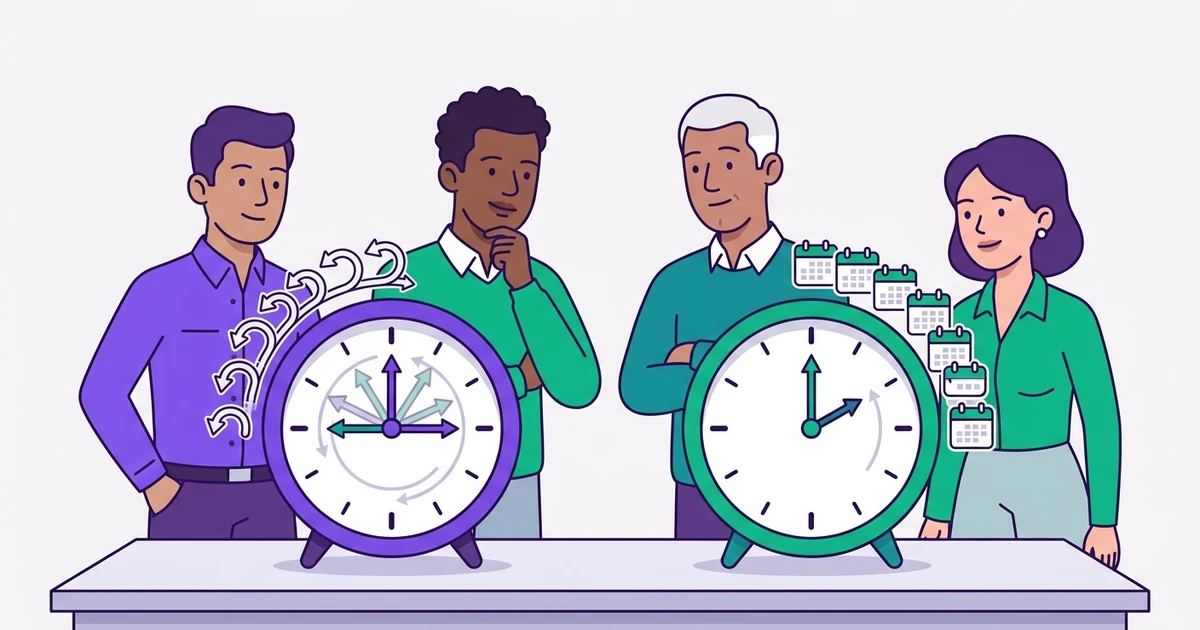
Every team that runs qualitative research is operating two separate clocks simultaneously, and most of them have never stated that plainly.
The decision clock runs in sprints and steering meetings. The cadence is two weeks, sometimes shorter. By the end of a sprint, something has been decided -- a scope got cut, a concept got chosen, a design direction got locked for dev handoff. That clock does not wait.
The research clock runs in recruitment, scheduling, moderation, transcription, analysis, and reporting. In a well-resourced team running a conventional qualitative study, that sequence takes three to six weeks. In a leaner setup, with slower panel response or heavier synthesis demands, it can run longer.
The arithmetic is the problem. A study that would inform a decision being made in sprint four cannot be commissioned in sprint three and expect to land in time. So the team defers it to sprint five. But sprint five has its own decisions already queued. So it defers again. And again. And the gap between when research is needed and when it arrives grows so familiar that nobody marks it as a failure anymore. It just feels like how things are.
This is what makes the Deferral Default different from a budget problem or a buy-in problem. Those are downstream explanations -- stories teams tell after the pattern is already established. The upstream cause is purely mechanical: the research clock and the decision clock are running at incompatible speeds, and nobody has been tasked with measuring the difference.
Why "Deferral" Is the Precise Word
Most post-mortems on skipped research reach for explanations like stakeholder resistance, resource constraints, or a culture that doesn't value qualitative work. Those explanations feel plausible because they are sometimes true. But they misidentify the sequence.
A team that genuinely doesn't value research cancels studies explicitly. What you see in most organizations is something subtler: the research is valued in the abstract and deferred in the specific. The same stakeholders who agree, after the fact, that it would have been good to talk to users are the ones who could not wait three weeks for the results. Both things are true simultaneously. The problem isn't that they don't care -- it's that caring doesn't override the calendar.
Deferral is also distinct from deprioritization. When something is deprioritized, it goes below the line on a ranked list and waits for capacity. When something is deferred, it stays on the list at nominal priority but gets bumped each cycle for scheduling reasons. The psychological difference matters: deferred work still feels like it's happening, which is precisely why the pattern persists unexamined. The team believes the research is coming. It just keeps not arriving.
The connection here to the insight half-life problem is worth naming directly. As we explored in The Insight Half-Life Problem, findings don't just arrive late -- they arrive into a context that has already shifted. By the time a deferred study reports out, the decision it was meant to inform has often been succeeded by two more decisions downstream. The finding is accurate but no longer actionable.
What Commissioning Behavior Actually Looks Like at Different Latencies
Here is a concrete pattern that plays out across teams of very different sizes and sectors.
A study that can be commissioned today and return findings in four days gets commissioned. The decision is close enough that the results will still matter. The team can hold the decision briefly or accept the small risk that the study arrives slightly after the fact. Either way, someone hits go.
A study that returns in five weeks gets discussed. It goes into a planning document. Someone notes that it should inform the next big initiative. It comes up in the next research roadmap review. It is not commissioned. Not because anyone decided against it -- but because five weeks from now is not a real planning horizon for teams making weekly decisions.
The threshold between "gets commissioned" and "gets discussed" is somewhere around two to three weeks for most product teams. Studies below that threshold get run. Studies above it get deferred, and the Deferral Default takes hold.
This means that every insight generated by a slow research process competes not just with other priorities, but with the team's implicit commissioning horizon. Teams don't calculate this consciously. They feel it. A proposal for a three-week study produces an immediate, often unspoken question: will the results actually change anything by the time they land? When the honest answer is "probably not," the study goes back into the queue.
This is also why the usual interventions fail. Presenting the business case for research investment does not close the clock gap. Winning a seat at the planning table does not close the clock gap. Adding a research headcount does not close the clock gap, unless that headcount can also run faster studies. As we described in The Insight Latency Tax in 2026, the cost of late insight is not theoretical -- it compounds with every cycle a decision gets made without it.
The Mechanism Teams Miss
The Deferral Default is a latency problem that presents as a prioritization problem. That misdiagnosis is what keeps it from getting fixed.
Teams that believe they have a prioritization problem create frameworks: research intake processes, scoring rubrics, impact matrices. These tools are useful. They are not sufficient. A perfectly prioritized study that takes five weeks still misses the window. The intake process becomes a place where studies get formally acknowledged and informally deferred.
The mechanism is actually simpler than any framework. Every research study has a half-life of commissioning opportunity -- a window during which the findings will still be relevant to the decision they were designed to inform. Once the decision clock advances past that window, the study stops being a candidate for commissioning and starts being a candidate for the next cycle. If the research clock is longer than the commissioning window on most studies, studies consistently don't get commissioned. That is the Deferral Default.
There is a structural parallel worth noting here: in AI systems, a similar pattern plays out when retrieval freshness lags behind the rate at which underlying data changes. As the team at bigyan.dev described in The Retrieval Freshness Problem in Enterprise RAG, a system whose index silently rots while dashboards stay green is operationally dangerous precisely because the failure is invisible. Research teams face the same invisible rot: the gap between what the team knows and what it needs to know widens every sprint, but no dashboard turns red.
The Counter-Practice: Measure the Gap First
Most insights teams have never measured the gap between their two clocks in their own organization. Not roughly, not precisely -- not at all. They know the research clock is slow, and they know decisions happen fast, but they have not sat down with the last twelve months of study data and asked: what was the average time between "study commissioned" and "findings reported"? What was the average time between "decision question identified" and "decision made"? How often did those two timelines overlap?
That measurement is the starting point. Without it, any improvement effort is guessing.
Once the gap is visible, the lever to pull is reducing the research clock -- not by compressing rigor, but by removing the latency that accumulates between stages. Recruitment delay is typically the largest single source. Scheduling friction between recruitment and moderation is the second. Transcription and initial synthesis are the third. Any process change or tooling investment that shortens those three stages shortens the research clock in a way that directly expands the commissioning window.
The connection to the research debt spiral is direct. As we examined in The Research Debt Spiral, unanalyzed studies accumulate and devalue -- and the Deferral Default accelerates that accumulation by ensuring that even the studies that do get commissioned are racing against an already-elapsed decision clock. Speed of delivery is not a luxury feature of a research program. It is the condition under which research gets commissioned in the first place.
It's also worth flagging what The Stakeholder Question Injection Problem describes from the opposite direction: when studies do get commissioned under time pressure, stakeholders often load them with injected questions that extend the timeline further -- which pushes future studies back over the deferral threshold. The two failure modes feed each other.
Practical Takeaways
- Measure your two clocks before doing anything else. Pull the last ten studies. Record the date each was commissioned and the date findings were delivered. Then map that against the decision dates those studies were meant to inform. The overlap -- or lack of it -- is your actual problem statement.
- Identify your commissioning threshold. Ask your product and design partners honestly: what's the longest turnaround on a study that would still change your decision? That number is the target your research clock needs to beat, not an aspirational goal.
- Audit where your research clock loses time. For most teams, the three biggest sources of latency are recruitment, scheduling, and synthesis. Quantify each stage across your last several studies. Fix the biggest one first.
- Name the Deferral Default in your next planning conversation. Call the pattern by its name. "This is the third sprint we've discussed this study without commissioning it" is a more productive framing than "we need more research buy-in."
- Separate study size from study speed. Not every question requires a six-week study. Map your recurring research questions against the minimum viable methodology that would answer them. Some questions that are currently getting full-scale studies could be answered faster with a tighter design.
- Track deferrals explicitly. Add a column to your research backlog that counts how many times each study has been deferred. When a study hits three deferrals, treat that as a signal to either accelerate it or formally close the question another way -- not to defer it again.
- Report latency as a team metric, not just study quality. Researchers are accustomed to reporting on the rigor of their work. Start also reporting average time from commission to delivery, and track whether that number is improving. Make the clock gap visible to the people who keep deferring.
If your team is running the Deferral Default and wants to understand what a faster research clock actually looks like in practice, book a session with the Qualz team to walk through your current workflow and find where the time is going.