The Bandwidth Problem No One Solved
Consumer packaged goods companies face a research paradox. The number of products in development has exploded -- line extensions, reformulations, regional variants, entirely new categories. Meanwhile, the qualitative research capacity within most CPG organizations has stayed flat or shrunk. The math does not work.
A mid-size CPG company might have 40-60 active projects moving through the innovation pipeline at any given time. Each one needs consumer input at multiple stages. Traditional qual -- recruiting panels, scheduling moderators, renting facilities, conducting 8-12 depth interviews per wave -- simply cannot cover the volume. So teams make hard choices: skip qual entirely for "lower risk" launches, rely on quant alone for concept screening, or compress timelines until the research is too rushed to be useful.
The result is predictable. Products reach market without adequate consumer understanding. The 2024 Innovation Edge data showed that CPG product failure rates have not meaningfully improved in a decade despite massive investment in analytics and testing infrastructure. The missing piece is not more data -- it is more depth, applied earlier and more broadly across the portfolio.
Patch Tests and Early-Stage Concept Validation
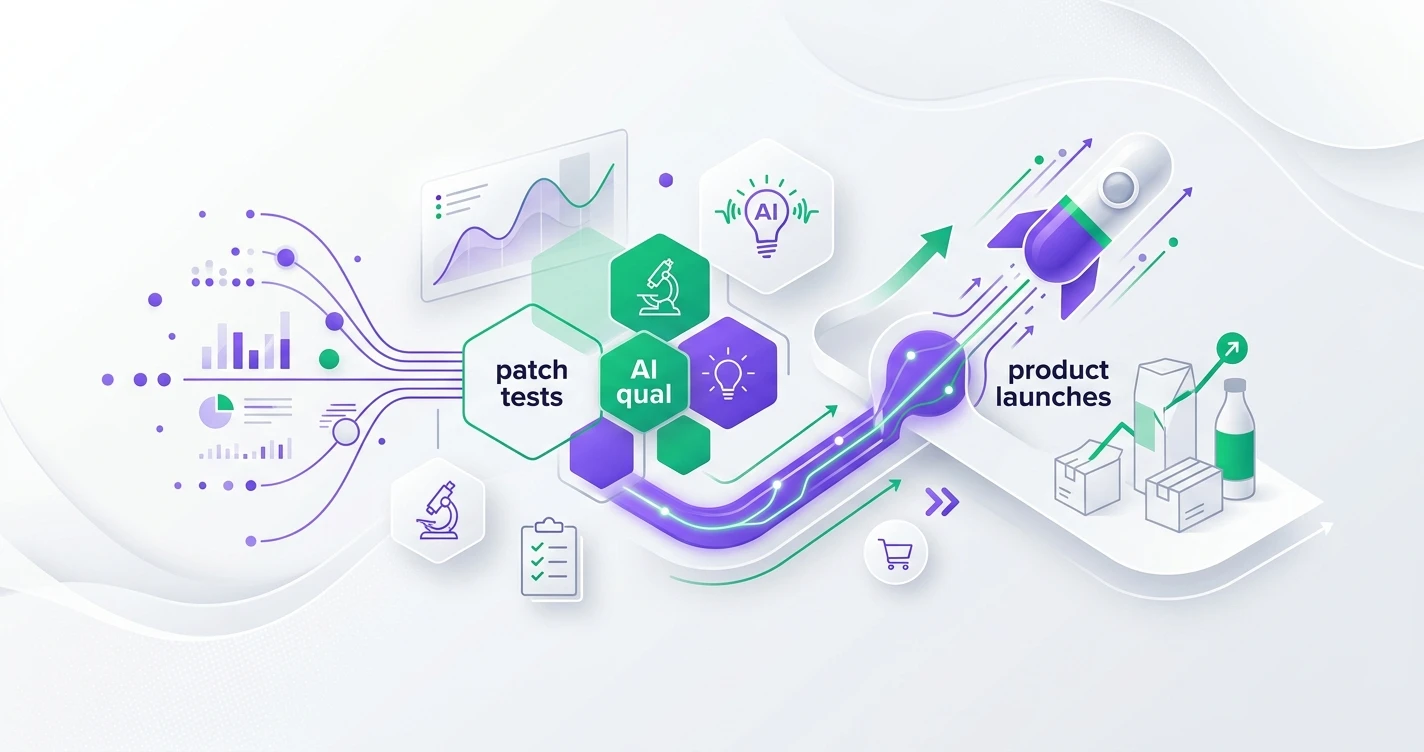
The earliest stage where AI qual is transforming CPG research is patch testing and initial concept screening. Traditionally, this phase involved either quantitative concept tests (fast but shallow) or small-scale qualitative sessions (deep but slow and expensive).
AI-moderated interviews occupy a space that did not previously exist: qualitative depth at quantitative speed. A CPG team can field 50-100 AI-moderated depth interviews across multiple consumer segments in the time it would take to schedule and conduct 8 traditional interviews with a single segment.
For patch tests specifically -- where companies need to understand skin feel, scent perception, texture response, and overall sensory experience -- the conversational format of AI interviews surfaces reactions that structured surveys miss entirely. Participants describe their experiences in natural language, and the AI moderator probes on specific sensory dimensions without leading. The principles of adaptive interviewing mean the conversation follows the participant's experience rather than forcing them through a rigid questionnaire.
This changes the economics of early-stage testing. Instead of choosing which three concepts get qualitative validation, teams can run qual against the full shortlist. Bad ideas die earlier. Promising directions get richer context faster.
Real Applications Across the CPG Lifecycle
Sensory Evaluation
Sensory research has historically required expensive specialized facilities and trained panels. AI qual does not replace instrumental sensory analysis, but it adds a consumer language layer that trained panels cannot provide. When real consumers describe a moisturizer as "heavy but not greasy" or a snack as "crunchy in a satisfying way, not a dry way," those distinctions drive packaging copy, positioning, and formulation priorities.
AI interviews excel here because they can show visual stimuli -- product images, texture close-ups, usage context photos -- and ask participants to react in real time. The stimulus-based research methodology translates directly to CPG sensory work, where showing is as important as asking.
Packaging Preference
Packaging research is one of the clearest wins for AI qual in CPG. Teams can present multiple packaging mockups within a single interview, probe on shelf presence, brand perception, sustainability signals, and purchase intent -- all while maintaining conversational depth.
The scale advantage matters here. Packaging preference varies dramatically by demographic, region, and retail context. A traditional qual study might test three designs with one segment. AI qual can test six designs across four segments simultaneously, surfacing the interaction effects between design elements and consumer profiles that single-segment studies miss entirely.
Ingredient Perception and Clean Label
The clean label movement has made ingredient communication a strategic battleground. Consumers have strong but often contradictory reactions to ingredient lists, "free from" claims, and processing language. AI interviews can probe these reactions with nuance -- understanding not just preference but the reasoning and emotional associations behind ingredient perceptions.
This is territory where concept testing through AI interviews shines. Teams can test multiple claim framings ("made with" versus "contains" versus "powered by") and understand how each lands with different consumer segments without the moderator fatigue that would compromise a traditional 12-interview study covering the same ground.
Brand Positioning
Repositioning or launching into a new category requires deep understanding of how consumers map the competitive landscape. AI qual enables broad exploratory research -- 50+ interviews across multiple segments -- to build a rich picture of category perceptions, unmet needs, and positioning white space before committing to a direction.
Fitting AI Qual Into the Stage-Gate Process
CPG innovation typically follows a stage-gate model: discovery, scoping, business case, development, testing, and launch. Traditional qual usually appears at one or two gates -- often too late to redirect fundamental decisions. AI qual changes the insertion points.
Discovery/Ideation. Run exploratory AI interviews with 30-50 consumers to understand unmet needs, usage occasions, and category frustrations. This replaces or supplements trend reports and social listening with direct consumer language. The approach mirrors how teams validate assumptions without full studies -- lightweight but rigorous.
Concept Screening. Test 5-10 initial concepts with AI qual across multiple segments. Kill weak concepts with evidence. Identify which elements of strong concepts resonate and why.
Development. Use AI interviews to evaluate prototypes, packaging directions, and claim language iteratively. Run a study every two weeks as the product evolves rather than waiting for a single make-or-break validation study.
Pre-Launch. Conduct launch readiness research across target markets simultaneously. Test final positioning, pricing perception, and purchase triggers with enough depth to inform go-to-market strategy.
Post-Launch. Deploy AI interviews within the first 30 days to understand early adopter experience, identify usage barriers, and surface word-of-mouth language for marketing optimization.
The key shift: qual is no longer a gate check. It becomes a continuous input across the entire development process.
Visual Stimuli and Product Experience Research
CPG research relies heavily on showing things to people -- products, packaging, shelf sets, advertisements, usage scenarios. AI-moderated interviews support visual stimulus presentation natively, which unlocks research designs that were previously only possible in-person or through expensive online qual platforms.
Teams are using this for:
- Shelf simulation -- showing planogram images and asking participants to describe what draws their attention, what they would pick up, and why
- Ad concept testing -- presenting storyboards or rough cuts and probing on message takeaway, emotional response, and brand attribution
- Unboxing and first-use reaction -- sending physical products to participants and conducting AI interviews during or immediately after first use
- Competitive comparison -- showing side-by-side product images and exploring perceptual differences
The visual research techniques developed in UX contexts translate directly to CPG stimulus-based research, with the added advantage that AI moderation removes the social desirability bias that creeps into live sessions when participants know a brand team is watching.
Scale: Multiple Segments, Simultaneously
This is where the economics of AI qual become transformative for CPG. Consumer packaged goods serve broad, heterogeneous populations. A single product might need to work for health-conscious millennials, price-sensitive families, and convenience-oriented Gen Z consumers -- each with different needs, language, and purchase triggers.
Traditional qual forces painful choices about which segments to study. Budget constraints typically limit research to one or two segments per wave. AI qual eliminates this constraint. Running 30 interviews each across five segments costs a fraction of what two segments would cost in traditional qual -- and the cross-segment analysis reveals patterns that single-segment studies cannot surface.
This matters enormously for global CPG companies managing regional launches. Testing a product concept across US, UK, German, and Japanese consumers simultaneously -- in their native languages, with culturally adapted stimuli -- was previously a six-figure, multi-month undertaking. The cross-cultural research capabilities of AI moderation compress this to weeks.
Speed: Days, Not Months
The traditional CPG qual timeline looks something like: two weeks for recruitment, one week for fieldwork, two weeks for analysis, one week for reporting. Six weeks minimum from brief to insight.
AI qual compresses this dramatically. Recruitment can happen in parallel with study design. Fieldwork (interviews) runs 24/7 as participants complete sessions on their own schedule -- the async research model means no scheduling bottleneck. Analysis begins immediately as transcripts flow in, with AI-powered thematic analysis surfacing initial patterns within hours.
Total timeline: 5-10 business days from brief to actionable insight. For CPG teams operating on tight development cycles with hard retail deadlines, this is the difference between having consumer input and not having it.
The Researcher's Evolving Role
AI qual does not eliminate the CPG researcher. It eliminates the least strategic parts of their job -- scheduling, moderating repetitive sessions, transcribing, initial coding -- and concentrates their time on the work that actually requires human judgment.
The shift is from moderator to strategist. Instead of personally conducting 12 interviews and hoping those 12 participants represent the full picture, the researcher designs studies that cover the relevant landscape, defines the analytical framework, interprets patterns across segments, and translates findings into business decisions.
This is a meaningful upgrade in organizational impact. A researcher who personally moderates can cover maybe 2-3 projects per month. A researcher who designs and interprets AI qual studies can cover 8-10 projects, each with broader coverage and faster delivery. The shift from research operations to strategic insight is not theoretical -- it is happening now in CPG organizations that have adopted AI qual at scale.
Getting Started
CPG teams adopting AI qual typically start with one of two entry points: either a high-volume program (like packaging testing across SKUs) where the scale advantage is immediately obvious, or a speed-critical project (like a competitive response launch) where the timeline compression justifies the new approach.
The critical success factor is not the technology -- it is study design. AI interviews are only as good as the discussion guide, stimulus materials, and analytical framework behind them. Researchers who invest in designing effective interview structures get dramatically better results than those who simply port their traditional guide into an AI format.
The CPG companies seeing the biggest returns are those treating AI qual not as a cheaper substitute for traditional research, but as a fundamentally different capability -- one that makes it economically rational to apply qualitative depth to decisions that previously got none.
Ready to explore how AI qual fits your CPG research program? Book an information session to discuss your specific use cases.