The Verbal Description Problem
Ask a participant to describe how they complete a complex workflow and you will receive a clean, logical narrative. Steps follow in sequence. Decisions appear rational. The account sounds coherent because verbal description forces coherence — language demands linear structure, and participants oblige by constructing post-hoc narratives that smooth over the actual chaos of lived experience.
This is not deception. It is the fundamental limitation of verbal self-report. Language is sequential and propositional. But skilled physical action is parallel, embodied, and largely pre-conscious. The gap between what people do and what they can say about what they do represents one of the deepest methodological challenges in qualitative research — what researchers call the articulation gap.
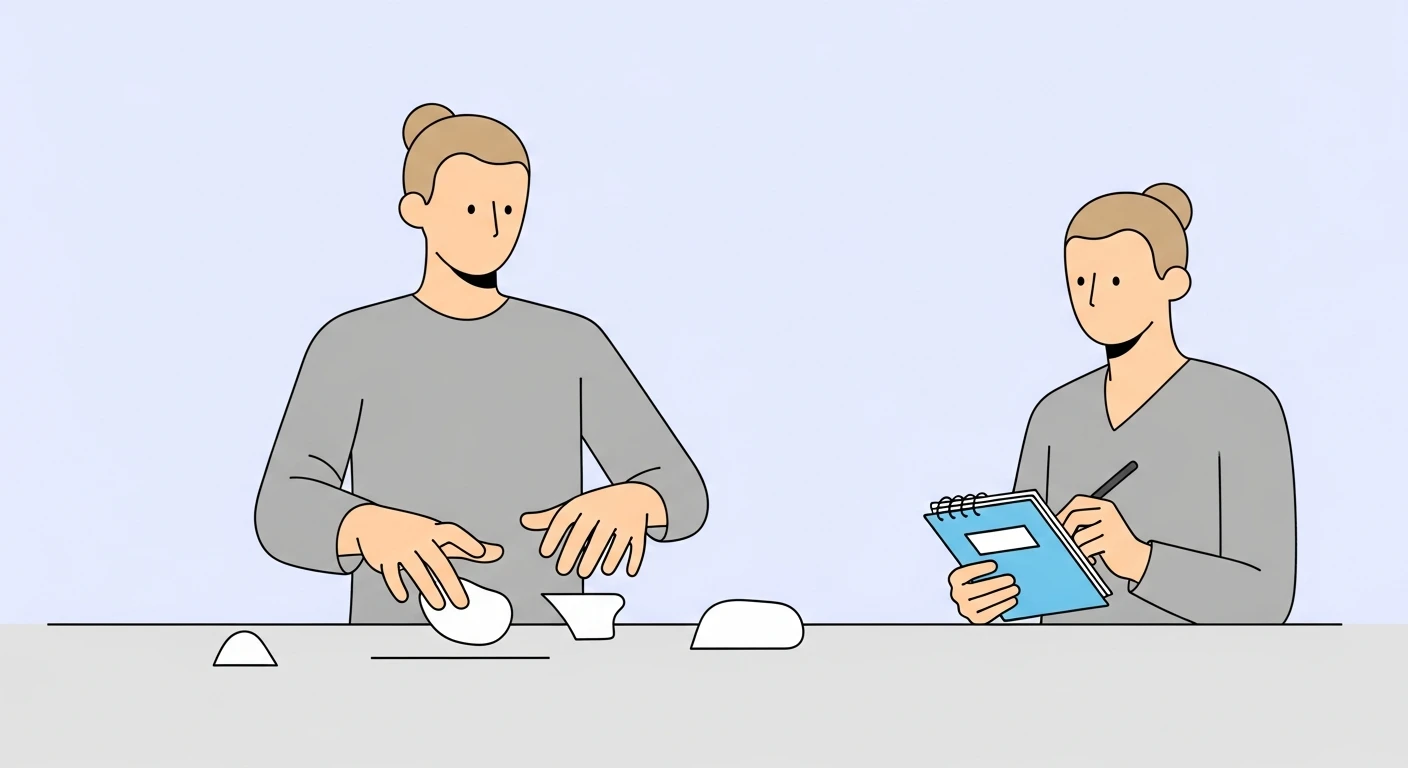
Embodied elicitation bypasses this limitation by asking participants to show rather than tell. The method treats the body as a research instrument, capable of revealing procedural knowledge, spatial relationships, temporal dynamics, and emotional associations that verbal interviews systematically miss.
Why Bodies Know More Than Words Can Say
Procedural Memory Lives in the Hands
Consider a surgeon describing how they tie a particular knot. Verbally, they might offer a vague "I loop it around and pull through." But hand them the suture material and their fingers execute a precise, multi-step procedure that reveals decision points, quality checks, and adaptive responses to material resistance that the verbal account entirely omitted.
The same principle applies to UX research. A product manager describing how they prioritize their backlog might say "I look at customer impact and effort." Ask them to physically walk through their actual prioritization with their real tools open, and you discover they actually start by checking which items their VP mentioned in the last meeting, then work backward to justify those selections with the framework they described.
This gap between described process and demonstrated process is not an edge case. Research consistently shows that expert practitioners cannot fully articulate their own expertise — it lives in embodied patterns that only become visible through physical performance.
Spatial Relationships Reveal Architecture
When participants physically arrange artifacts — sticky notes representing steps, cards representing people, objects representing tools — the spatial relationships they create reveal cognitive architecture that verbal description flattens.
A participant might describe their team communication as "pretty collaborative." But when asked to physically arrange cards representing team members to show information flow, they place three people tightly clustered and two others at the far edge of the table. The spatial arrangement contradicts the verbal claim without the participant even recognizing the discrepancy.
This technique connects to broader principles of visual elicitation using diagrams and artifacts, but embodied methods go further by recruiting proprioceptive and kinesthetic channels that even visual methods cannot access.
Temporal Micro-Dynamics Become Visible
Verbal descriptions compress time. A participant says "I check my notifications" as if it takes one second. Physical demonstration reveals: unlock phone, swipe past three notification categories, open app, scroll past irrelevant items, find the one relevant notification, tap it, wait for load, scan content, decide action. What was described as one step is actually twelve micro-decisions with distinct cognitive loads.
These temporal micro-dynamics are precisely where UX friction hides. The moments of hesitation, the repeated checking, the false starts — all invisible in verbal accounts but glaringly obvious in physical demonstration.
Methods for Embodied Elicitation
The Walk-Through Protocol
The most basic embodied method: ask participants to physically perform the workflow while you observe. Not describe it. Not recall it. Perform it, in their actual environment, with their actual tools.
Key differences from standard contextual inquiry:
- You explicitly ask them to narrate decision points as they encounter them (not before)
- You interrupt to ask "what just happened there?" at moments of hesitation or deviation
- You track the sequence of physical actions, not just the verbal commentary
- You note discrepancies between what the body does and what the mouth says
The critical insight is that physical performance activates procedural memory in ways that verbal recall cannot. As research on contextual activation through environmental triggers demonstrates, the physical environment itself serves as a memory cue that unlocks experiences inaccessible through abstract discussion.
Object Arrangement Exercises
Give participants physical objects and ask them to create spatial representations of abstract concepts:
- "Arrange these cards to show how information flows in your team"
- "Use these blocks to represent how important each tool is to your daily work"
- "Place yourself relative to these stakeholders based on how much influence you feel you have"
The physical act of arrangement forces decisions that verbal description allows to remain ambiguous. You cannot place a card both close and far from another card. The body must commit to a position that the mouth would hedge.
Gestural Analysis
Pay systematic attention to what participants do with their hands while speaking. Gesture research shows that hand movements often convey information that speech does not:
- Spatial gestures revealing mental models ("it goes up here, then branches out")
- Rhythmic gestures indicating emphasis patterns
- Object-manipulation gestures showing imagined tool interaction
- Self-touching gestures signaling discomfort or uncertainty
These gestural signals provide real-time validation or contradiction of verbal claims — the kind of multimodal data that AI tools built purely for text systematically miss.
Scenario Re-enactment
Ask participants to physically re-enact a specific recent experience rather than describing it abstractly:
- "Show me exactly what you did when that error message appeared"
- "Walk me through your morning routine with your actual devices"
- "Demonstrate how you explained this to your colleague"
Re-enactment recruits episodic memory more effectively than recall questions because it reactivates the sensorimotor traces associated with the original experience. The body remembers details the conscious mind has already discarded.
When Embodied Methods Are Most Valuable
Complex Multi-Tool Workflows
When participants use multiple tools in sequence, verbal descriptions inevitably omit transition costs, context-switching overhead, and the physical ergonomics of moving between interfaces. Only physical demonstration reveals these friction points.
Expert Domains
The more expertise a participant has, the more their knowledge is proceduralized and automatic — and the less accessible it is to verbal articulation. Embodied methods are essential for researching expert workflows precisely because expertise makes verbalization unreliable.
Emotional or Sensitive Topics
Physical demonstration can surface emotional responses that verbal discussion suppresses. A participant might say they "do not mind" a particular workflow, but their physical demonstration reveals sighing, eye-rolling, and aggressive clicking that tells a completely different story.
Collaborative Workflows
When research involves how people work together, physical demonstration with multiple participants (or role-playing with the researcher) reveals coordination mechanisms, power dynamics, and communication breakdowns that individual verbal accounts would never surface.
Practical Considerations
Recording and Analysis
Embodied elicitation sessions must be video recorded from multiple angles. Audio recording alone captures verbal commentary but loses the embodied data that makes this method valuable. Your analysis should systematically compare verbal claims with physical evidence, noting convergence and divergence.
This kind of multimodal evidence strengthens research triangulation across multiple data sources, providing richer validity than any single-modality method alone.
Participant Comfort
Not all participants are comfortable being physically observed. Build gradual engagement — start with hands-only demonstrations before moving to full workflow walk-throughs. Normalize the process by demonstrating something yourself first.
Remote Adaptation
In remote settings, embodied elicitation is constrained but not impossible. Screen-sharing with think-aloud captures some physical workflow data. Ask remote participants to use their phone camera to show their physical workspace setup, their desk arrangement, their note-taking systems.
Integration With AI Analysis
Current AI research tools process transcripts, not bodies. This means embodied elicitation data requires manual analytical attention that AI cannot (yet) provide. However, the verbal commentary generated during physical demonstrations often contains richer, more specific language than pure recall interviews — giving AI tools better raw material to work with even within their text-only limitations.
The Analytical Payoff
Researchers who integrate embodied elicitation into their practice consistently report three outcomes:
- Discovery of unknown workarounds — participants reveal compensatory behaviors they have so thoroughly internalized that verbal questions never surface them
- Identification of false consensus — physical demonstrations reveal that team members who describe "the same" workflow actually perform radically different procedures
- Richer design implications — because embodied data includes spatial, temporal, and physical constraint information, it translates more directly into design specifications than abstract verbal insights
The investment is primarily in session time and analysis complexity. But the return — accessing the 60% of user knowledge that lives below the threshold of verbal articulation — makes embodied elicitation one of the highest-leverage methodological additions a research practice can make.
The question is not whether your participants know more than they can say. They always do. The question is whether your methods are designed to access that knowledge, or whether you are content with the polished verbal summary that represents only a fraction of their actual experience.