The Productivity Trap
Research leaders face a paradox every performance review cycle. Their teams are busier than ever -- more studies, more interviews, more deliverables. Yet when executives question research ROI, these same leaders struggle to point to concrete business outcomes their work produced.
The problem is not lazy researchers or indifferent stakeholders. The problem is structural: career progression in most organizations rewards research volume, not research impact. A researcher who conducts 40 studies per year advances faster than one who conducts 8 studies that each reshape product strategy.
This creates a perverse incentive where the rational career move is always to start the next study rather than ensure the current one actually changes something.
How Volume Metrics Became Default
Research operations emerged to solve real coordination problems -- scheduling, recruitment, tool management. But as ResearchOps matured, it brought operational metrics that became proxies for team value. Studies completed per quarter. Average time from brief to delivery. Participant throughput. Cost per interview.
These metrics are easy to measure, easy to report upward, and easy to optimize. They also have nothing to do with whether research actually influences decisions. A team can hit every operational target while producing work that sits unread in a repository.
The research ops metrics that actually matter are the ones that track downstream action -- but those require cross-functional measurement systems most organizations lack.
The Career Ladder Problem
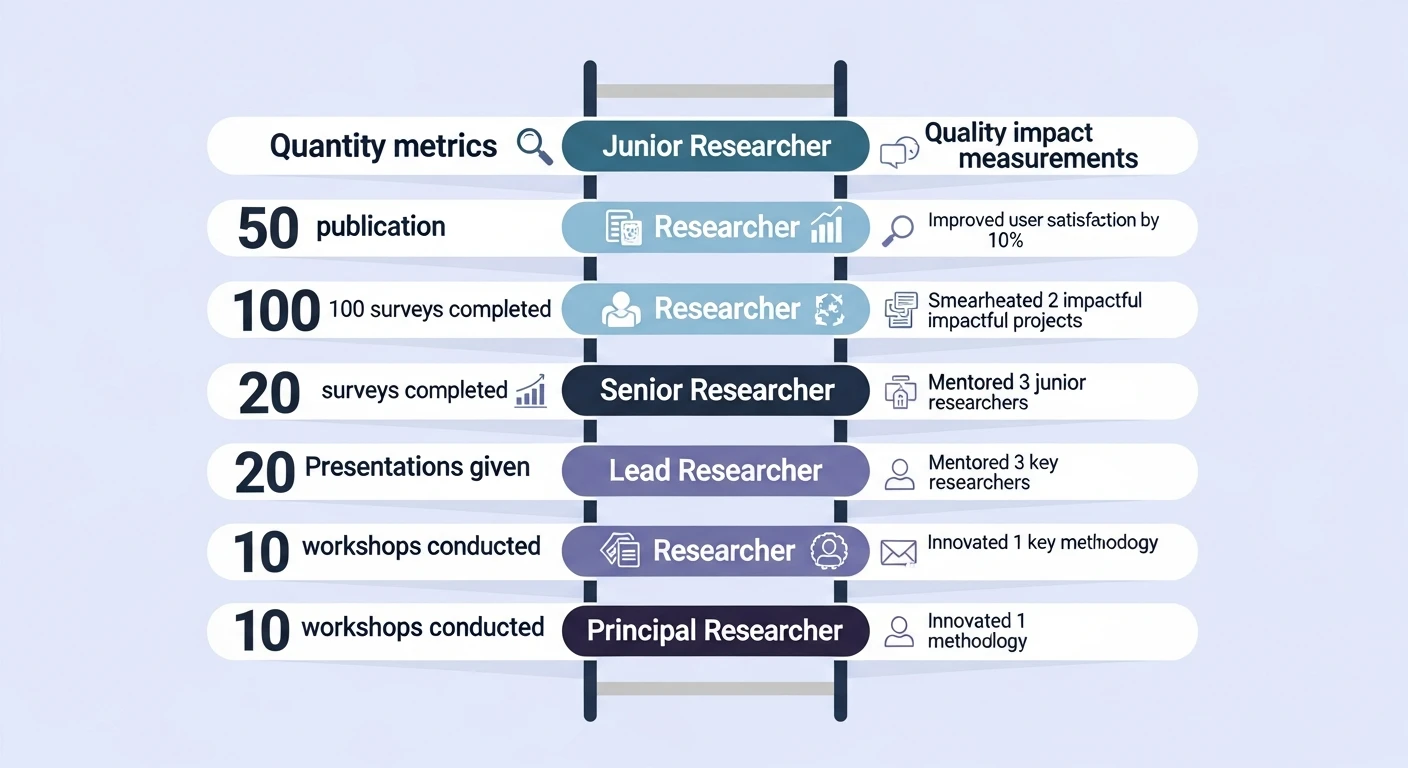
Examine any standard UX research career ladder and you will find progression criteria weighted toward scope and complexity of studies conducted. Senior researchers run larger studies. Staff researchers manage research programs. Directors own research strategy across multiple product areas.
Notice what is missing: demonstrated influence on business outcomes. A researcher can advance from junior to staff without ever proving their work changed a single product decision. The ladder measures capability to execute research, not capability to drive organizational change through research.
This is not unique to research -- most knowledge work suffers from similar output-over-outcome confusion. But research is particularly vulnerable because its impact is mediated through other people's decisions. A researcher cannot ship a feature. They can only inform someone who ships features. This indirectness makes impact attribution genuinely difficult, which makes volume metrics attractive as a simpler alternative.
What Volume Optimization Actually Produces
Shallow, confirmatory studies. When the incentive is study count, researchers optimize for speed. Fast studies use existing recruitment panels (risking panel fatigue effects), ask surface-level questions, and produce predictable findings. Deep, exploratory work that might yield surprising insights takes too long to be career-optimal.
Report-driven rather than decision-driven delivery. Volume-optimized teams produce reports because reports are countable artifacts. But reports are passive documents that require stakeholders to extract value. Teams optimized for impact would instead focus on decision support -- showing up in product reviews with specific recommendations tied to specific evidence.
Research theater at scale. As we have explored in understanding why teams conduct studies they never intend to act on, volume incentives create institutional pressure to perform research regardless of whether anyone needs the answers. Stakeholders request studies to check boxes. Researchers conduct them to hit targets. Everyone is busy. Nothing changes.
Talent attrition among impact-oriented researchers. The best researchers -- those who care about changing outcomes, not just producing artifacts -- eventually leave organizations where volume metrics dominate. They recognize that their career progression requires playing a game they find meaningless. This creates a selection effect where volume-oriented teams self-reinforce over time.
The Measurement Challenge
Measuring research impact is genuinely hard. Unlike engineering (shipped features, uptime, performance) or sales (revenue, conversion, pipeline), research impact is diffuse and delayed. A single insight might influence a product decision six months later, and the researcher who produced it may never know.
But difficulty is not impossibility. Organizations that take research impact seriously develop tracking mechanisms:
- Decision logs that record which research informed specific product choices
- Quarterly impact reviews where researchers trace the path from their work to measurable outcomes
- Stakeholder feedback loops that capture whether research actually influenced thinking
- Outcome-linked OKRs that tie research activities to product or business metrics
The principles behind building AI systems that actually track their own effectiveness apply equally to research operations: you need evaluation frameworks that measure what matters, not what is convenient to count.
Restructuring Incentives Without Losing Rigor
Shift from study count to decision count. The primary metric for a research team should be: how many product decisions did our work demonstrably influence this quarter? This requires tracking infrastructure but fundamentally reorients what researchers optimize for.
Create impact case studies for career progression. Instead of listing studies conducted, require researchers seeking promotion to present 2-3 detailed cases where their work changed outcomes. What was the business context? What did the research reveal? What decision was made differently because of it? What was the measurable result?
Reward research that kills projects. Some of the highest-impact research work is killing bad ideas before they consume engineering resources. But under volume metrics, a researcher who proves a concept should not be built has "nothing to show" for their quarter. Impact-oriented teams celebrate avoided waste as much as confirmed direction.
Build collaborative accountability. Research impact depends on stakeholder partnership. Researchers cannot force product managers to act on findings. But they can be measured on the quality of their stakeholder relationships, the accessibility of their insights, and their persistence in following up. Approaches like building shared understanding through sensemaking become career-relevant skills rather than optional extras.
Align research planning with business outcomes from the start. Every study brief should specify: what decision will this research inform, and how will we know if that decision was better because of our work? If these questions cannot be answered, the study should not begin -- regardless of how interesting the research question might be.
The Organizational Courage Required
Shifting from volume to impact metrics requires organizational courage because it will initially make research teams look less productive by traditional measures. A team that runs 15 high-impact studies per year looks worse on a dashboard than one running 45 shallow studies -- until you measure what actually changed because of the work.
This transition also requires executive sponsorship. Research leaders cannot unilaterally change how their teams are evaluated without alignment from their management chain. The argument must be made in business terms: we are investing in research capability, so we should measure research return, not research activity.
The parallel to how AI-native operating models rethink human-agent collaboration is instructive. Just as the best organizations are rethinking productivity metrics for AI-augmented teams, research organizations need to rethink what researcher productivity actually means in an era where AI can handle much of the volume work.
The Path Forward
The research profession is at an inflection point. AI tools can now handle many of the volume activities -- transcription, initial coding, pattern identification -- that previously consumed researcher time. This makes the volume-optimization strategy even more hollow: if AI can produce 100 coded transcripts per day, what is the human researcher's unique value?
The answer is judgment, influence, and organizational change. The researchers who thrive in this new landscape will be those measured by their ability to transform evidence into action, not those measured by their ability to process data quickly. Organizations that restructure incentives now will retain their best talent and build research functions that genuinely drive business outcomes.
Those that continue rewarding volume will find their research departments increasingly automated -- and increasingly irrelevant.