The Neurotypical Default in Research Design
User research has an accessibility problem that nobody talks about. We obsess over recruiting diverse panels across demographics -- age, gender, ethnicity, income -- but almost universally ignore cognitive diversity. The result is research infrastructure built for one type of brain, systematically excluding or degrading data quality from the estimated 15-20% of the population that is neurodivergent.
This is not just an ethics issue. It is a data quality issue. When your interview protocol assumes sustained eye contact signals engagement, you miss the autistic participant whose deepest insights come while looking away. When your survey demands linear completion in one sitting, you lose the ADHD participant who needs to process in bursts. When your consent forms are walls of legal text, you create anxiety that contaminates every response that follows.
The fix is not complicated. It requires rethinking assumptions that most researchers have never examined.
Why Standard Protocols Fail Neurodivergent Participants
Consider a typical 60-minute moderated interview. The participant joins a video call with a stranger, is asked to maintain conversational flow for an hour, must process abstract questions in real-time, and is expected to articulate complex experiences verbally and linearly. This format privileges extroverted verbal processing, sustained attention, comfort with social ambiguity, and real-time language production.
For participants with ADHD, the 60-minute block without breaks is the first barrier. Attention naturally cycles in shorter intervals, and forcing sustained focus produces either disengagement or performative attention -- neither of which yields quality data. For autistic participants, the social ambiguity of an unstructured conversation with a stranger creates cognitive overhead that competes with the actual research questions. For participants with anxiety disorders, being recorded while a stranger evaluates their responses triggers self-monitoring that suppresses authentic reactions.
The research on how AI-assisted approaches can reduce moderator bias applies directly here. When the interview format itself creates barriers, you are not capturing authentic experience -- you are capturing performance under duress.
Practical Accommodations That Improve Data Quality for Everyone
Flexible Session Structures
Instead of rigid 60-minute blocks, offer sessions in configurable chunks. A 60-minute interview can be three 20-minute segments with breaks, or two 30-minute sessions on different days. This accommodates ADHD attention patterns, reduces anxiety from extended social performance, and gives all participants processing time that improves response depth.
The bonus: neurotypical participants also produce better data with breaks. The research on participant fatigue confirms that engagement degrades predictably over time for everyone. Designing for neurodivergent needs raises the floor for all participants.
Multi-Modal Response Options
Not everyone processes and communicates best through real-time speech. Offering written responses, visual mapping, asynchronous voice notes, or drawing as alternatives to live verbal responses opens pathways for participants who think in images, who need time to formulate language, or who express themselves more precisely in writing.
This does not mean abandoning live interviews. It means supplementing them. Send key questions in advance so participants can pre-process. Allow written follow-ups after the session. Accept that the richest data might come in a voice memo sent at 2 AM when the participant finally found the words.
Sensory Environment Considerations
For in-person research, sensory environment matters enormously. Fluorescent lighting, background noise, strong scents, uncomfortable chairs -- these are not minor annoyances for many neurodivergent participants. They are cognitive load that directly competes with your research questions.
For remote research, this translates to camera-optional policies, permission to use comfort items or stim tools, and flexibility about background environments. The participant who is pacing while talking may be giving you their most focused attention.
Recruitment and Screening Without Gatekeeping
Traditional screener surveys often inadvertently exclude neurodivergent participants. Time-pressured completion, complex conditional logic, and ambiguous wording create barriers. The principle of designing questions with cognitive load in mind applies doubly to screeners for inclusive research.
More importantly, do not require disclosure of neurodivergent status as a condition of accommodation. Many adults are undiagnosed. Many who are diagnosed choose not to disclose. Build universal accommodations into your default protocol rather than offering them only upon request. Offer breaks to everyone. Send questions in advance to everyone. Make cameras optional for everyone.
Analysis Implications
Inclusive research also requires inclusive analysis. Neurodivergent communication styles -- tangential narratives that circle back to the point, intense focus on specific details, pattern-matching across seemingly unrelated domains -- contain signal that traditional coding frameworks may miss.
Analysts trained to code for "clear, direct statements of preference" may overlook the autistic participant whose repeated mention of a specific UI detail signals a deep usability issue. The ADHD participant who jumps between topics may be revealing genuine workflow patterns that linear-thinkers would never demonstrate. Enterprise teams working on stakeholder interview synthesis face similar challenges when communication styles vary across organizational levels.
AI-assisted analysis can help here by identifying patterns across diverse communication styles without privileging one format over another. The key is training your analysis framework -- human or AI-augmented -- to recognize value in varied expression styles.
The Business Case Beyond Ethics
Neurodivergent users represent a significant and growing market segment. Products designed without their input will have accessibility gaps that affect adoption and retention. Research that excludes neurodivergent perspectives produces blindspots that ship as product decisions.
But the stronger argument is simpler: accommodations that work for neurodivergent participants improve data quality from neurotypical participants too. Breaks improve everyone's focus. Pre-sent questions improve everyone's depth. Multi-modal options reveal richer data from everyone. Reduced social performance pressure produces more honest responses from everyone.
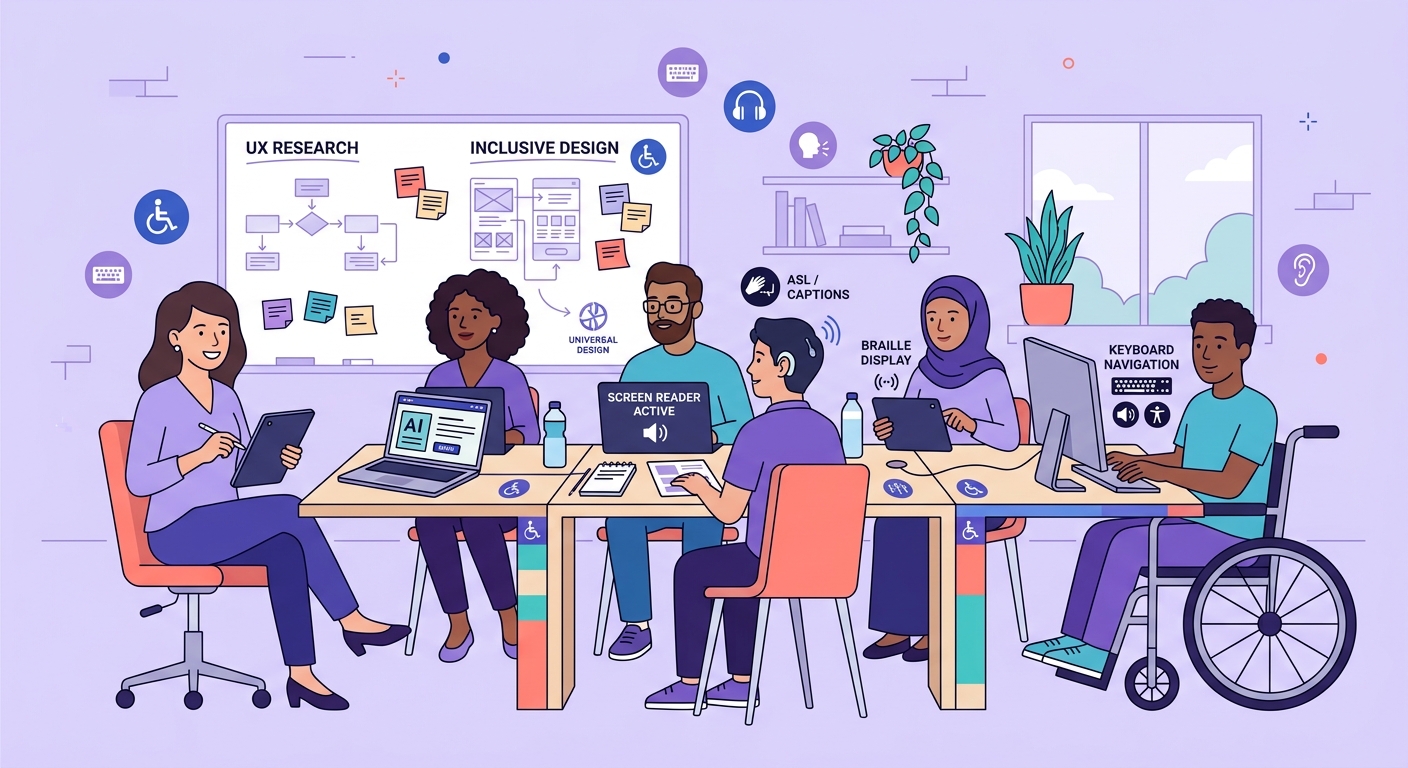
Designing for the margins improves the center. That is the fundamental insight of inclusive design, and it applies as powerfully to research methodology as it does to product design.
Getting Started
You do not need to overhaul your entire research practice at once. Start with three changes:
- Make all accommodations default and universal -- do not require disclosure to access them
- Offer session structure flexibility (breaks, async options, multi-modal responses) in every study
- Train your analysis team to recognize signal in diverse communication styles
The participants who benefit most will never tell you they needed it. That is the point. When research infrastructure accommodates all brains by default, you stop selecting for participants who perform well under neurotypical conditions and start hearing from the full spectrum of your user base.
The data will be better. The insights will be richer. And your products will work for more people. That is not charity -- it is competitive advantage.