The Finding That Outlived Its Truth
There is a moment in almost every product organization where a decision gets settled by a study that is quietly out of date. Someone says "but research showed users don't want that," and the room nods, and the debate ends. The problem is that the research showed it eight months ago -- before the redesign, before the pricing change, before a wave of new users with entirely different expectations arrived. The finding is being treated as a standing fact when it is really a photograph of a moment that has passed.
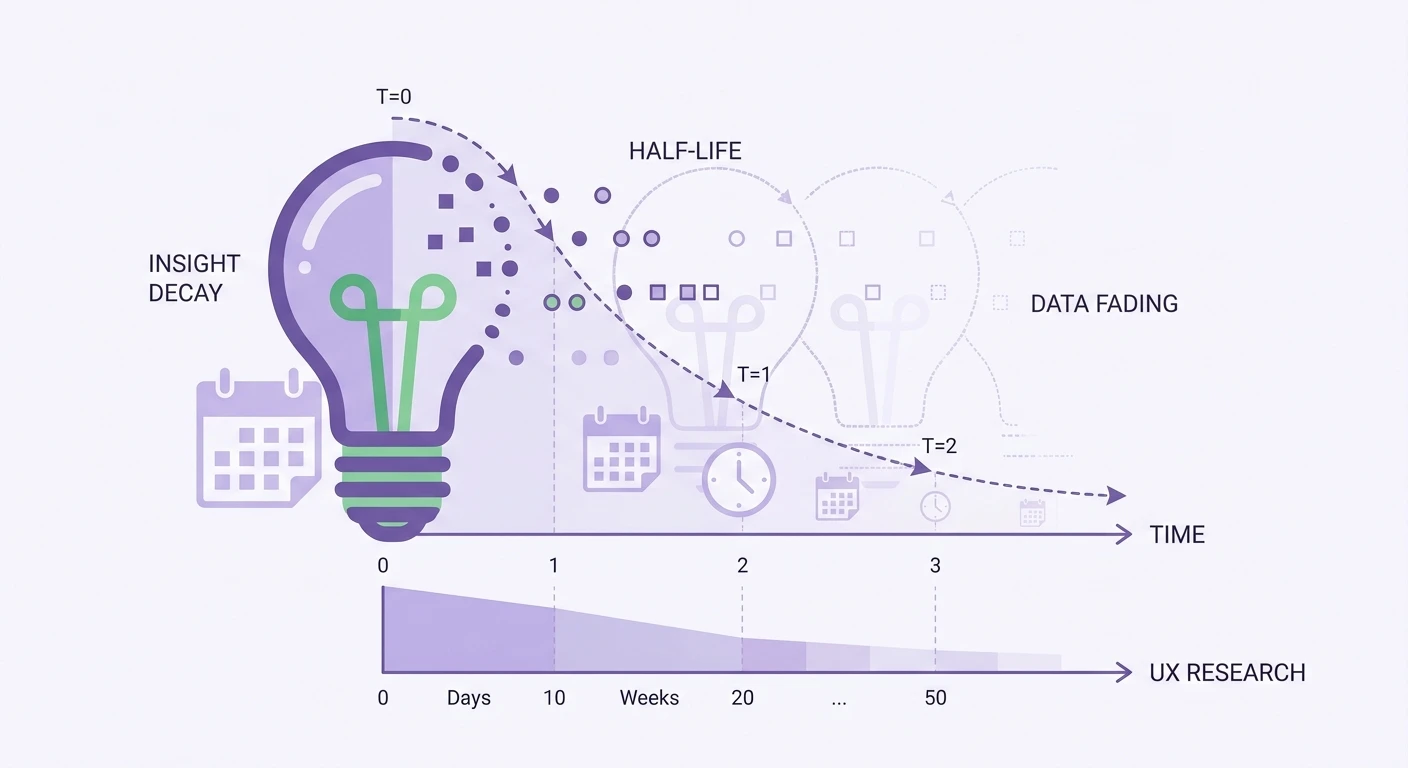
Insights have a half-life. Like a decaying isotope, a research finding loses a predictable fraction of its validity over time as the conditions that produced it drift away. Some findings decay slowly -- deep human motivations, core mental models. Others decay fast -- reactions to a specific flow, attitudes toward a feature, expectations set by a competitor's latest release. The mistake is not that teams forget to do research. It is that they treat every finding as if it has the same, indefinite shelf life, and keep citing insights long after their evidentiary value has dropped below the level a decision deserves.
This is an industry-wide blind spot in how research is stored, shared, and reused. We build repositories to preserve insights forever, and in doing so we accidentally preserve their authority forever too -- long after the truth underneath them expired.
What Actually Drives the Decay
Insight half-life is not one clock; it is several running at different speeds.
The product changed. The most direct decay: findings about a specific interface, flow, or feature become invalid the moment you ship the thing they were about. A usability finding on the old checkout is not evidence about the new one, however confidently it gets quoted. This is amplified by the novelty confound in first-session usability tests, where initial excitement masks durable friction -- findings captured at one point in a product's life do not transfer to another.
The population shifted. The users you interviewed are a sample of who you had then. Growth, churn, and new segments mean today's user base may barely overlap with yesterday's. An insight generalized from an aging sample silently becomes a claim about people who are no longer your customers -- a slow-motion version of the vocal minority problem, where your most engaged panelists point you at the wrong product.
The context moved. Competitors ship, norms change, expectations reset. A finding about what feels intuitive or acceptable is anchored to the market context of its moment, and that context has the shortest half-life of all.
Memory reconstructed the finding. Even a valid insight decays in transmission. As findings get retold in debriefs and decks, they get simplified, sharpened, and detached from their caveats -- the availability cascade in stakeholder debriefs, where the first insight shared becomes the one everyone remembers. By the time a finding is a one-liner in a roadmap doc, its confidence interval has been quietly deleted.
Why Repositories Make It Worse
The well-intentioned move to centralize research into searchable repositories has a dark side: it decouples findings from their expiration. A polished insight card in a repository looks exactly as authoritative on day 400 as it did on day 4. There is no wilting, no yellowing, no visible age. This is a fast track to research repository rot, where insights databases become graveyards within six months -- except the dangerous version is not the insights nobody reads. It is the ones people keep reading and citing long after they should have expired.
Compounding this, teams under-invest in re-validation because the research automation paradox means faster data collection creates slower organizational learning. It is easier to search the repository for an old answer than to question whether that answer still holds. The archive becomes a source of confident, aging truth.
Managing the Half-Life
Tag findings with a decay class, not just a date. A publish date tells you when a study ran; it does not tell you how fast it expires. Classify each finding by how quickly its underlying conditions change -- durable motivations decay slowly, product-specific reactions decay fast -- and let that class govern how long the insight can be cited without re-validation.
Attach conditions, not just conclusions. Record what the finding depended on: which product version, which user segment, which market moment. When any of those conditions change, the finding is flagged as potentially expired rather than silently reused. This is the research equivalent of a dependency: when the input changes, the output needs re-checking.
Re-validate the load-bearing insights on a schedule. The findings that settle debates and steer roadmaps are exactly the ones that most need a freshness check. Triangulating an aging insight against current behavior and new evidence -- in the spirit of research triangulation for product decisions -- turns a stale citation back into a live finding, or reveals that it has expired.
Build re-validation into how research earns its keep. Continuous discovery should include revisiting standing assumptions, not only chasing new questions. Otherwise you fall into the feedback loop trap in continuous discovery, where research confirms instead of challenges -- re-citing old findings that quietly stopped being true. And when governance or compliance depends on research, remember that the same expiration logic applies to data itself, which is why enterprise teams increasingly borrow from AI governance frameworks to track the provenance and freshness of the evidence behind decisions.
The Takeaway
Every insight is decaying from the moment it is captured. Some decay over years; some are stale within a sprint. The organizations that get this wrong are not the ones that stop doing research -- they are the ones that treat findings as permanent, store them without expiration, and keep citing them with undimmed confidence long after the product, the population, and the market have moved on. Treat insights the way you treat any perishable asset: label the shelf life, record the conditions, and re-validate what your roadmap leans on. A finding you have not questioned in a year is not a stable truth. It is an expiration date you have chosen not to read.
If your team is still steering by studies whose half-life ran out months ago, Qualz.ai makes it fast enough to re-validate the insights that matter before you bet on them. Book a demo and keep your evidence as current as the decisions it drives.