The Probe That Arrives Too Late
A participant describes a moment of confusion mid-task. Something flickered across their face, their sentence trailed off, and there was a real thread to pull. But the interviewer was writing a note, or waiting politely for a full stop, or debating whether to interrupt. Ten seconds pass. Then the interviewer asks, "Can you say more about what happened there?" The participant, now several beats removed from the raw moment, no longer answers from inside the experience. They answer from outside it -- reconstructing, rationalizing, and smoothing the rough edge into a clean explanation. The probe technically succeeded. The insight it was reaching for is already gone.
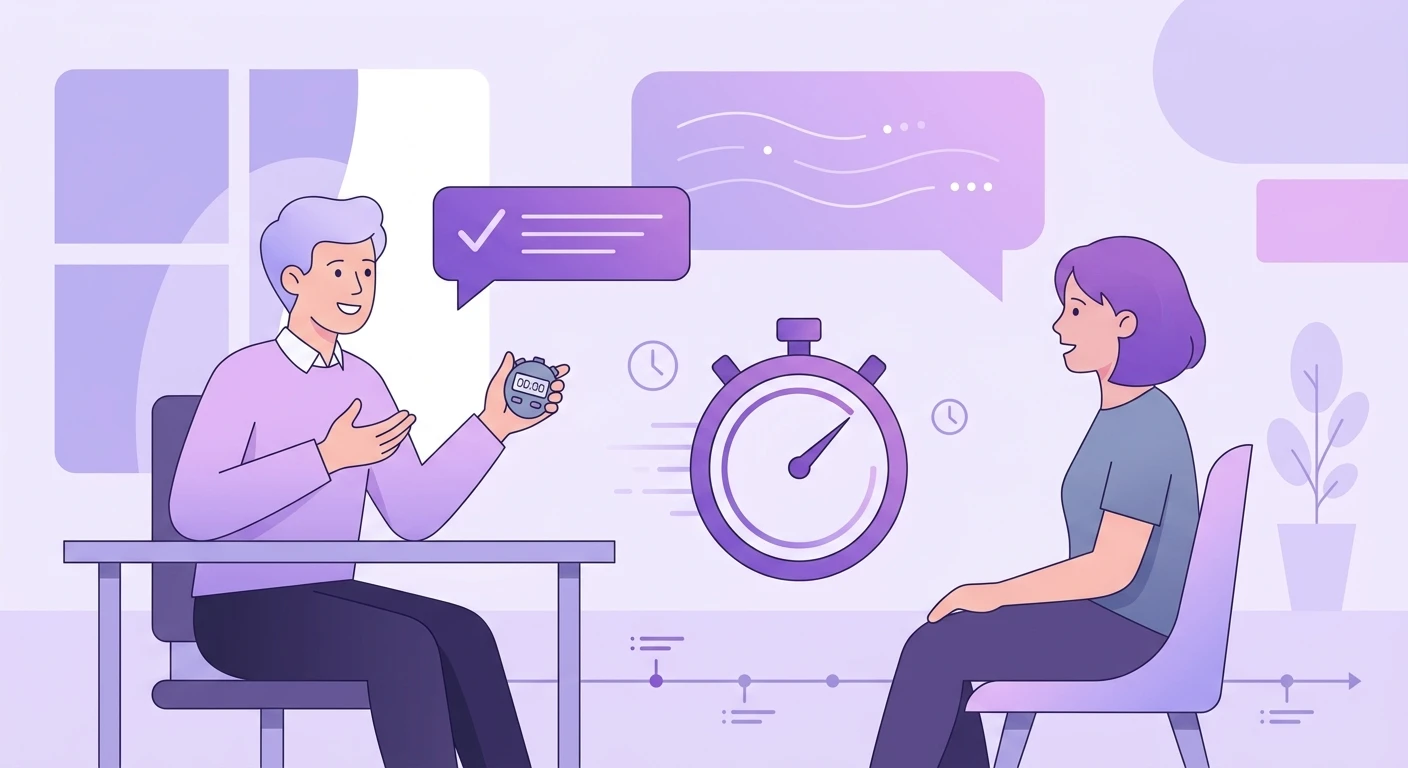
This is the follow-up latency effect: the deepening power of a probe decays sharply with the time between the revealing moment and the question about it. Ask inside the window and you get the texture of lived experience. Ask outside it and you get a narrative the participant has already begun editing.
Why Delay Changes the Answer, Not Just the Detail
The intuitive view is that a late probe just recovers slightly less detail -- memory fades a little. That undersells what actually happens. In the seconds after an unguarded statement, participants begin doing something more consequential than forgetting: they start imposing coherence on their own story. A confusing, contradictory, half-formed reaction is uncomfortable to hold. Given a few seconds, people resolve that discomfort by constructing an explanation that makes their behavior look sensible and intentional.
So the late probe does not retrieve a faded version of the original moment. It retrieves a freshly manufactured justification. The participant is now more fluent and more confident than accuracy warrants, and the interviewer -- hearing a smooth, assured answer -- has no obvious signal that they are recording a reconstruction rather than a memory.
The Two Failure Modes: Too Fast and Too Slow
Latency has a cost on both ends, which is what makes it hard.
- Too fast: interrupting the instant a participant pauses cuts off the thought before it forms. It also mirrors their language and framing back at them prematurely -- the vocabulary mirroring effect that traps participants in their first framing. You get a reaction to your interruption, not a deeper account.
- Too slow: waiting for full narrative closure lets the reconstruction machinery run. By the time you probe, the answer has hardened.
The productive window sits between them: after the thought has surfaced but before it has been rationalized. Finding it is a skill, and it is exactly the kind of judgment that separates expert interviewers using probing techniques for depth from note-followers running a script.
Why Silence Beats a Fast Probe
The counterintuitive fix for the too-fast failure is not a faster question -- it is strategic silence. A deliberate pause held open by the interviewer, rather than filled, invites the participant to continue from inside the moment on their own terms. This is the underused power of silence in user interviews: it extends the window without contaminating it with your framing. Silence buys you latency budget. It lets the thought finish forming without letting the rationalization start.
The worst pattern is the anxious fill -- a reassuring comment or a leading rephrase dropped into the pause to relieve the tension. That both closes the window and softens it, the reassurance reflex erasing the signal you needed. Learn to sit in the pause. The participant usually breaks it for you, and what they say next is closer to the truth than anything your probe would have extracted.
How AI-Assisted and Asynchronous Formats Blow the Window Open
The latency problem gets structurally worse the moment a human interviewer is removed from the loop.
Asynchronous and unmoderated studies have effectively infinite latency: the participant answers a follow-up minutes or hours after the moment, if the moment is even captured at all. By then, reconstruction is total. AI-moderated interviews are better but not immune -- the model's probe timing is governed by turn-taking and transcription lag, not by reading the flicker of hesitation a skilled human catches. An AI moderator that waits for a clean sentence boundary before probing is, by design, always slightly too late.
There is a second-order risk in analysis. When AI tools synthesize transcripts, they cannot distinguish a fast in-the-moment answer from a slow reconstructed one -- both are just text. A confidently reconstructed justification reads as strong signal, and the pipeline can manufacture consensus your participants never actually reached by treating polished after-the-fact narratives as primary data.
Practical Tactics for Managing Latency
- Mark, don't chase. When you spot a revealing moment you cannot probe immediately, drop a one-word note and return to it explicitly later -- but treat the later answer as reconstruction, not raw data, and label it that way in analysis.
- Probe the moment, not the summary. "Right there -- what were you thinking?" beats "Earlier you mentioned..." The first anchors them back inside the experience; the second invites a fresh retelling.
- Protect the pause. Train yourself and your team to hold three to five seconds of silence before filling it. Most productive follow-ups are pauses, not questions.
- Front-load probing capacity. Reduce your own cognitive load during sessions -- lighter note-taking, fewer competing tasks -- so you have the attention to catch and act on moments in the window. Offloading everything to automated capture can quietly cost you the analytical engagement that in-session presence provides.
- Instrument reconstruction risk. In readouts, flag which quotes came from in-the-moment probes versus delayed ones. The distinction changes how much weight a quote deserves.
The Discipline of the Window
Good probing is often framed as asking the right question. Just as often, it is asking at the right time. The same words -- "say more about that" -- can open a participant up or send them into their press-release voice, depending entirely on where they land in the latency window. Treat timing as a first-class variable in interview craft, not an afterthought, and you stop mistaking your participants' reconstructions for their experience.
Qualz.ai helps research teams keep probing anchored to the moment -- surfacing where in a session an answer was reconstructed versus lived, so your synthesis rests on real experience rather than tidy hindsight. See how Qualz.ai supports higher-fidelity interviews.