The Question Behind the Question
Ask a user what they want and they will tell you about features. "I want a faster export." "I wish it synced automatically." "I'd use it more if it had dark mode." These are real, but they sit at the surface. Build a roadmap out of them and you get a product that answers requests without understanding motives -- which is how teams ship exactly what users asked for and still watch adoption stall. The gap is not that users lie. It is that the features they name are means to ends they rarely articulate on their own, a version of the articulation gap between what users can say and what actually drives their behavior.
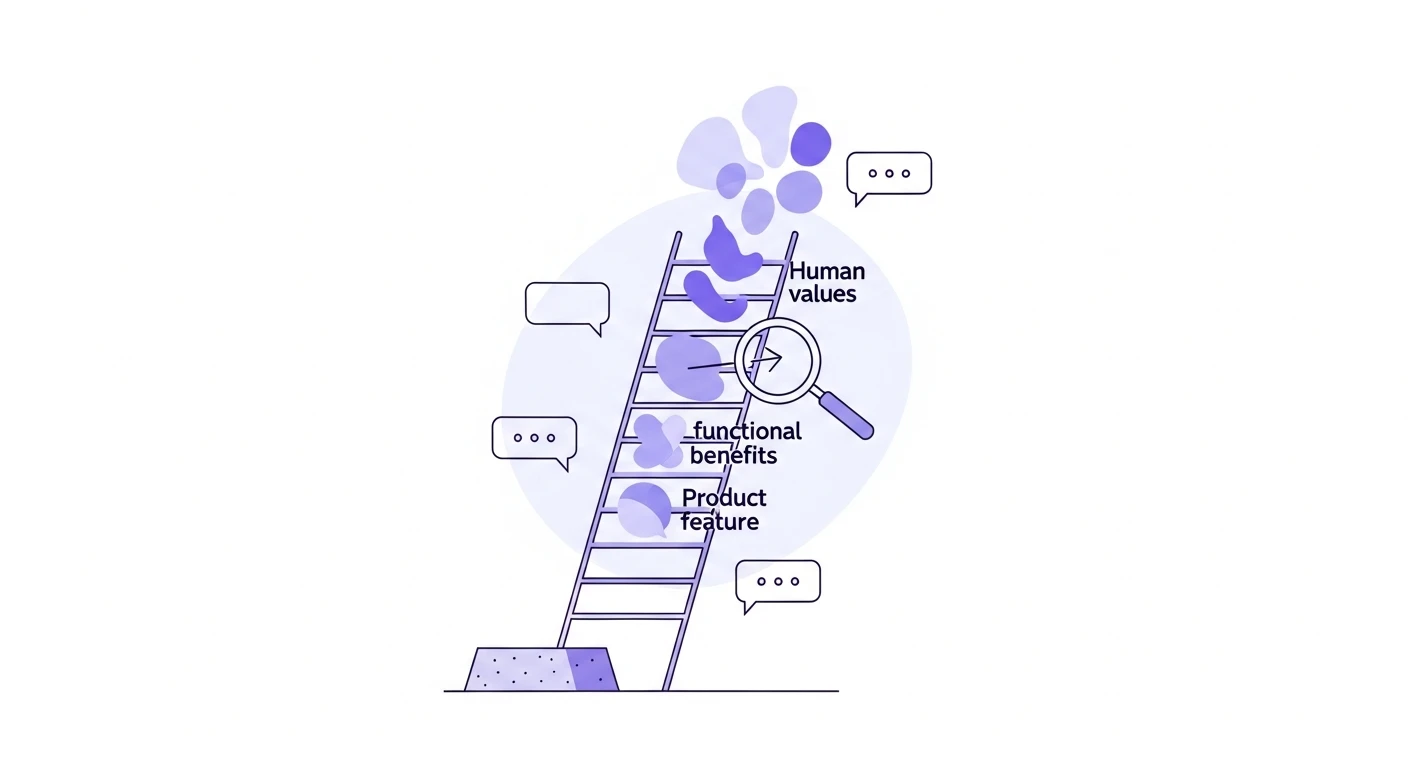
Laddering is the technique for closing that gap. Rooted in means-end theory, it treats every stated preference as the bottom rung of a ladder and climbs -- from attributes (what the feature is), to consequences (what it does for the user), to values (why that matters to who they are). Done well, it turns "I want a faster export" into "I need to look prepared in front of my boss, and slow exports make me feel disorganized." One of those is a feature ticket. The other is a reason people stay or leave.
The Three Rungs
Attributes are the concrete, describable properties of a product or experience -- the export button, the sync toggle, the color scheme. They are where users start because they are easy to name.
Consequences are what those attributes do for the person -- functional ("I finish reports faster") and emotional ("I don't feel behind"). This is the middle of the ladder, and it is where most of the actionable insight lives, because consequences connect the product to the user's real situation.
Values are the deep, stable beliefs the consequences serve -- competence, security, belonging, autonomy, being seen as capable. Values rarely change and rarely get stated directly, which is exactly why reaching them tells you what will still matter after this feature request is obsolete.
The skill of laddering is moving up these rungs without dragging the participant. Each step is a "why does that matter to you?" -- but asked in a way that feels like curiosity, not interrogation.
How to Actually Climb
Start at a concrete preference the participant has already stated. Do not invent one; work from something they brought up, so the ladder stays grounded in their reality rather than your hypothesis.
Then ladder up with variations of a single move: "Why is that important to you?" "What does that let you do?" "What would it mean if you couldn't?" The phrasing matters -- you want to elicit the participant's own chain of reasoning, not supply one. This is where laddering gets dangerous if done carelessly. A leading ladder ("So faster exports make you feel more professional, right?") manufactures a value the participant never held, the same priming contamination that embeds the interviewer's assumptions into the answer. The fix is to keep your rungs empty: ask the why, then shut up and let them fill it.
Watch for the two failure modes. Stalling happens when the participant hits "I don't know, it just is" -- often a sign you have climbed past their conscious reasoning. Back down a rung and approach from a concrete recent example instead of an abstraction. Looping happens when they keep restating the same consequence in new words; that usually means you have reached a genuine value and should stop climbing, not push for a philosophical answer that does not exist.
Anchor Every Rung in a Real Moment
The single biggest quality lever in laddering is refusing to let the conversation float into hypotheticals. "Why do you value being organized?" invites a rehearsed, self-flattering answer. "Tell me about the last time a slow export actually caused a problem" invites a specific memory with texture, friction, and truth. Concrete beats abstract at every rung -- the same principle behind the specificity gradient, where concrete questions unlock real experience while abstract ones produce performative answers.
So pair every "why" with a "when." Climb the ladder, but keep one foot on a real event. This does two things: it keeps the participant honest, because it is hard to confabulate a value while narrating a concrete episode, and it gives you evidence you can trace later, rather than a tidy abstraction with no receipts.
Analyzing the Ladders
A single ladder is a story. The value comes from stacking ladders across participants and finding where the chains converge. Ten users might name ten different features at the bottom rung and arrive at the same two or three values at the top -- and those shared values are your real design targets, because they are stable across the surface diversity of requests.
This is also where laddering plugs into a broader program rather than sitting as a one-off. Values surfaced through laddering become hypotheses to test with other methods -- behavioral data, diary studies, follow-up sessions -- in the spirit of triangulating multiple sources before betting a product decision on them. A value that shows up in laddering, gets corroborated in behavior, and survives a contradicting-case check is about as solid as qualitative motivation gets.
Structurally, the discipline resembles good data engineering: you are building a traceable chain from a concrete observation up to an abstract claim, and every link needs to hold. The same rigor that data contracts enforce between the raw and the derived in AI pipelines applies here -- if you cannot trace a stated value back down through consequences to an actual attribute the participant named, you have a floating abstraction, not a finding.
Common Mistakes That Collapse the Ladder
Climbing too fast. Jumping from attribute straight to value skips the consequence rung where the actionable insight lives. Take every step.
Supplying the rungs. The moment you offer the value, you have contaminated it. Ask, wait, let the silence do the work.
Treating the top rung as the only prize. Values matter, but the consequences in the middle are what your product actually delivers. Do not discard them in the rush to sound profound.
Laddering everything. Not every preference needs a full climb. Ladder the ones that recur or surprise you; let the trivial ones stay trivial.
Why Laddering Still Matters in the AI Era
AI tools are excellent at summarizing what users said and increasingly good at clustering it. What they cannot do reliably is decide when to climb, when to stop, and when a "just because" answer means a real value versus a dead end -- those are live judgment calls that depend on reading the person in front of you. Laddering remains a fundamentally human interviewing skill precisely because it is adaptive: the next question depends entirely on the last answer.
Qualz.ai supports the analysis side -- keeping each laddered chain linked to the moment that grounded it, and surfacing where values converge across participants -- so the human interviewer can focus on the climb while the platform preserves the traceability. The technique is old; the discipline of doing it without leading your participant is what separates a map of motivations from a wish list of features.
Want to turn feature requests into a map of what actually drives your users? Book a Qualz.ai demo and see how laddered insights stay anchored to real evidence.