The Text Supremacy Assumption
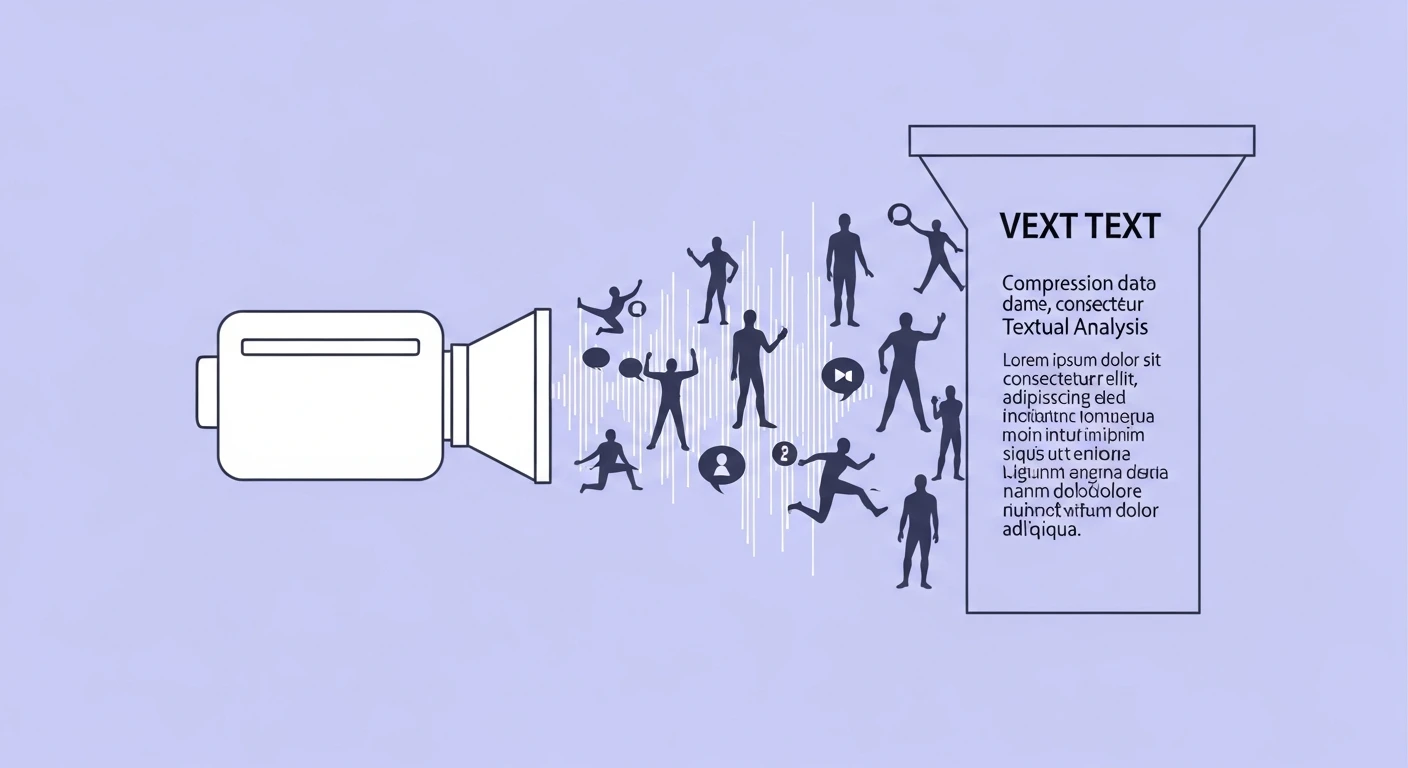
Every major AI research analysis platform shares one foundational assumption: that the transcript is the interview. They ingest text, process text, and return text-derived themes. The entire analytical pipeline treats verbal content as a complete representation of what happened in the research session.
This assumption is wrong. It has always been wrong. But it persisted in manual analysis because human researchers compensated naturally — they remembered the participant's nervous laugh, the long pause before a contradiction, the way someone's body language said the opposite of their words. Now that AI tools handle the analysis, that compensatory mechanism has vanished. And nobody is talking about what we lost.
The problem is not that transcription is imperfect. The problem is that transcription, no matter how accurate, represents perhaps 40% of the analytical data generated in a qualitative interview. The other 60% — prosodic variation, embodied response, temporal dynamics, interactional synchrony — evaporates the moment you reduce an interview to text.
What Text Cannot Capture
Prosodic Meaning
Consider the sentence "I really love that feature." In text, this is unambiguous positive sentiment. But a researcher who heard the participant say it with falling intonation, a slight pause before "love," and an audible breath afterward knows this might be polite disagreement, resignation, or outright sarcasm.
Prosodic features — pitch contour, speech rate variation, amplitude dynamics, voice quality shifts — carry semantic information that often contradicts or fundamentally recontextualizes verbal content. When AI tools analyze the transcript, they process the words without the music. The result is analysis that consistently over-represents stated sentiment while missing performed sentiment.
This connects directly to why detecting contradictions in qualitative interviews requires more than textual analysis. Verbal contradictions are easy to spot. But the most analytically significant contradictions in interview data occur between what participants say and how they say it — a dimension that text-only tools cannot access.
Embodied Hesitation
Transcripts mark pauses with ellipses or timestamp gaps. But there is a world of difference between a cognitive processing pause (where the participant looks up-left and their lips move slightly) and an emotional avoidance pause (where they break eye contact, shift posture, and touch their face). Both appear as "..." in the transcript. Only one signals an analytical goldmine.
Experienced researchers know that the moments participants struggle to articulate something are often where the richest data lives. But text-based AI tools process these moments as gaps — absences of data rather than presence of meaning. The very moments that should receive the most analytical attention get the least.
Interactional Dynamics
Qualitative interviews are co-constructed events. The researcher's micro-expressions, nodding patterns, and postural mirroring shape what participants share. When analysis happens at the text layer, these interactional dynamics become invisible. The result is analysis that treats participant utterances as independent statements rather than responses produced within a specific relational context.
This is particularly problematic for understanding how the observer effect shapes what users reveal. If your analysis tool cannot see the interactional dynamics, it cannot account for how researcher behavior influenced participant responses — a critical validity consideration that disappears entirely in text-only analysis.
The Systematic Bias Pattern
The modality mismatch does not just reduce analytical richness — it introduces systematic directional bias into findings.
Bias Toward Articulate Participants
Text-based analysis systematically overweights data from verbally fluent participants. Someone who struggles to articulate an important insight but communicates it through gesture, expression, and tone gets analytically penalized. Their contributions appear thin in the transcript while appearing rich to the present researcher. The AI tool privileges the articulate participant whose insights may be shallower but text-denser.
This creates a perverse incentive structure in your data: the participants who produce the most analyzable text are not necessarily the ones with the most valuable insights. The articulation gap between user behavior and verbal expression becomes not just a research challenge but an analytical bias — text tools amplify the gap rather than bridge it.
Bias Toward Explicit Content
Text-based tools excel at identifying what participants explicitly state. They systematically miss what participants implicitly communicate through paraverbal and nonverbal channels. This creates findings biased toward rational, consciously-held positions rather than the emotional, embodied, and habitual dimensions of experience that often drive actual behavior.
Consider a participant discussing a workflow they use daily. In the transcript, they describe the steps clearly and efficiently. In the video, you can see their shoulders tense at step three, a micro-expression of frustration at step five, and visible relief when they describe workarounds. The text analysis produces "user successfully completes workflow." The multimodal analysis produces "user experiences significant friction at steps three and five despite verbal minimization."
Bias Toward Individual Over Interactional
When analysis operates on transcripts, it naturally treats each speaker's words as their individual production. But much of what participants say is interactionally produced — shaped by the immediate conversational context, the researcher's prior utterance, and the ongoing relational negotiation between speakers.
Text-based tools strip away the interactional frame and treat utterances as context-free propositions. This matters enormously for interpretation: a statement produced in response to a leading question carries different evidential weight than one volunteered spontaneously. But in the transcript, both look identical.
Practical Implications for Research Teams
The Annotation Layer Approach
Rather than waiting for fully multimodal AI analysis (which remains nascent), research teams can create annotation layers that supplement text analysis. Before submitting transcripts to AI tools, researchers add structured annotations at key moments: [TONE: sarcastic], [BODY: leans away], [PAUSE: 4s, emotional avoidance], [EXPRESSION: micro-surprise].
This is labor-intensive but transforms text-based analysis from systematically impoverished to contextually enriched. The AI tool can process these annotations as additional data points, producing themes that account for multimodal information even within a text-processing pipeline.
The Validation Protocol
For critical research where findings will drive significant product decisions, implement a multimodal validation step: after AI tools produce text-based themes, a researcher reviews the source video for each key finding, checking whether visual and prosodic data confirms, contradicts, or complicates the text-derived interpretation.
This catches the most dangerous errors — cases where text analysis produces confident themes that the multimodal record directly contradicts. These are not rare edge cases; in our experience, 15-20% of AI-generated themes shift meaningfully when validated against video data.
Research teams already navigating how AI governance frameworks shape analytical decisions should extend their governance protocols to include modality coverage requirements — ensuring that critical findings are not based solely on text-layer analysis.
The Timestamp Integration Method
A lighter-weight approach: when reviewing AI-generated themes, identify the three most significant supporting quotes for each theme. Return to the video at those exact timestamps and watch 30 seconds of context around each quote. This takes roughly 10 minutes per theme but catches cases where the text and video tell different stories.
This method works particularly well for validating emotional or attitudinal themes, where the gap between textual and multimodal evidence is largest.
The Future Is Multimodal — But the Present Requires Vigilance
Multimodal AI analysis is coming. Some platforms are beginning to process video directly, extracting features from facial expression, gesture, and prosody alongside verbal content. But these capabilities remain immature, and their analytical frameworks are even less transparent than text-based tools.
For now, the most important step is awareness: knowing that every text-based AI analysis you run operates on an incomplete record of your research data. This is not a reason to abandon AI tools — their speed and pattern-detection capabilities across large datasets remain genuinely valuable. But it is a reason to treat their outputs as preliminary rather than definitive, and to maintain practices that preserve access to the multimodal richness that text analysis necessarily discards.
The teams that build multimodal validation into their workflows now will produce consistently better research — not because their tools are better, but because they understand what their tools cannot see. In a field where methodological transparency in AI-assisted research is becoming a professional obligation, acknowledging the modality mismatch is not optional — it is a requirement of rigorous practice.