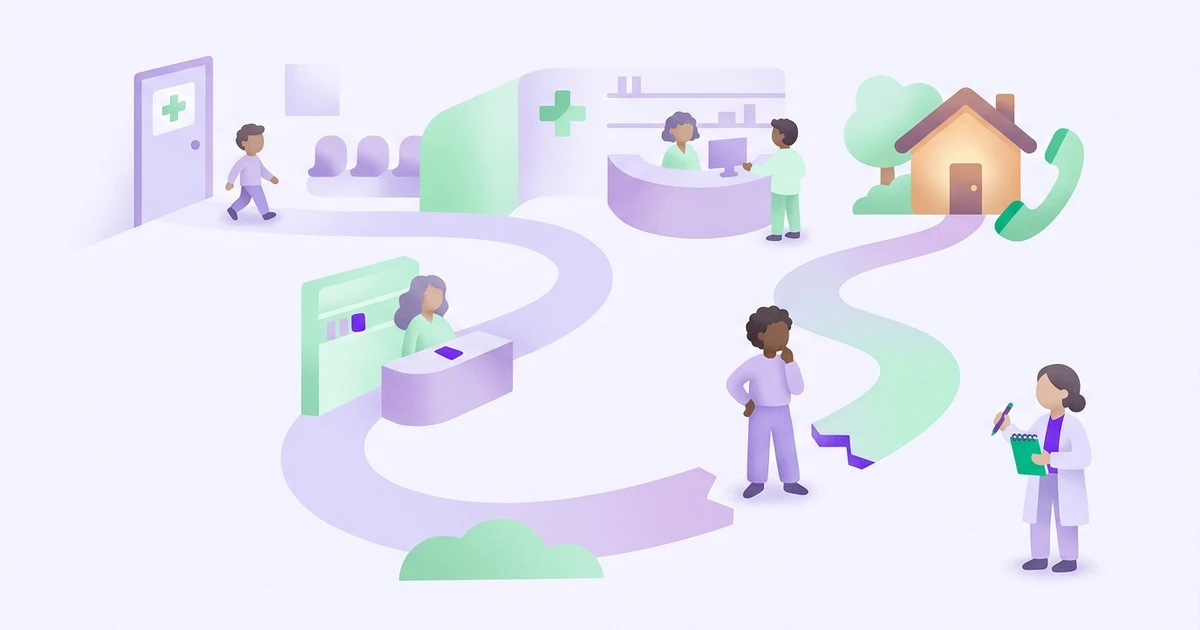
A patient journey map usually starts life in a workshop. Someone draws boxes on a whiteboard: referral, scheduling, first appointment, tests, results, treatment, follow-up. The boxes match the organisation's own process, because that is what the people in the room know. Then the team adds sticky notes for "pain points", mostly drawn from complaint logs and what front-desk staff remember hearing. What comes out is a picture of how the system thinks patients move through it.
Patients don't move through it that way. They go through it as a string of phone calls, parking problems, portal messages they half understood and conversations at the kitchen table about whether the second appointment was worth the time off work. The steps that matter most to them often aren't on the organisation's diagram, and the place they drop off usually sits between two boxes rather than inside one.
This guide covers building a journey map from interview data, so the stages come from patients rather than the org chart, and finding the drop-off points the workshop version leaves out. The steps are in order because each one depends on the one before.
1. Decide whose journey you are mapping
"The patient journey" is too broad to study. A newly referred cardiology patient, a parent getting a child through an asthma pathway and an older adult coming home after hip surgery go through different journeys with different people involved. Pick one pathway and say where it starts and ends. "From first specialist appointment to the six-week follow-up" can be studied. "Outpatient experience" can't.
Then decide who counts as the patient. In a lot of pathways the person managing the journey is a spouse, an adult child or a caregiver who books the appointments, collects the prescriptions and remembers what the doctor said. If you only interview patients, part of the journey will be missing.
2. Sample for the people who left
This step decides whether you can find drop-off points at all, and it's the one teams most often get wrong. Recruit from the people who reach your clinic, answer your survey or are still in care, and your sample is made up of people who finished the journey. They can tell you about friction they got past. They can't tell you about the friction that stopped someone else.
So sample on purpose across outcomes. You want people who completed follow-up, people who missed it or rescheduled more than once, and if your data and consent processes allow it, people who left the pathway altogether. This is the healthcare form of a general sampling problem: the people who don't respond often matter most to the decision, a point made more broadly in our piece on why non-participants end up shaping the roadmap. Reaching people who have left care is hard. It usually means outreach through scheduling records, a short and low-pressure ask, and an incentive that respects their time. A few of these interviews will teach you more about drop-off than many interviews with people who stayed.
Malterud and colleagues' idea of information power fits here. How many interviews you need depends less on a saturation number than on how narrow the aim is and how specific the sample is. A tightly scoped pathway with deliberately varied participants needs fewer interviews than a vague one.
3. Write a guide that follows time, not topics
Journey interviews work best when they're chronological and concrete. Rather than asking "what was difficult about your care?", which gets a general verdict, take the person through it in order: "Can you take me back to when you first heard you'd need to see a specialist? What happened next?" Spradley's distinction between grand tour and mini tour questions helps. Start with the full sequence, then go back to specific moments in detail.
Keep asking about the gaps between appointments. What happened in the eleven days between the scan and the results? Who did you call? What did you assume was going on? Patients don't think of those stretches as part of their care, so they skip them unless you ask. Disengagement often starts there.
Ask about decisions in the participant's own words. Something like "Was there a point where you thought about not going back?" lets someone admit to wavering without sounding like a bad patient. Social desirability is strong in healthcare interviews. People want to look compliant and grateful, especially if they suspect the interviewer is connected to their provider. Say clearly that you aren't, if you aren't, and be honest about it if you are.
Retrospective accounts reorder events and compress time, and people tell their stories more neatly than they lived them. Where you can, anchor recall in artifacts: the appointment letter, the portal message, the pill organiser. Those help memory more than general prompts do. And be careful with identifiers. Patients will mention names, dates and facilities whatever the guide says, so plan for it ahead of time, as covered in handling incidental PHI in AI-moderated patient interviews.
4. Code for stages from the transcripts
Don't start with the organisation's stage labels. Read a first batch of transcripts and mark every moment where the participant describes doing something, waiting for something, deciding something or feeling something change. These are your raw journey events. Then group them by what the participant was trying to do at that point, in their own language: "trying to find out what's wrong", "waiting to hear back", "working out if I can afford this", "getting back to normal".
This is the emic and etic distinction applied to mapping. Your final map will probably include the system's stages too, because stakeholders need to know where to act. But the stages that organise the map should come from how patients experience it. Often they cut across the organisation's categories. "Waiting to hear back" might cover three departments and two phone systems, and that's useful to know.
For each event, record four things: what happened, who was involved, what the participant felt or concluded, and what they did next. The last of these is what turns a list of complaints into a journey.
5. Look for drop-off as a sequence, not a moment
When teams look for drop-off they search for the moment someone quit. In interviews you rarely find one. You find something like this:
I mean, I got the letter, and it said call to book, so I called, and it was the -- you know, the press-one-press-two thing, and I didn't really know which one I was. And then work got busy. And I sort of figured if it was serious they'd ring me.
Nothing in that account is a decision to leave care. There's a letter that hands the work to the patient, a phone menu that assumes they know the system's terms, a competing demand, and then a reasonable belief that the system would follow up if it mattered. That belief is what made the drop-off stick. Each step on its own looks minor. Put together, they amount to a patient who has disengaged without ever choosing to.
So when you analyse drop-off, read for chains. For each participant who missed or delayed a step, go back through their account and find what came before: where the work moved onto them, where they had to interpret something unclear, where they built a belief about what silence meant, and what else was competing for their attention. Then compare those chains with the participants who got through the same point. Ask what they had that the others didn't. Often it's a person: a nurse who called, a daughter who chased the referral. That tells you what the drop-off point depends on.
Comparing the two groups is where your sampling choice from step 2 pays off. Without people who left, you can describe friction but you can't show which friction actually made someone leave.
6. Check each stage against the full set
Once you have a draft map, go back through every transcript and test it. Does each participant's journey fit the stages? Where it doesn't, is the map wrong, or is this person's pathway really different? Negative cases, the people whose journeys break the pattern, are often where the map gets better. A participant who skipped the expected stage entirely might show you a route the organisation doesn't know exists.
This is also the point where you should state how widespread each drop-off pattern is without inflating it. "Several participants who missed follow-up described waiting for a call that didn't come" is honest. "62% of patients" from eighteen interviews isn't. We've written more about reporting counts in qualitative work without pretending they're quantitative.
AI analysis tools can help with this pass, and this is where we think they help most. In Qualz.ai you can ask the research assistant a question across the whole corpus, such as "which participants described waiting for the clinic to contact them after a missed booking?", and get an answer with citations to the specific transcript passages. You then read those passages to decide if they actually support the claim. That reading can't be skipped. A cited answer is something to check, not a finding. Retrieval systems can also weight some passages over others for reasons that have nothing to do with meaning, a technical issue explained well in this piece on how chunk ordering changes RAG answers. Treat the citations as a quick way back into the data, not a replacement for reading it.
7. Draw the map with evidence attached
The finished map should show stages in patient terms, the actions and feelings at each one, and the drop-off chains marked where they happen, including in the gaps between appointments. Each claim on it should link to at least one verbatim from a named participant ID. Stakeholders will question a map that tells them their discharge call process loses people. They'll question it less when they can read three patients describing it in their own words.
Be reflexive in the write-up. Say who you couldn't reach. Say where your guide may have shaped the answers. If you interviewed in a clinic setting, say that people were sitting in the place they were being asked to criticise. A journey map shows one study's view of the journey, and readers need to know what that view left out.
If you're mapping across several sites, the same steps apply, but you'll need to keep stage definitions consistent across teams. That's covered in researching patient experience across facilities with a small team. And if you want to look at a single transcript through journey pain alongside jobs-to-be-done and empathy maps, this walk-through of one patient interview shows what each lens brings out.
Where this method stops working
Interviews tell you how patients understood their journey and why they did what they did. They're weaker on timing, volume and sequence across a population. Your scheduling and claims data will show where drop-off happens far more precisely than eighteen recollections can. The best journey maps put the two together: operational data shows where patients fall out, and interviews explain why. Running only one of them leaves you either with numbers you can't explain or with stories you can't size.
There's also a limit to what a map can do. It can show that a letter which hands the work to the patient leads to disengagement. Changing the letter, the phone tree and the assumption that patients will chase their own care is organisational work, and the map is only where that argument starts.
If you're scoping a patient journey study and want to see how interviewing, journey mapping and cited analysis fit together in a healthcare setting, the Qualz.ai healthcare solutions page explains the approach. You can also book a short information session to talk through your pathway with us.