More Consent Screens, Less Actual Consent
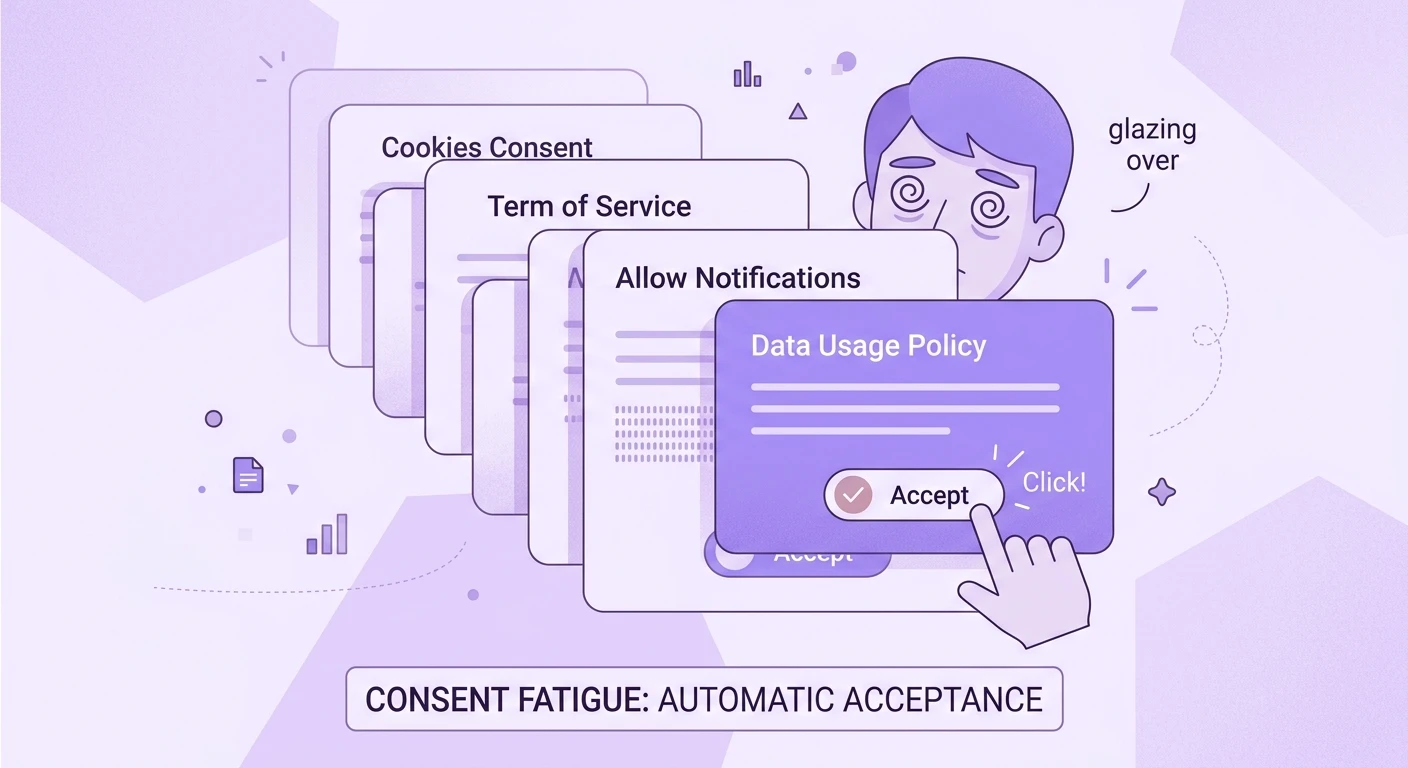
The instinct is understandable and well-meaning. Legal wants a recording notice. Research ops wants a data-use acknowledgment. The platform adds its own terms. The moderator reads a verbal consent script on top of all of it. Each layer feels like additional protection, so we keep adding them. But there is a threshold past which every additional prompt does the opposite of what it intends. Participants stop reading. They learn, within the first minute of the session, that the fastest path through the friction is to click accept, say yes, and move on.
The consent fatigue effect is the erosion of genuine informed consent caused by repetition itself. It is not that participants do not care about privacy or how their data is used. It is that you have trained them, prompt by prompt, to treat consent as a turnstile rather than a decision. By the third acknowledgment, the content of the disclosure has become invisible. They are no longer processing what they agree to; they are pattern-matching to 'this is the part where I click the button so we can start.'
Why Repetition Destroys Attention
Human attention is adaptive. When a stimulus repeats without consequence, we habituate to it -- we stop noticing. This is the same mechanism that makes you stop hearing a fan running in the background. Consent prompts, especially ones that look and feel similar, habituate fast. The participant's brain files them under 'administrative noise to be dismissed,' and once that category forms, even a genuinely important disclosure buried in the stack gets swept away with the rest.
This matters for research quality, not just ethics. A participant who has been trained to reflexively click through your opening screens carries that reflex into the session. The same disengagement that made them skip the consent language makes them skim your task instructions, half-read your prompts, and satisfice their way through your questions. The problem you created at the door follows you into the room. It is closely related to the satisficing threshold in unmoderated research, where participants complete tasks without ever actually engaging with your product -- consent fatigue is often where that disengagement is first rehearsed.
Worse, the compliance you extract is hollow. A participant who clicks accept without reading has technically consented and substantively has not. When you later rely on that consent -- to record, to share clips, to process responses with AI -- you are standing on a foundation the participant never actually understood. This is a distinct failure from the research consent theater problem, where participants nominally agree to AI processing they have no real mental model of; consent fatigue is the mechanism that manufactures that theater at scale.
The Compliance-Candor Tradeoff
There is a subtler cost. Every prompt a participant clicks through is a small act of surrender. Stack enough of them at the start of a session and you have primed the participant into a compliant posture before your first real question. They have spent the opening minutes agreeing to whatever you put in front of them, and that agreeable stance does not evaporate when the interview begins.
This compounds with a well-documented dynamic: participants who feel they are in a low-agency, just-say-yes context give you acquiescence-biased answers in remote and video research, agreeing with premises they would otherwise question. The consent stack is not neutral throat-clearing before the study. It is the first training exercise in a session, and what it trains is compliance. You wanted informed, engaged, critical participants. Your onboarding taught them to be the opposite.
How to Design Consent That Actually Registers
The fix is not to abandon consent -- it is to respect the attention budget it consumes and spend it deliberately.
Consolidate ruthlessly. Every separate prompt dilutes the ones around it. Combine recording, data use, and AI processing into a single, clearly structured disclosure rather than three sequential screens. One prompt that gets read beats four that get dismissed.
Make the important part impossible to autopilot through. If there is one disclosure that genuinely matters -- say, that sessions are processed by AI, or that clips may be shared externally -- separate it from the boilerplate and require an active, specific acknowledgment of that item alone. Break the pattern so habituation cannot swallow it.
Front-load meaning, not legalese. Participants disengage fastest from dense legal language. Lead with plain-language stakes ('We record so we don't have to take notes; here's who sees it') and put the formal terms behind that. Comprehension is the goal, not coverage.
Watch your latency tells. If participants are clearing your consent screens in under two seconds, they are not reading them. That timing is data. Treat instant acceptance the same way you would treat instant, zero-latency answers to a deep interview question -- as a signal of generation rather than genuine processing.
The Engineering Parallel
This is not a uniquely human failing. The same anti-pattern shows up in production AI systems, where teams stack layer after layer of guardrail prompts and safety wrappers, each added defensively, until the model is drowning in instructions and the one constraint that actually mattered gets diluted into noise. The discipline that fixes it is the same: stop treating every safeguard as free, and engineer the critical constraints so they cannot be silently ignored. That is precisely the logic behind AI guardrails in production, where the goal is engineering safety without smothering the signal under redundant defensive layers, and it is why serious teams invest in AI audit trails that record what a system actually did rather than what a stack of unread policies said it should do. Unread consent and unenforced guardrails are the same bug wearing different clothes.
What to Do Monday Morning
Count your prompts. Open your study as a participant would and tally every screen, notice, and acknowledgment they must clear before the real work begins. If it is more than two, you have a fatigue problem. Consolidate the boilerplate, isolate the one disclosure that genuinely matters, rewrite it in plain language, and require a specific acknowledgment for that item alone. Then watch your acceptance latency -- if people are still clicking through in under two seconds, you have not fixed comprehension, you have only shortened the turnstile. Consent that nobody reads protects nobody. Design it so it registers, or admit you are collecting signatures instead of understanding.
If you want to pressure-test whether your participants are genuinely engaging or just clicking through, see how Qualz.ai surfaces disengagement signals across your sessions.