The Myth of Platform Neutrality
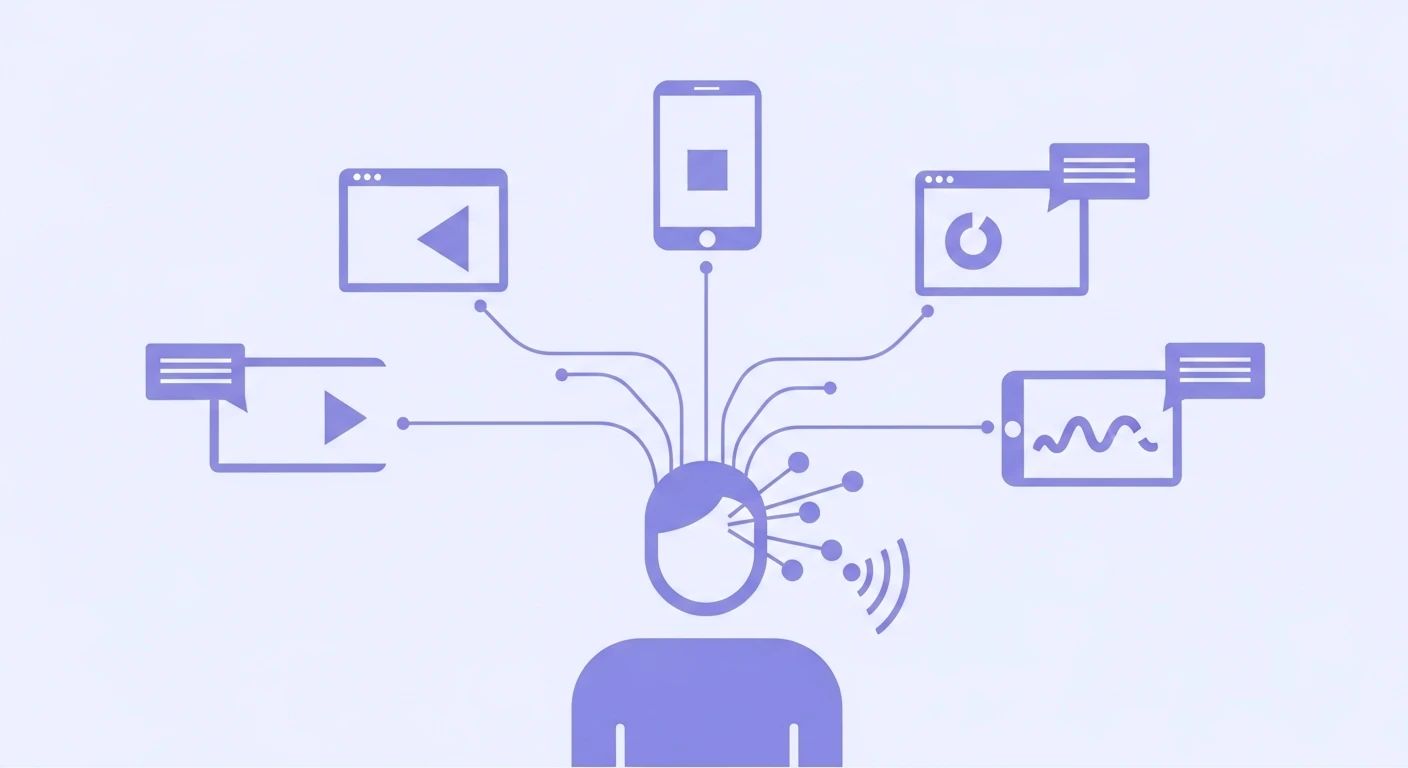
Research teams choose their data collection tools based on operational criteria: cost, scheduling ease, recording capability, team access. They treat the platform as infrastructure -- a neutral pipe through which participant data flows unchanged. This assumption is wrong, and its consequences are invisible precisely because teams rarely collect the same data through different platforms to observe the distortion.
Every platform imposes interaction norms. Zoom interviews produce performative behavior -- participants sit up straighter, construct more complete sentences, and manage their self-presentation more actively than they would in person. Text-based surveys generate abbreviated, socially filtered responses stripped of the hedging, contradiction, and emotional texture that makes qualitative data rich. Asynchronous audio tools unlock a reflective mode that real-time interactions cannot access -- but lose the probing capability that makes live interviews analytically productive.
These are not minor variations. They are systematic distortions that shape which categories of insight emerge from research. The platform effect operates below researcher awareness because teams rarely have comparative data -- they used Zoom for this study, so they have no way to know what the same participants would have shared differently on a different platform.
How Different Platforms Distort Data
Video Calls: The Performance Stage
Video interviews produce data shaped by three platform-specific forces:
Self-monitoring amplification. Seeing your own face on screen increases self-monitoring behavior. Participants become more aware of how they appear, which increases social desirability responses. The acquiescence bias amplification in video interviews documents how this platform-specific dynamic produces systematically more agreeable, less critical responses compared to audio-only or in-person formats.
Turn-taking rigidity. Video platforms enforce strict turn-taking norms -- latency and audio lag make interruption awkward and overlapping speech incomprehensible. This produces more structured, sequential responses than natural conversation allows. Participants complete their thoughts in single turns rather than building meaning collaboratively through the back-and-forth of natural dialogue.
Background context suppression. Participants choose their video backgrounds carefully (or use virtual ones). This removes the contextual cues that in-person research captures naturally: the physical environment, the artifacts on their desk, the interruptions that reveal their real workflow. The platform strips context that would enrich interpretation.
Text Surveys and Chat Interfaces
Text-based data collection produces a fundamentally different data type than spoken responses:
Editing before sending. Participants compose, review, and edit text responses before submitting them. This self-editing process removes the hesitations, false starts, contradictions, and mid-thought corrections that reveal cognitive process. The final text represents a polished, post-hoc construction rather than a real-time expression of thought.
Brevity pressure. Text interfaces create implicit expectations about response length. Even without character limits, participants calibrate their responses to what feels appropriate for the medium. A participant who would speak for three minutes about a frustration in an interview writes two sentences about it in a survey. The emotional weight and contextual detail are lost not because the participant does not have them but because the medium signals that brevity is appropriate.
Emotional flattening. Written text lacks tone, pace, emphasis, and affect markers. Participants compensate inconsistently -- some use emphatic punctuation, others write flatly about intense experiences. Researchers cannot reliably detect emotional significance in text the way they can in voice or video, making the emotional coding that reveals analytical depth substantially harder.
Asynchronous Audio and Video
Platforms that allow participants to record responses on their own time produce yet another data type:
Reflective depth. Without real-time pressure to respond immediately, participants think before speaking. This produces more considered, more structured responses -- but also more genuinely reflective ones. Participants access memories and formulations they would not reach in the time pressure of a live interview.
Loss of probing. The fundamental trade-off of async formats: you gain reflective depth but lose the ability to follow up in the moment. A live interviewer hears an interesting comment and probes deeper. An async participant makes that comment and moves on. The probing techniques that expert interviewers use to extract depth are structurally impossible in async formats.
Naturalness variation. Some participants are comfortable recording themselves. Others find it awkward and produce stilted, self-conscious responses. The platform introduces a participant-specific variable: recording comfort level becomes a filter on data quality that has nothing to do with the participant's relevant experience.
The Compounding Effect of Platform Choice
Question Types That Platform Distorts
Platform effects are not uniform across all question types. Some research questions are more sensitive to platform distortion than others:
- Behavioral recall: Relatively platform-robust. Participants report what they did similarly across platforms.
- Emotional experience: Highly platform-sensitive. Video captures affect signals; text strips them; async audio may produce more honest but less spontaneous emotional expression.
- Social context: Extremely platform-sensitive. Who else was involved, what the social dynamics were, how participants navigated interpersonal situations -- these topics trigger social desirability differently depending on whether responses feel private (text) or observed (video).
- Criticism and complaint: Platform-sensitive in predictable ways. Participants express criticism more freely in anonymous text, less freely in face-to-face video. Async formats fall between -- private enough for honesty, but recorded enough to trigger some self-monitoring.
The observer effect in UX research describes how being watched changes behavior. Platform choice determines the intensity and character of that observation effect -- real-time video maximizes it, anonymous text minimizes it, and each position on the spectrum produces different data, not better or worse data.
The Recruitment-Platform Interaction
Platform choice does not just shape data collection -- it shapes who participates. Requiring video calls excludes participants without stable internet, private spaces, or comfort with video presentation. Text surveys exclude participants with low literacy or typing fluency. Async audio excludes those uncomfortable speaking to a recording device.
This means platform effects compound with selection effects. You are not just getting distorted data from your participants -- you are getting data from a participant pool that was filtered by platform accessibility before your screening criteria even applied. The recruitment funnel fallacy describes how optimization creates bias; platform choice is a pre-funnel filter that creates its own systematic exclusions.
Practical Interventions
Platform-Aware Study Design
Before choosing a data collection platform, explicitly map the relationship between your research questions and platform characteristics:
- What data type does each question require? (behavioral, emotional, social, evaluative)
- Which platforms preserve vs. strip the signals needed for that data type?
- What population are you trying to reach, and which platforms exclude them?
This mapping will not eliminate platform effects but will make them visible and deliberate rather than accidental.
Multi-Platform Triangulation
For high-stakes research questions, collect data through multiple platforms and compare what emerges. Run some interviews on video, collect async responses from the same participants, and use text-based follow-ups for specific questions. The discrepancies between platform-specific responses are analytically valuable -- they reveal which aspects of participant experience are platform-robust (likely genuine) and which are platform-dependent (potentially artifacts).
This is a specific application of research triangulation for product decisions: using methodological variation to distinguish signal from noise. Platform triangulation is underused because it appears redundant -- why collect the same data twice? But the "same" data collected differently is not the same data. The variation reveals something.
Platform Effect Disclosure
In research reports, explicitly state the platform used and its likely effects on data character. "These interviews were conducted via video call, which may have increased social desirability responses and limited emotional expression compared to in-person formats." This disclosure does not fix the distortion but makes it visible to consumers of the research.
This aligns with the broader principle of methodological transparency in AI-assisted research -- except applied to the data collection layer rather than the analysis layer. Transparency about platform effects helps stakeholders calibrate their confidence in different findings.
Compensatory Design Within Platforms
Once you know how a platform distorts data, design your protocol to compensate:
- Video calls: Build in moments that reduce performance (turn cameras off for sensitive questions, start with low-stakes warm-up that normalizes imperfection, explicitly name that unpolished responses are more valuable)
- Text surveys: Add voice-note options for emotional questions, use progressive disclosure to signal that longer responses are welcome, include "tell me more" prompts that counter brevity pressure
- Async audio: Provide specific follow-up questions based on initial responses (delayed probing), offer multiple recording attempts to reduce performance anxiety
These compensations cannot eliminate platform effects. But they can reduce the most predictable distortions -- bringing each platform's data character closer to what the research questions actually need.
The Infrastructure Illusion
Research platforms market themselves as neutral infrastructure -- tools that simply capture data as it naturally occurs. This marketing succeeds because the platform effect is invisible without comparative data. Teams using one platform see consistent data and assume consistency means accuracy.
But consistency within a platform may reflect platform norms more than participant reality. If all your video interview participants produce polished, agreeable responses, this consistency might indicate that your research question genuinely has a clear answer -- or it might indicate that your platform is producing uniform distortion that looks like genuine agreement.
The infrastructure illusion persists because platform vendors have no incentive to reveal it and researchers have limited ability to detect it within single-platform workflows. Breaking the illusion requires deliberate methodological experiments: collecting the same data through different platforms and examining what changes. What changes is likely platform artifact. What persists is likely signal.
This is why observability in research systems matters -- not just for AI pipelines but for research pipelines. If you cannot observe how your measurement instrument (the platform) shapes your measurements (the data), you cannot distinguish instrument effects from genuine phenomena. Platform-aware research treats the collection tool as a variable to monitor, not a constant to ignore.
The Decision for Research Teams
Platform selection is a methodological decision, not an operational one. It should be made based on what data type your research questions require and which platforms preserve that data type -- not based on scheduling convenience or team familiarity.
This does not mean every study needs multi-platform design. It means every study needs platform-awareness: explicit reasoning about how the chosen platform will shape data, what distortions to expect, and what compensatory designs can mitigate predictable effects.
The platform is never neutral. Once you accept that, you can design around it rather than being distorted by it without knowing.