The Speed Imperative
Every research team faces the same pressure: move faster. Ship insights before the sprint ends. Deliver findings before the decision meeting. Turn around studies in days, not weeks.
The pressure is understandable. Product cycles have compressed. Competitors ship constantly. Stakeholders cannot wait three weeks for a research readout. So teams optimize for velocity: shorter studies, faster recruitment, automated analysis, rapid synthesis.
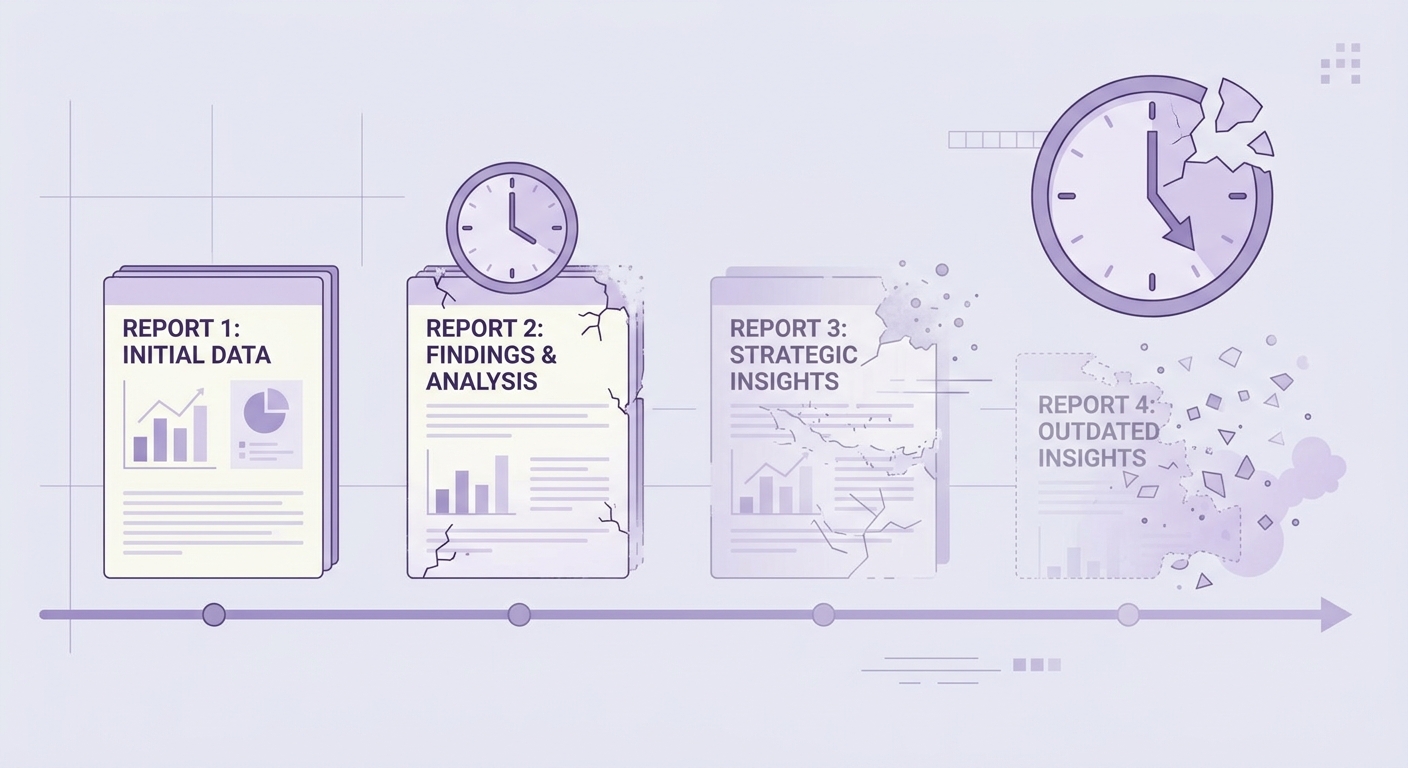
But something breaks when research operates at pure sprint speed. The findings arrive on time but lack depth. The recommendations sound right but miss context. Decisions get made faster but not better. Teams celebrate their research velocity while their product decisions quietly deteriorate.
What Actually Breaks at High Velocity
Analytical depth requires incubation time. Pattern recognition in qualitative data is not instantaneous. The connections between interview three and interview seven often become visible only after the researcher has stepped away, processed unconsciously, and returned with fresh perspective. When analysis gets compressed into hours instead of days, researchers default to surface patterns -- the obvious themes that require no incubation.
Cross-study synthesis disappears. At high velocity, each study exists in isolation. The insight from last month's diary study that reframes this week's interview finding never gets connected because nobody has time to look back. As research synthesis debt accumulates, teams have growing backlogs of insights that never connect to each other or to strategic decisions.
Stakeholder absorption cannot match research output. Even if researchers can produce findings weekly, stakeholders cannot meaningfully process them at that rate. Findings stack up unread. Recommendations get acknowledged but not internalized. The research program generates output without generating understanding -- which mirrors the broader sensemaking gap between findings and shared understanding.
Recruitment shortcuts corrupt samples. Speed demands fast recruitment. Fast recruitment means existing panels, convenience samples, and professional participants. Data quality silently degrades while velocity metrics look excellent. The panel fatigue problem compounds: the same participants tell researchers what they want to hear, faster and faster.
The Velocity Paradox
Here is the counterintuitive reality: teams that do fewer, deeper studies often produce better product outcomes than teams that ship research weekly.
A single well-designed study with proper analytical depth can inform a quarter of product decisions. A dozen rushed studies can inform none of them adequately. The volume feels productive. The depth is what actually changes decisions.
This does not mean slow research is inherently better. It means that velocity is the wrong primary metric for research programs. The right metric is decision quality: how often do research-informed decisions produce better outcomes than uninformed ones?
When research velocity increases but decision quality does not, you have a velocity trap -- a system optimized for output that has decoupled from outcomes.
Diagnosing Your Velocity Trap
Track recommendation implementation rates. If your team ships insights weekly but fewer than 30% of recommendations get implemented, velocity is outpacing absorption. You are producing faster than anyone can consume.
Measure time between finding and action. If insights sit in repositories for weeks before influencing anything, the speed of production is irrelevant. The bottleneck is elsewhere -- likely in the translation between research and design where insights need to become operational decisions.
Audit analytical depth. Compare your rushed studies to your deeper work. Do the fast studies produce findings that hold up over time? Or do they generate "insights" that get contradicted by the next study? Shallow analysis produces shallow findings that do not survive contact with reality.
Check for recycled findings. Teams in velocity traps often rediscover the same insights repeatedly because nobody has time to build on prior work. If your last three studies all surfaced some version of "users want simpler onboarding," you are not generating new knowledge -- you are running in circles at high speed.
Designing Sustainable Research Cadence
The alternative to velocity obsession is intentional cadence: a research rhythm designed around decision quality rather than output volume.
Batch discovery around decision points. Instead of continuous production, concentrate research effort before major decisions. A deeper study timed to a strategy review produces more impact than four shallow studies scattered across a month.
Build in synthesis weeks. Explicitly schedule time between studies for cross-study analysis. What patterns emerge when you read the last six months of findings together? These meta-insights often contain the highest-value strategic implications that rushing never surfaces.
Match depth to decision stakes. Not every question needs a deep study. Tactical usability questions can be answered quickly. Strategic direction questions deserve weeks. Calibrate depth to the decision weight, not to an arbitrary velocity target. This connects to principles of how research ops metrics should measure impact rather than volume.
Protect analytical incubation. Researchers need unscheduled time after data collection. Not for other projects -- for unconscious processing of the data they just collected. The insight that emerges in the shower three days after the last interview is not laziness. It is how pattern recognition actually works in qualitative analysis.
When Speed Actually Matters
Velocity is not inherently bad. Some research genuinely needs speed:
- Usability validation before a release deadline
- Quick pulse checks on a specific, narrow question
- Competitive response research with time pressure
- Live issue diagnosis where users are actively affected
The problem is not fast research. It is applying sprint speed universally to questions that require depth. The mature research program runs fast when speed matters and slow when depth matters -- and has the organizational credibility to tell stakeholders which is which.
Building Velocity Intelligence
The highest-performing research teams develop what might be called velocity intelligence: the ability to accurately assess how much analytical depth a question requires before beginning work.
This requires experience, methodological sophistication, and organizational trust. It also requires teams to track not just output metrics (studies completed, findings delivered) but outcome metrics (decisions improved, product outcomes traced to research input). Many teams that successfully implement continuous discovery habits have found that sustainability matters more than raw speed.
When outcome metrics show that faster research produces equivalent decision quality, speed up. When they show that speed degrades decision quality, slow down. Let the data about your research process guide your research process -- the same empiricism you apply to user behavior, applied reflexively to your own practice.