The User in Your Report Does Not Exist
You ran twelve interviews across a deliberately mixed sample: some power users, some newcomers, a couple of skeptical holdouts, a few enthusiastic champions. In synthesis, you did the natural thing -- you looked for what they had in common and wrote it up. "Users want faster onboarding but worry about losing control." It reads like a finding. It is actually an average, and the average user it describes was not any of the twelve people you talked to.
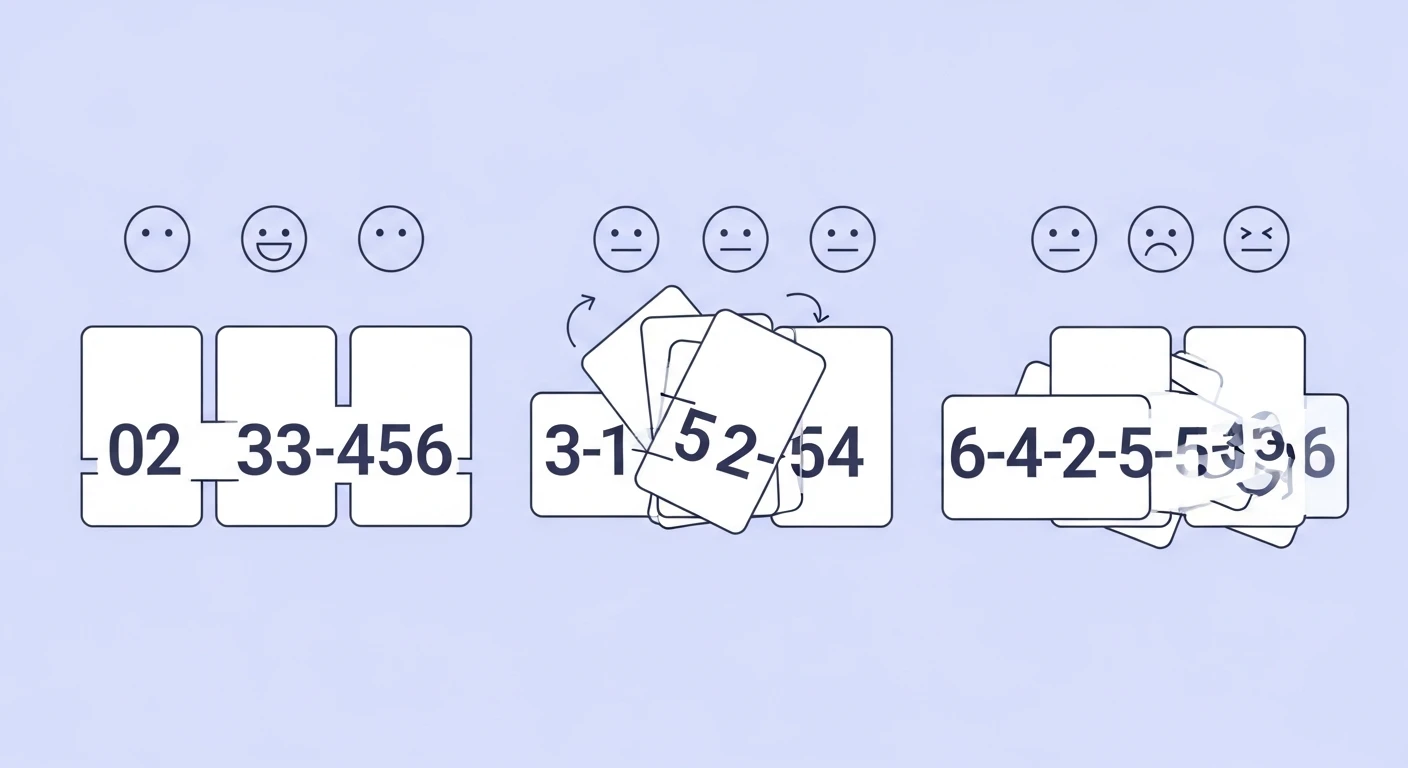
The power users did not want faster onboarding; they wanted deeper configuration. The newcomers were not worried about losing control; they did not know enough yet to fear it. The sentence that felt like a synthesis is a blend that is simultaneously true of the aggregate and false of every single participant. This is the segment averaging illusion: the moment you collapse a heterogeneous sample into one composite voice, you manufacture a user who reconciles contradictions no real person holds, and then your team designs for that impossible person.
Why the Average Is Worse Than Any Individual
An average is a defensible summary when the thing being averaged is roughly unimodal -- when most people cluster around a middle. It is actively misleading when the distribution is bimodal or multimodal, which is almost always the case in a well-recruited qualitative sample, because good recruitment deliberately spans different segments. When you average across a bimodal population, the mean lands in the valley between the two peaks -- a value that describes the fewest actual people. You end up with a persona nobody matches and a roadmap that half-satisfies everyone and fully satisfies no one.
This is a close cousin of the dilution effect in large-sample qualitative research, where adding more interviews floods the signal and the distinctive segment insight gets washed into a bland aggregate. Averaging is dilution's more deliberate sibling: dilution happens to you as N grows, but segment averaging is a choice you make in synthesis, and it can flatten even a small, sharp sample into mush.
How the Blend Sneaks Into Synthesis
Segment averaging rarely announces itself. It arrives through three quiet doors.
The first is theme frequency. When you code across the whole sample and count how often a theme appears, you implicitly weight every participant equally and let the largest subgroup dominate the narrative. But frequency is not importance, and a theme that appears in eight lukewarm mentions can bury a theme that appears in three intense ones from a critical segment -- which is the heart of the counting trap, where theme frequency gets mistaken for theme significance. Averaging by count silently privileges the majority segment and erases the minority one.
The second door is the composite persona. Personas are supposed to represent segments, but under deadline pressure teams merge them: one persona to rule them all, stitched from traits that never co-occur in a real human. The result is a Frankenstein user with the newcomer's confusion and the power user's ambitions -- internally contradictory, and impossible to design a coherent flow for.
The third door is the headline finding. Executives want one sentence. The one-sentence version of a multimodal study is, by construction, an average, and once it is spoken in a debrief it becomes the thing everyone remembers -- an effect amplified by the availability cascade in stakeholder debriefs, where the first tidy summary shared becomes the organization's canonical version of the truth. The blend, once uttered, is very hard to un-say.
What Good Synthesis Does Instead: Segment-Preserving Analysis
The fix is not to stop summarizing. It is to summarize within segments before -- and often instead of -- summarizing across them. Concretely:
- Analyze each segment as its own study first. Before you look for what unites the sample, write the finding for each subgroup in its own terms. The power users' story, the newcomers' story, the skeptics' story. Only then ask whether anything genuinely spans them.
- Report the split, not the mean. When two segments diverge, the finding is the divergence itself -- "newcomers want X, power users want the opposite" -- not a compromise between them. A contradiction preserved is more useful than a contradiction averaged away.
- Weight by decision relevance, not by headcount. If the segment you are actually building for is a minority of your sample, its voice should dominate the synthesis regardless of frequency. Let the decision, not the arithmetic, choose whose story leads.
- Guard the outliers. The participant who fits no segment is often the early signal of a segment you have not named yet, which is why negative case analysis -- treating the participants who contradict your emerging themes as your most valuable data -- is the antidote to premature blending. The average deletes the outlier; good analysis interrogates it.
The Systems Lesson: Aggregation Destroys Information
This is not a uniquely human analytical failing -- it is a general property of aggregation, and mature data engineering treats it as a first-class hazard. Any pipeline that rolls heterogeneous records up into a single summary statistic is throwing away the variance that often carried the real signal, which is why serious teams insist that data contracts in AI pipelines preserve the granularity and segment structure of the source data rather than pre-aggregating it into an irreversible summary. Once you have averaged, you cannot recover the modes; the information is gone. The discipline of keeping raw, segmented data addressable all the way through the pipeline is the same discipline a researcher needs in synthesis: never collapse the distribution before you have learned its shape.
The deeper point connects to how research actually drives product decisions. A blended finding feels safe because it offends no segment, but it also informs no decision, because you cannot build a coherent experience for a contradictory composite. The value of qualitative work is precisely its ability to hold multiple real users in view at once -- which is why research triangulation for product decisions depends on keeping distinct evidence streams distinct rather than averaging them into false agreement. The blend is the enemy of the decision.
Bringing It Into Your Practice
On your next mixed-sample study, try this constraint: you are not allowed to write a single cross-sample sentence until you have written a complete, standalone paragraph for each segment. Most teams discover that once the segment paragraphs exist, the cross-sample average they were about to lead with looks obviously wrong -- because they can finally see the two peaks it was trying to sit between.
Qualz.ai is built to keep segments intact through analysis -- letting you slice themes, quotes, and sentiment by subgroup rather than collapsing them into a composite that matches no one. If your team keeps designing for an average user who was never in the room, book a demo and see what segment-preserving synthesis does to the clarity of your findings.