The Text Looks Complete. It Isn't.
AI transcription is one of the genuine gifts of the last few years for research teams. What used to cost hours and dollars per interview is now instant and nearly free, and the output is clean enough to read like a script. That is exactly the problem. The transcript is so good at capturing the words that it creates the impression it has captured the interview -- and it hasn't. It has captured one channel of a multi-channel signal and discarded the rest without telling you.
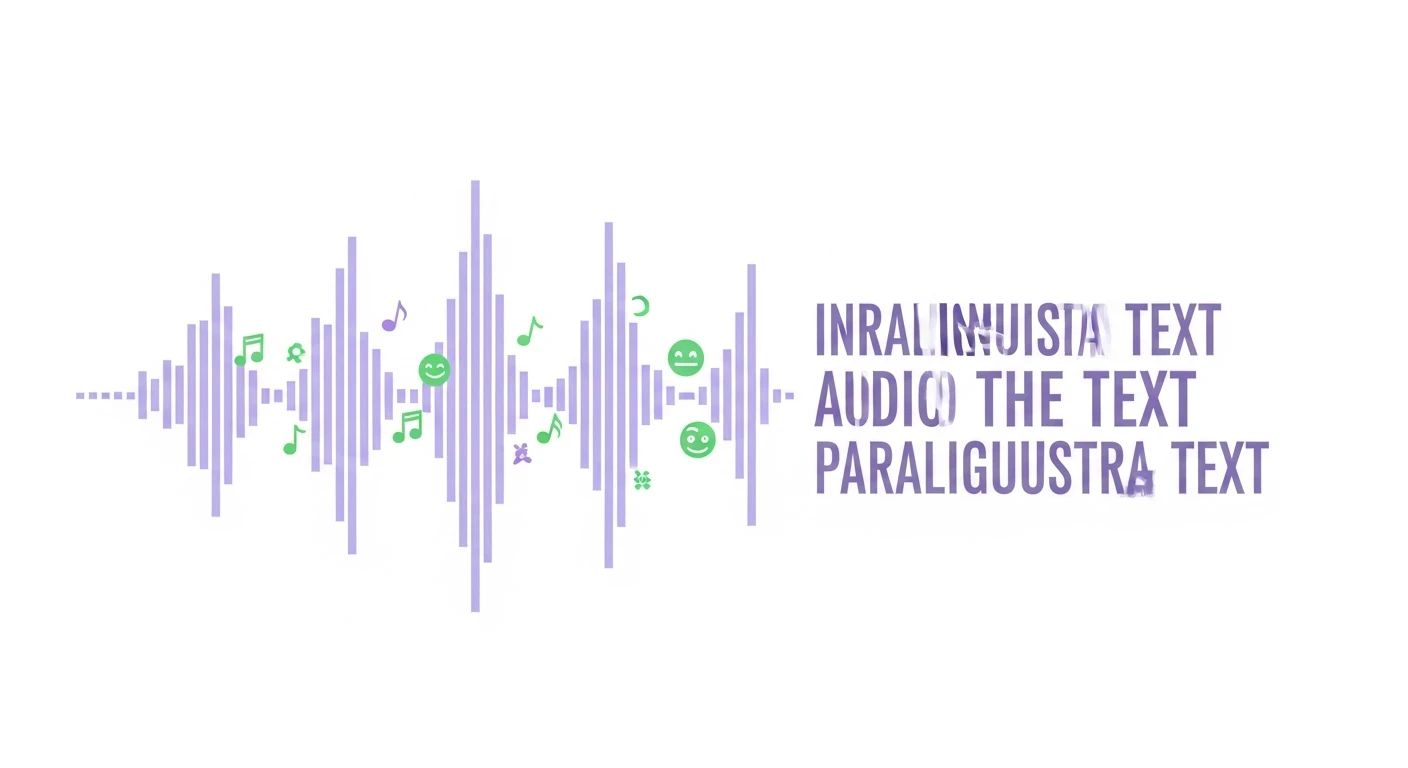
The transcription substitution effect is what happens when the transcript stops being an index into the recording and becomes a replacement for it. Once the text exists and reads fluently, the recording goes unopened. The team codes from words on a page, quotes from words on a page, and builds findings from words on a page -- and the paralinguistic layer that carried half the meaning, the tone and timing and hesitation that told you whether a statement was confident or performed or ironic, was gone before analysis even began.
What Actually Falls Off the Page
Spoken language is not text read aloud. It is text plus a continuous stream of prosodic and temporal information that listeners decode automatically and transcripts throw away. "Yeah, it's fine" is agreement, resignation, or sarcasm depending entirely on contour and pause -- and the transcript renders all three identically. The single most analytically important event in many interviews, the pause before an answer, does not survive at all. A three-second silence before "no, I never really had trouble with it" is the whole finding; on the page it is just a sentence.
This is a close cousin of the modality mismatch problem, where tools built for text systematically miss what video and audio data reveal. It also amplifies the silence problem in interviews, where the pauses carry information that words alone cannot -- because a transcript does not merely under-represent silence, it erases it, and an erased pause cannot be recovered by re-reading. Worst of all, when an automated summarizer works from the same flattened text, it fills the missing prosody with invented confidence, the confabulation risk where fluent machine-written findings manufacture coherence that was never in the data.
Why the Loss Is Invisible Until It Costs You
The insidious part is that a transcript never announces what it dropped. A truncated file throws an error; a flattened tone does not. The text looks whole, reads smoothly, and gives every appearance of being the complete record, so no one thinks to check the audio -- and the absence of the paralinguistic layer is precisely the kind of loss you cannot detect by inspecting what remains. This is the same failure mode enterprise AI teams fight with observability and monitoring, where the dangerous failures are the silent ones that leave the dashboard green: the system looks healthy exactly because the missing signal is missing.
And it compounds down the funnel. A quote pulled from a transcript arrives with no tonal context, so the analyst supplies their own -- reading confidence into a line that was actually hesitant, or sincerity into one that was dry. That is the decontextualization problem, where quotes lose meaning when extracted from the conversation, made worse because even the analyst who was in the room reconstructs tone from memory once the audio goes unrevisited. By the readout, a resigned "it's fine" has become evidence of satisfaction, and the product team hears the opposite of what the participant meant.
Using Transcripts Without Being Fooled by Them
The answer is not to abandon transcription -- the efficiency is real and worth keeping. The answer is to demote the transcript from record to index, and to build the workflow so the audio stays in the loop.
- Treat the transcript as a map to the recording, not a substitute for it. Code from text for speed, but return to the audio for any quote that will carry weight in the findings.
- Timestamp and re-listen to decisive moments. The lines that will drive a decision are exactly the ones whose tone you cannot afford to guess. Anchor them to the recording the same way you would anchor abstract claims to concrete episodes.
- Annotate prosody as you go. Mark hesitation, sarcasm, and emotional shifts directly in the transcript during a listening pass, so the paralinguistic layer is preserved as data rather than lost to memory.
- Keep the audio in the analytic loop the way mature AI pipelines keep raw inputs traceable through audit trails that let you trace any finding back to its source. A finding you cannot trace back to a moment you actually heard is a finding built on the transcript's guess.
The Recording Is the Data. The Transcript Is a Compression.
Every transcript is a lossy compression of an interview, and AI made that compression so clean it stopped looking lossy. The discipline that separates rigorous teams is remembering what the compression threw away and refusing to let the convenient proxy become the analyzed object. The words are on the page. The meaning, often, is still in the audio -- and it is still there only if you go back and listen.
Qualz.ai keeps the recording and the transcript bound together, so tone, pause, and emphasis stay one click away from every coded line and every quote in your findings. See how Qualz.ai keeps the meaning in the loop.