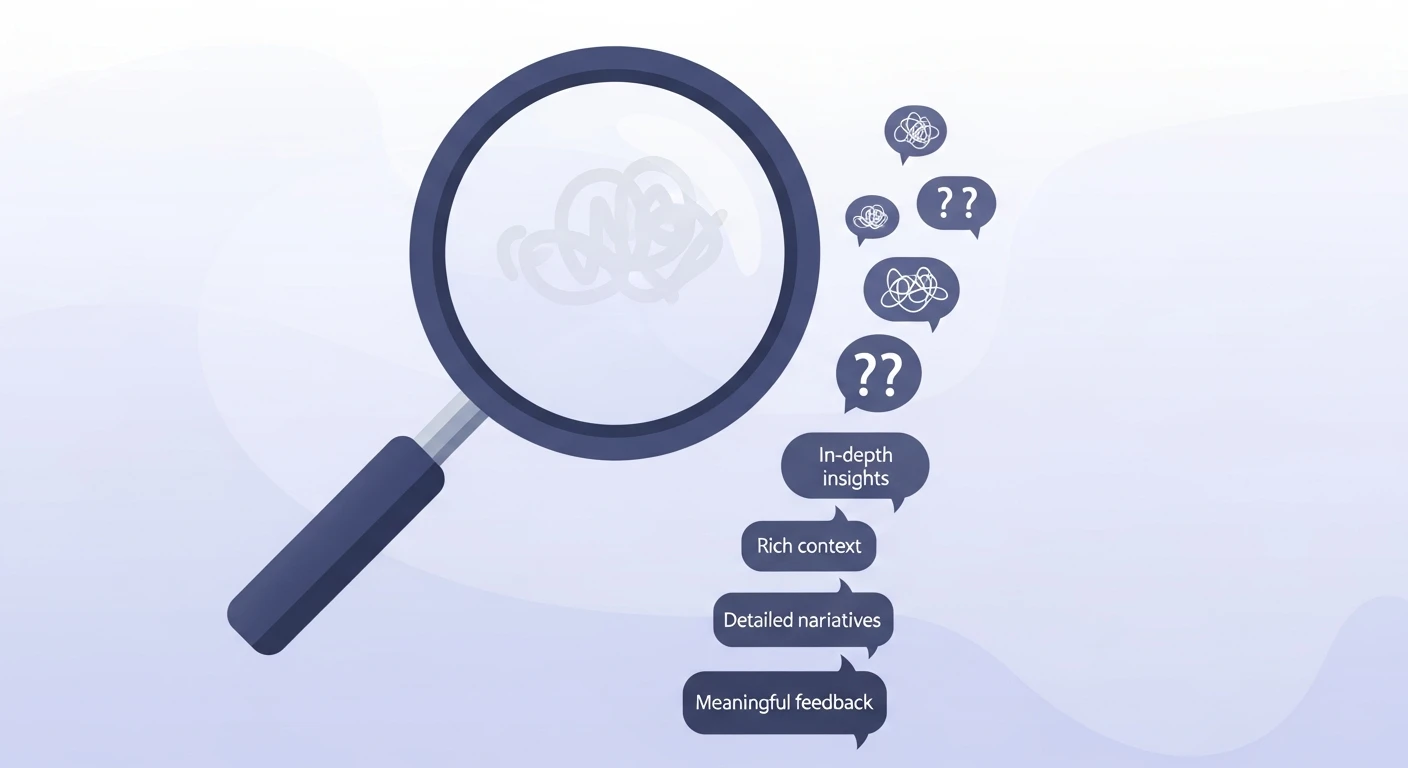
The Performance Problem in User Interviews
Every researcher has experienced it. You ask a carefully crafted question — "How would you describe your experience with our product?" — and receive an answer that sounds rehearsed. The participant pauses, constructs something socially appropriate, and delivers a response that tells you almost nothing about their actual experience.
This is not a participant problem. It is a question design problem.
When questions operate at high levels of abstraction, they activate what social psychologists call impression management processes. The participant stops retrieving experience and starts constructing performance. They are not lying — they are doing exactly what abstract questions implicitly request: summarize, evaluate, and present a coherent narrative.
The specificity gradient offers a framework for understanding why this happens and how to engineer questions that bypass performative responses entirely.
Understanding the Specificity Gradient
The specificity gradient describes four levels at which questions can operate, each producing fundamentally different types of participant responses:
Level 1: Abstract — "How do you feel about project management tools?"
Abstract questions ask participants to generate opinions about categories. They require the participant to aggregate across all experiences, select representative moments, construct a coherent evaluation, and present it in socially appropriate terms. The cognitive load is enormous, and the result is almost always a polished abstraction that reveals nothing actionable.
Level 2: Category — "What frustrates you about task assignment features?"
Category questions narrow the scope but still require aggregation. The participant must recall multiple instances of frustration, identify patterns, and articulate a summary. Better than abstract, but still produces generalized responses rather than experiential data.
Level 3: Instance — "Tell me about a specific time when you tried to assign a task and something went wrong."
Instance questions anchor the participant in a concrete event. They shift from evaluation mode to retrieval mode — the participant begins accessing episodic memory rather than constructing semantic summaries. The data quality jumps dramatically because you are accessing actual experience rather than rationalized narrative.
Level 4: Moment — "When you clicked the assign button and saw that error message, what went through your mind in that exact second?"
Moment questions drill into micro-experiences within specific instances. They produce the richest data because they access pre-reflective experience — what happened before the participant had time to construct meaning around it. This is where you find the articulation gap at its narrowest, because you are asking about something so specific that social performance becomes impossible.
Why Abstract Questions Trigger Social Performance Mode
The mechanism is straightforward but underappreciated. Abstract questions create a cognitive context where performance is the rational response.
Consider what happens neurologically when someone is asked "How do you feel about remote collaboration tools?" The prefrontal cortex activates for evaluation and judgment. The participant accesses semantic memory (general knowledge) rather than episodic memory (specific experiences). Self-monitoring circuits engage because the response will represent them as a person. Social desirability bias activates because there is no anchoring event to constrain the response.
The participant is not being evasive. They are responding rationally to the implicit demands of the question. An abstract question says: "Give me your considered opinion." And considered opinions are, by definition, performances.
Compare this with what happens when you ask "Walk me through what happened the last time you tried to schedule a meeting with someone in a different timezone." The hippocampus activates for episodic retrieval. The participant begins re-experiencing the event rather than evaluating a category. Self-monitoring decreases because they are reporting what happened, not what they think. Specificity constrains social desirability because fabricating a convincing false narrative about a specific event is cognitively expensive.
The Articulation Barrier and How Specificity Bypasses It
One of the deepest problems in qualitative research is that participants often cannot articulate their actual experiences, motivations, and decision processes. This is not because they are withholding — it is because much of human experience operates below the threshold of reflective awareness.
Abstract questions amplify this barrier. When you ask "Why do you prefer tool A over tool B?" you are asking the participant to access causal reasoning about their own preferences — reasoning that may not exist in accessible form. They will generate a plausible-sounding reason (post-hoc rationalization), but it may have nothing to do with their actual behavior drivers.
Specific questions bypass the articulation barrier by not requiring articulation of abstract reasoning. Instead of asking why, you ask what happened. Instead of requesting evaluation, you request narration. The participant does not need to understand their own motivations — they just need to describe what they did and what they experienced.
This is why probing techniques for depth always emphasize concrete follow-ups. The probe "Can you tell me more about that?" after an abstract response often produces another abstract response. But "What did you do next?" after a specific narrative reliably produces more specific narrative.
Practical Techniques for Converting Abstract Questions to Specific Ones
The conversion process follows predictable patterns that any researcher can learn:
The Last Time Anchor
Take any abstract question and add "the last time" to it.
- Abstract: "How do you handle conflicting priorities?"
- Specific: "Tell me about the last time you had two urgent tasks competing for your attention. What happened?"
The temporal anchor forces episodic retrieval. The participant cannot generate a polished performance because they are locked into a specific event.
The Walk-Through Request
Replace evaluative questions with narration requests.
- Abstract: "What do you think about our reporting dashboard?"
- Specific: "Walk me through what you did the last time you needed to pull data for a stakeholder meeting."
This technique produces behavioral data rather than attitudinal data. You learn what people actually do rather than what they think they do.
The Moment Zoom
After getting an instance narrative, zoom into specific decision moments.
- Participant: "So I was looking at the dashboard and decided to export the data instead."
- Moment zoom: "Right at that moment when you decided to export — what were you seeing on screen that made you switch approaches?"
This produces micro-behavioral data that reveals interface friction, cognitive load moments, and decision triggers that participants would never surface through abstract questioning.
The Contrast Anchor
Use known events to create comparative specificity.
- Abstract: "Has the product improved over time?"
- Specific: "Think about the last time you created a report in January versus the most recent one. What was different about the experience?"
Contrast anchors force comparative retrieval across specific instances, producing rich data about experiential differences without requiring abstract evaluation.
This approach to question design parallels principles from context engineering — just as providing specific context to AI systems produces more precise outputs, providing specific anchors to research participants produces more precise responses. The quality of input determines the quality of output in both human and machine contexts.
The Specificity-Quality Relationship Is Not Linear
A critical nuance: more specificity does not always produce better data. The relationship has an optimal zone.
Too abstract (Level 1) produces performances and rationalizations. Optimal specificity (Levels 3-4) produces experiential data and behavioral narration. Too specific can produce confusion or trivial responses — "What color was the button?" may anchor too narrowly to reveal anything meaningful.
The skill lies in calibrating specificity to match your research question. If you need to understand decision patterns, anchor at the instance level and zoom into decision moments. If you need to understand emotional responses, anchor at the instance level and probe for felt experience within that instance.
The parallel to structured output engineering is instructive here. Just as structured prompts constrain LLM outputs into useful formats without over-constraining into meaninglessness, structured questions constrain participant responses into experiential data without over-constraining into triviality. The design challenge is identical: find the constraint level that maximizes signal.
When Abstract Questions ARE Appropriate
Despite everything above, abstract questions serve legitimate research functions in specific contexts:
Opening new conceptual territory. When you genuinely do not know what categories exist in a participant's experience, a broad question like "Tell me about your relationship with time management" can reveal conceptual frameworks you would never have anticipated. The key is using abstract questions for exploration, not for data collection.
Assessing mental models. Sometimes you specifically want to know how participants conceptualize something — not what they experience, but how they think about it. Abstract questions access these mental models directly.
Warm-up and rapport. Early abstract questions can establish conversational comfort before specific probes. The participant practices talking with you on low-stakes terrain.
Triangulation. Comparing abstract responses (what people say they do) with specific narrative responses (what they report actually doing) reveals gaps that are themselves valuable data.
The error is not in asking abstract questions. The error is in expecting abstract questions to produce experiential data. They produce attitudinal data, which has its own validity for its own purposes.
Implementing the Gradient in Your Research Practice
Practical implementation requires restructuring interview guides around specificity progression:
Opening (2-3 minutes): Abstract questions for rapport and mental model mapping. Accept that responses will be performative. That is fine — you are warming up, not collecting core data.
Anchoring (5-7 minutes): Transition to instance-level questions. "Let me get specific — can you tell me about the last time you..." This is where the participant shifts from performance mode to retrieval mode.
Deep exploration (15-25 minutes): Operate at instance and moment levels. Follow narrative threads with moment-zoom probes. This is where your core data lives.
Synthesis (3-5 minutes): Return to category-level questions to test whether the participant's abstract framing matches their reported experience. Gaps between abstract self-description and specific narrative are goldmines.
The specificity gradient is not just a questioning technique — it is a fundamental framework for understanding what kind of data different question designs can access. Master it, and you stop collecting performances and start collecting experiences.
The difference between good research and transformative research often comes down to this single design choice: did you ask questions that let participants perform, or questions that required them to remember?