Every strategic initiative starts with the same ritual: interview the stakeholders. Talk to customers, partners, internal leaders, industry experts. Collect perspectives. Synthesize findings. Present recommendations.
The ritual is sound. The execution is almost always broken.
Here is what typically happens. A team conducts 30 to 50 interviews over several weeks. Each interviewer takes notes in their own format — some detailed, some skeletal. The notes sit in a shared drive. Someone reads through them, highlights themes they notice, and builds a PowerPoint. The themes that make the final deck are the ones that confirm what leadership already believed, flavored with a few memorable quotes.
This is not analysis. It is confirmation bias wearing a research costume.
The gap between conducting stakeholder interviews and extracting genuine strategic intelligence is enormous. And it has nothing to do with the quality of the conversations. It has everything to do with what happens after the conversations end.
Why Stakeholder Interview Analysis Fails
The failure modes are predictable because they stem from structural problems, not individual incompetence.
The Volume Problem
Fifty one-hour interviews produce roughly 500,000 words of transcript. No human being can hold that volume in working memory. When an analyst reads through fifty transcripts, they are not synthesizing — they are sampling. They remember the vivid quotes, the dramatic anecdotes, the perspectives that surprised them. Everything else fades.
This creates a systematic bias toward the memorable over the representative. The stakeholder who told a compelling story about a product failure gets disproportionate weight. The fifteen stakeholders who described a subtle but consistent pattern in how they evaluate vendors — a pattern that would reshape your go-to-market strategy — get lost in the noise.
The Coding Problem
Rigorous qualitative analysis requires systematic coding — tagging segments of text with thematic labels, then analyzing the frequency, co-occurrence, and relationships among those codes. This is the difference between "I read the transcripts and here's what I think" and "here is what the data actually shows."
Most stakeholder interview projects skip coding entirely. Not because the team does not know it exists, but because coding fifty transcripts manually takes 200 to 400 hours. At consulting rates, that is $50,000 to $150,000 in analyst time. For an internal team, it is two to three months of dedicated work. Neither is practical when leadership wants findings in two weeks.
The result: teams default to impressionistic analysis. They scan transcripts, pull quotes, and organize them under headings that feel right. The output looks like research but lacks the systematic rigor that makes research trustworthy.
The Cross-Reference Problem
The most valuable insights from stakeholder interviews are not what any single person said. They are the patterns that emerge across conversations — the contradictions between what customers say and what internal teams believe, the consensus points that cut across organizational silos, the minority perspectives that predict where the market is heading.
Identifying these patterns requires cross-referencing every statement against every other statement. That is a combinatorial problem. With fifty interviews, you have 1,225 possible pairwise comparisons. No analyst does this systematically. They compare the interviews they remember most vividly, which circles back to the sampling bias problem.
A Better Framework: Systematic Stakeholder Analysis
The approach that actually works treats stakeholder interviews as a data pipeline, not a reading exercise. Here is how to structure it.
Phase 1: Structured Collection
The analysis starts before the first interview. Design your interview guide with analysis in mind.
Use consistent question domains. Every interview should cover the same core topics, even if the specific questions vary by stakeholder type. If you are evaluating a market opportunity, every interview should address market dynamics, competitive landscape, unmet needs, and adoption barriers — whether the stakeholder is a customer, a competitor, or an internal product leader.
Record everything. This seems obvious but is violated constantly. Teams that rely on notes instead of recordings lose 60 to 80 percent of the data. Modern AI transcription tools make this trivially easy and inexpensive.
Tag interviews at collection time. Before you start analyzing, tag each interview with metadata: stakeholder type, organization size, industry, role level, relationship to the topic. This metadata becomes your segmentation framework during analysis.
Phase 2: AI-Accelerated Coding
This is where the economics of stakeholder analysis have fundamentally changed.
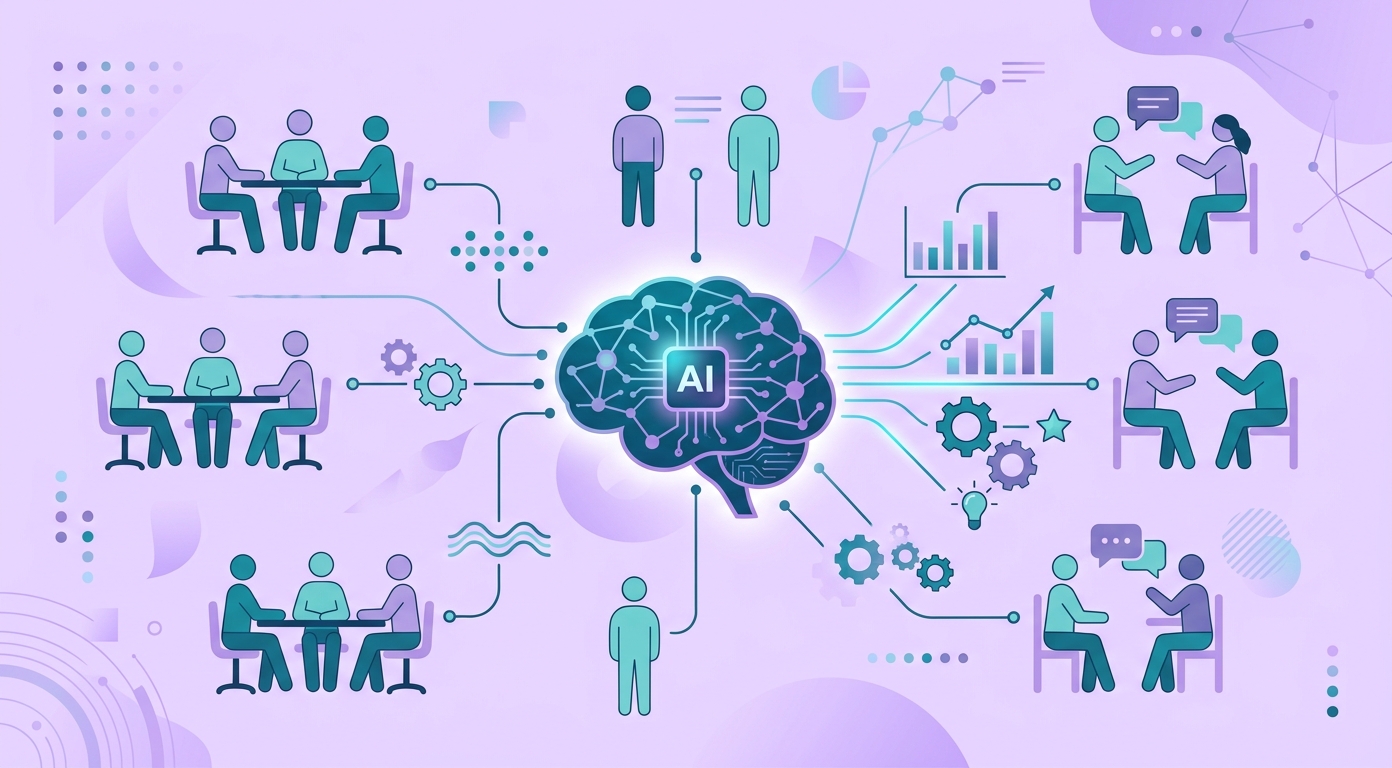
Traditional qualitative coding requires trained researchers spending hours per transcript. AI-powered coding can process a one-hour transcript in minutes, applying consistent codes across the entire corpus without fatigue or drift.
The key word is "accelerated," not "automated." The AI generates initial codes and applies them systematically. A human researcher reviews, adjusts, and validates. This hybrid approach delivers 80 to 90 percent of the rigor of fully manual coding at 10 to 20 percent of the cost and time.
For large-scale stakeholder studies — the kind that consulting firms and PE due diligence teams run regularly — this shift is transformative. What used to require a team of four analysts working for six weeks can now be done by one analyst in one week.
The critical requirement is that the AI coding system maintains an auditable codebook. Every code must have a clear definition. Every application of a code must be traceable to a specific passage in a specific transcript. Without this, you have summarization, not analysis.
Phase 3: Cross-Stakeholder Pattern Analysis
With systematic codes applied across all fifty interviews, you can now do what impressionistic analysis cannot: identify patterns with precision.
Consensus mapping. Which themes appear across more than 70 percent of stakeholders? These are your high-confidence findings — the things that virtually everyone agrees on. In strategy work, consensus findings often reveal table-stakes requirements that your initiative must address to be viable.
Divergence analysis. Where do stakeholder groups disagree? If customers say the market is moving toward self-service but your sales team insists enterprise buyers need high-touch engagement, that divergence is strategically important. It might mean your sales team is clinging to an outdated model. Or it might mean your customers are describing aspirations rather than actual behavior. Either way, the divergence demands investigation.
Signal detection. Which themes appear in fewer than 20 percent of interviews but are mentioned with high conviction? Minority signals in stakeholder interviews often predict emerging trends. The three stakeholders out of fifty who describe a workflow change that nobody else mentioned — that might be the leading edge of a market shift. Traditional analysis misses these signals because they get drowned out by majority themes.
Contradiction mapping. What do stakeholders say that directly contradicts what they do? This is particularly valuable in competitive intelligence. A stakeholder might describe their organization as "AI-forward" while describing a technology stack that is entirely manual. The gap between stated and revealed preferences is where strategic opportunities hide.
Phase 4: Structured Synthesis
The output of stakeholder analysis should not be a narrative document. It should be a structured intelligence product.
Evidence-backed findings. Every finding must cite the specific interviews that support it, with the exact prevalence (e.g., "mentioned by 34 of 47 stakeholders, including all 12 enterprise customers and 8 of 9 channel partners").
Confidence levels. Not all findings are equally robust. A finding supported by 40 stakeholders with consistent language is higher confidence than one supported by 15 stakeholders with varied descriptions. Make the confidence explicit.
Strategic implications. For each finding, articulate what it means for the specific decision being made. "Stakeholders consistently describe X" is an observation. "Because stakeholders consistently describe X, our go-to-market should prioritize Y over Z" is strategic intelligence.
Dissenting evidence. For every major finding, include the strongest counterargument from the data. This is not about being balanced for the sake of it — it is about giving decision-makers the full picture so they can stress-test the recommendations.
Scaling the Approach
The framework above works for a single study. But the real leverage comes when you treat stakeholder intelligence as a cumulative asset rather than a one-time project.
Building a Stakeholder Knowledge Base
Every stakeholder interview your organization conducts should feed into a searchable, analyzable repository. When you are planning a new product launch in Q3, you should be able to query not just the interviews you conducted for that launch, but every customer conversation from the past two years that touched on the relevant market segment.
This is the concept behind a research repository that teams actually use — not a graveyard of old reports, but a living system where past research compounds into organizational intelligence.
Cross-Study Synthesis
The most powerful form of stakeholder analysis connects findings across multiple studies. Your competitive intelligence interviews from January, your customer discovery interviews from March, and your partner feedback sessions from June — when analyzed together — reveal patterns that no single study could surface.
This kind of qualitative synthesis at scale was impractical before AI-powered analysis tools. It required a senior researcher with institutional memory spanning years of studies. Now, the tools can surface cross-study connections systematically, while the researcher focuses on interpreting what those connections mean.
Quality Assurance
The concern with AI-accelerated analysis is always the same: how do you know the AI got it right?
The answer is the same as with human analysis: systematic validation. The principle mirrors what evaluation-driven development has taught us in production AI systems — you build evaluation into the process, not after it.
Run inter-rater reliability checks between AI codes and human codes on a sample of transcripts. If agreement exceeds 85 percent, the AI coding is production-quality. If it does not, refine the codebook and re-run. This is faster and more rigorous than checking whether a single human analyst coded consistently across fifty transcripts — which most organizations never do.
What Changes When You Get This Right
Organizations that move from impressionistic stakeholder analysis to systematic intelligence extraction see three things happen.
Decisions speed up. When findings are evidence-backed with explicit confidence levels, leadership does not need three rounds of "but what about..." challenges. The data is there. The counterarguments are pre-addressed. Decision meetings go from two hours to thirty minutes.
Strategy gets sharper. Instead of generic insights ("customers want better integration"), you get specific, actionable intelligence ("14 of 18 mid-market customers in financial services describe their primary integration pain as data latency between CRM and billing systems, with 9 specifically naming a sub-two-second threshold").
Institutional knowledge compounds. The stakeholder interviews your organization conducts this quarter do not disappear into a slide deck archive. They become part of a growing intelligence base that makes every subsequent study faster and more insightful.
The technology to do this exists today. The bottleneck is no longer cost or tooling — it is the willingness to treat qualitative evidence with the same systematic rigor that organizations already apply to quantitative data.
Fifty expert conversations contain more strategic value than most organizations will ever extract. The question is whether you are willing to build the analysis infrastructure that unlocks it.