The Allure of Synthetic Participants
The promise is compelling: generate hundreds of simulated user responses overnight, iterate on product concepts without recruitment delays, and explore edge cases no real participant would represent. AI-generated synthetic participants have become a serious consideration for research teams under pressure to deliver insights faster than traditional recruitment allows.
But speed without validity is not research -- it is speculation dressed in research clothing. The fundamental question most teams skip is deceptively simple: do these synthetic responses actually correspond to what real humans would say? Without answering that question empirically, synthetic participant data is theater -- useful for generating hypotheses but dangerous as a foundation for product decisions.
The calibration problem is not theoretical. Teams deploying synthetic participants without validation are making implicit claims about human behavior based on patterns a language model learned from training data. Those patterns reflect internet text, not the lived experience of your specific user population. The gap between what a model predicts a user would say and what that user actually says is the calibration gap -- and it is larger than most teams assume.
Where Synthetic Responses Diverge From Reality
The Coherence Problem
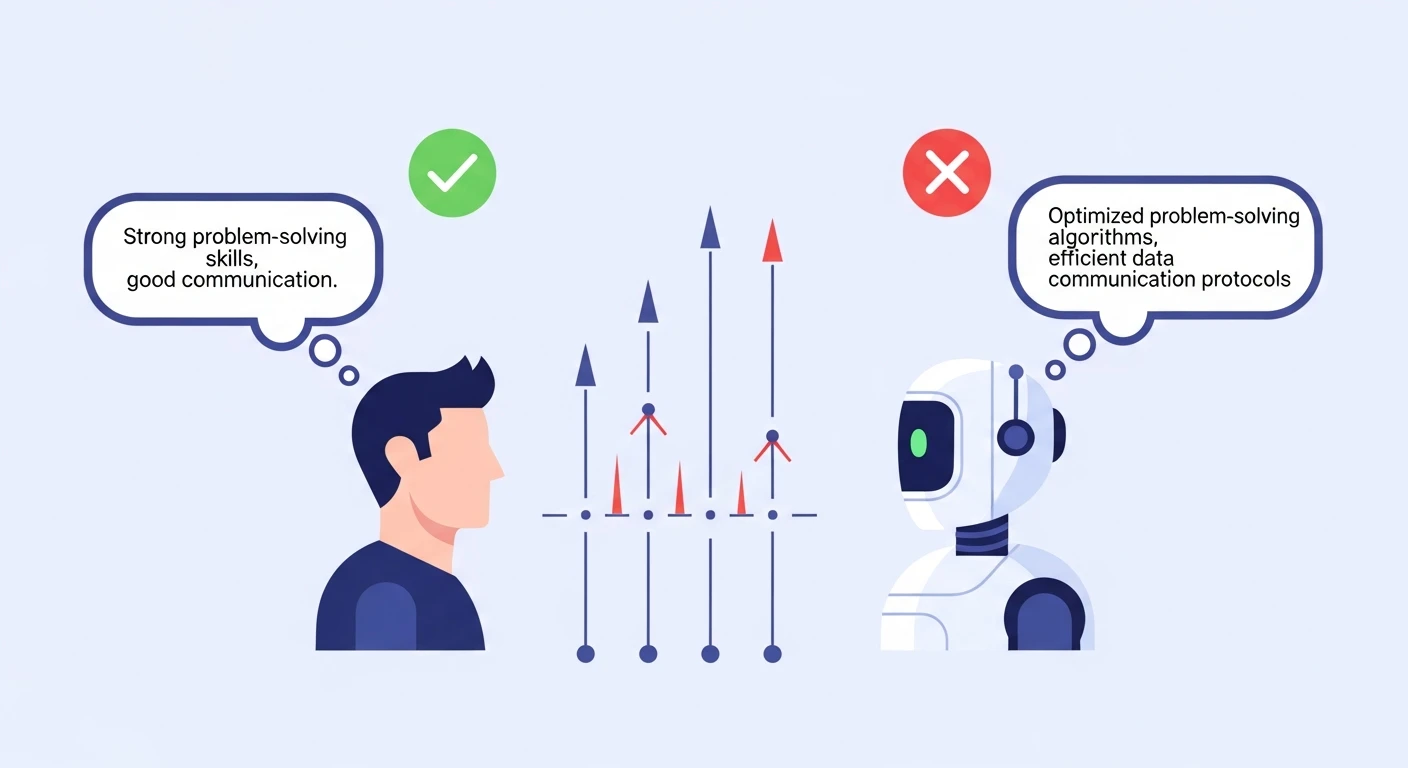
Real human responses are messy. Participants contradict themselves, trail off mid-thought, express uncertainty, and construct meaning in real-time through the conversational exchange. AI-generated responses are unnaturally coherent -- they present organized, internally consistent narratives that lack the productive messiness of genuine human expression.
This coherence is not a feature -- it is a validity threat. The articulation gap in real user research reveals that the most important experiences are precisely those users struggle to express clearly. Synthetic participants never struggle. They never say "I do not know how to explain this" or fall silent when processing an emotionally complex experience. They produce fluent text about everything, including experiences that real users find inarticulable.
The danger: teams using uncalibrated synthetic data mistake coherence for accuracy. A synthetic response that articulately describes a user journey feels more trustworthy than a real participant who stumbles through a fragmented, contradictory account of the same journey. But the fragmented real account contains information -- about cognitive difficulty, emotional complexity, and experiential nuance -- that the synthetic response simply cannot capture.
The Social Desirability Vacuum
Real participants manage self-presentation during interviews. They want to appear competent, reasonable, and helpful. This social desirability pressure shapes what they share and how they share it -- and experienced researchers learn to read through it, using probing techniques to access what lies beneath the managed surface.
Synthetic participants have no social self to manage. They respond without the filtering that real humans apply -- but they also respond without the emotional stakes that make filtered responses analytically valuable. When a real participant avoids a topic, that avoidance is data. When a synthetic participant addresses everything directly, you lose the signal that evasion and discomfort provide.
Conversely, synthetic responses sometimes simulate social desirability in ways that do not match real population patterns. The model has learned from text that includes social desirability artifacts, so it reproduces them -- but calibrated to internet text patterns rather than to the specific social dynamics of your research context.
The Distributional Mismatch
Synthetic participant responses cluster around modal behaviors -- the most common, most expected, most statistically average responses. Real participant populations include genuine outliers, edge cases, and surprising perspectives that no model reliably generates because they are, by definition, low-probability outputs.
But qualitative research derives much of its value from precisely these unexpected data points. Negative case analysis -- examining the participants who contradict emerging patterns -- is a core analytical technique that requires genuine deviation, not model-generated approximations of deviation.
When teams calibrate synthetic outputs against real data, they consistently find that synthetic populations are narrower than real ones. The tails of the distribution -- where the most analytically interesting data lives -- are underrepresented or absent in synthetic samples.
A Calibration Framework
Step 1: Establish Human Baselines
Before using synthetic participants for any research question, collect real human responses to the same prompts or questions. This baseline need not be large -- 8 to 12 genuine participant responses provides enough variation to calibrate against. The baseline should include the full range of response types: articulate and inarticulate, coherent and contradictory, surface-level and deeply reflective.
Store baselines per research domain and question type. A baseline for onboarding experience questions will differ from one for pricing sensitivity questions. Domain-specific calibration is essential -- synthetic responses may approximate reality well for some question types and poorly for others.
Step 2: Generate Matched Synthetic Responses
Using the same prompts, questions, and contextual framing, generate synthetic responses. Match the demographic and contextual parameters as closely as possible to your real baseline participants. Generate at a ratio of at least 3:1 (synthetic to real) to observe the distributional characteristics of the synthetic output.
Step 3: Blind Comparison Analysis
Have researchers who did not generate either dataset analyze both sets without knowing which responses are real and which are synthetic. Track:
- Can they reliably distinguish real from synthetic? (If yes, calibration has failed -- the synthetic data has obvious validity problems.)
- Do the same themes emerge from both datasets? (Theme-level convergence suggests adequate calibration for thematic analysis.)
- Do the synthetic responses contain the same emotional texture, contradiction patterns, and uncertainty markers as real responses? (This is where calibration most often fails.)
- Does the synthetic dataset produce any themes or insights not present in the real data? (These may be artifacts rather than genuine insights.)
Step 4: Measure Calibration Gaps
Quantify where synthetic responses diverge from real ones:
- Coherence gap: Average response coherence scores (synthetic will be higher -- document by how much)
- Contradiction rate: How often do responses contain internal contradictions? (Real data has more; measure the ratio)
- Emotional range: Count distinct emotional markers per response (real data is typically richer)
- Novelty density: How many genuinely surprising or unexpected ideas per response set? (Real data produces more genuine surprises)
- Hedging patterns: Frequency of uncertainty language, qualifications, and "I am not sure" markers (real data has more)
Step 5: Apply Calibration Corrections
Based on measured gaps, develop rules for interpreting synthetic data:
- If synthetic coherence is systematically higher, discount findings that depend on coherent narrative structure
- If synthetic emotional range is narrower, do not use synthetic data for affect-sensitive research questions
- If synthetic novelty density is lower, supplement synthetic data with targeted real-participant interviews specifically seeking edge cases and outliers
- If hedging patterns differ significantly, do not use synthetic data to gauge user confidence or certainty about preferences
When Synthetic Data Has Legitimate Value
Calibration is not about proving synthetic data worthless. It is about understanding its validity boundaries so you can use it appropriately:
Hypothesis generation: Synthetic responses can suggest interview questions, identify potential themes to explore, and map the hypothesis space before committing to real-participant research. This use case requires low validity thresholds -- you are generating starting points, not conclusions.
Scale testing for analysis tools: When developing coding frameworks, analysis pipelines, or research tools, synthetic data provides volume for testing without requiring large real datasets. The validity of the content matters less than its structural properties.
Edge case exploration: Once you have calibrated real data, synthetic responses can explore adjacent scenarios -- "what would users say about this variation?" -- with appropriate uncertainty labels. This is speculative by design, and the speculation is transparent.
Pilot testing research instruments: Before fielding interview guides or surveys with real participants, synthetic responses can flag confusing questions, identify missing probe areas, and test whether your research instrument produces usable data types. This uses synthetic data to improve real data collection rather than replace it.
The research operations stack increasingly includes synthetic participant tools. Integrating them responsibly requires calibration as a standard workflow step, not an optional extra.
Organizational Calibration Practices
Calibration Registries
Maintain a registry of calibration results by research domain, question type, and synthetic model used. When a team wants to use synthetic participants for a new study, they consult the registry to determine whether existing calibration data covers their use case -- or whether new baseline collection is needed.
This prevents the common failure mode where each team independently decides synthetic data is "good enough" without empirical validation. The registry creates organizational memory about where synthetic data works and where it fails.
Validity Labeling
Every insight or finding derived partly or wholly from synthetic participant data should carry a validity label indicating:
- Whether calibration was performed for this specific research context
- The measured calibration gap for relevant dimensions
- What proportion of supporting evidence comes from real vs. synthetic sources
This transparency allows consumers of research findings to calibrate their own confidence. It aligns with broader principles of methodological transparency in AI-assisted research -- stakeholders deserve to know the evidential basis of findings presented to them.
Recalibration Triggers
Calibration is not permanent. Recalibrate when:
- The synthetic model is updated (model behavior changes between versions)
- The target user population shifts (e.g., expanding to new markets or demographics)
- The research domain changes significantly (e.g., post-launch vs. pre-launch contexts)
- More than six months have passed since last calibration (user behaviors evolve)
The Validity Floor
The most dangerous use of synthetic participants is not when teams know the data is synthetic and use it carefully. It is when synthetic responses are so convincingly human-like that teams forget they are simulations -- treating model outputs as evidence with the same epistemic weight as real participant testimony.
Calibration prevents this by making the gap visible and quantified. A team that has measured a 40% coherence gap, a 60% lower contradiction rate, and a 50% narrower emotional range in their synthetic data will not accidentally treat it as equivalent to real research. The numbers make the limitation concrete rather than abstract.
The goal is not to eliminate synthetic participant use. It is to ensure that every use is calibrated, labeled, and bounded -- that teams know what they are gaining (speed, scale, accessibility) and what they are losing (validity, emotional richness, genuine surprise). AI governance in research contexts requires exactly this kind of bounded deployment -- know the tool's limits before trusting its outputs.
Without calibration, synthetic participants are not a research method. They are a hypothesis generator being misused as an evidence source. The distinction matters for every product decision built on their output.