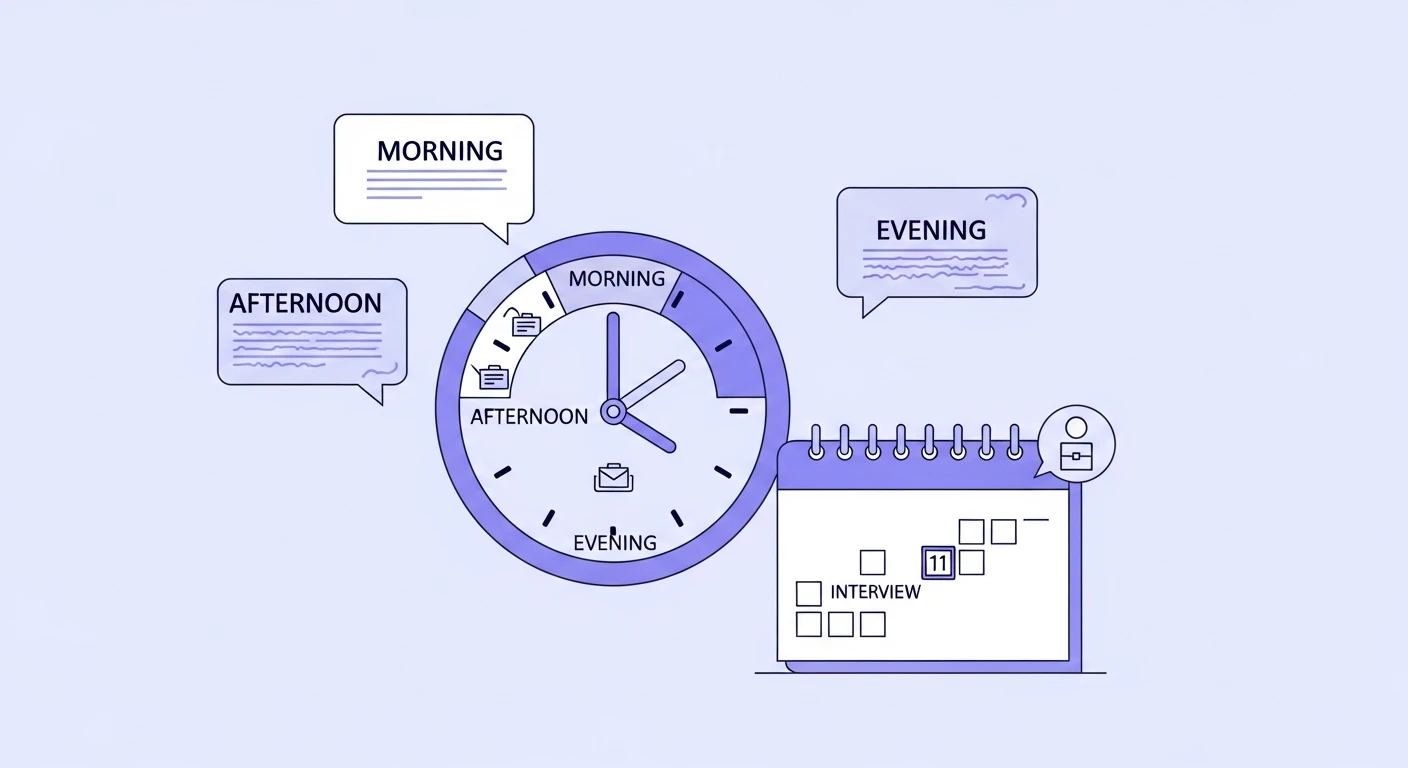
The Universal Opening That Damages Every Interview
Every interview methodology textbook recommends starting with easy warm-up questions. Build rapport. Let the participant settle in. Ask something simple before diving into the real questions.
The logic seems sound. But after analyzing thousands of research interviews, a pattern emerges: participants who receive standard warm-up questions produce measurably less depth throughout the entire session compared to those who receive contextually anchored openings.
The warm-up question does not just waste five minutes. It trains the participant in a response style — brief, chronological, surface-level — that they maintain for the remaining forty-five minutes. You are not warming them up. You are teaching them what kind of answers you expect.
What Standard Warm-Ups Actually Signal
When you ask "Tell me about yourself" or "Walk me through a typical day," you communicate several things implicitly:
You signal that breadth matters more than depth. The participant learns to cover topics quickly rather than explore any single moment thoroughly. They develop a scanning pattern — mention this, mention that, move on — that becomes their default mode.
You signal that chronology is the organizing principle. Participants begin thinking temporally rather than experientially. They narrate sequences instead of reflecting on meanings, frustrations, or decisions. This temporal framing persists even when your later questions ask for reflection.
You signal that polished narratives are appropriate. Standard warm-ups invite the rehearsed version — the story participants have told before, smoothed by repetition. By the time you reach questions that require raw, unrehearsed thinking, the participant is locked into performance mode.
The result is what researchers call the articulation gap — participants cannot access or express the messy, contradictory reality beneath their polished narratives because the interview format never invited that register.
The Priming Cascade Effect
Cognitive priming research shows that initial frame-setting persists far longer than interviewers realize. The first three minutes of an interview establish:
- Appropriate response length (participants calibrate to match early question complexity)
- Expected level of specificity (abstract questions get abstract answers that persist)
- Emotional register (casual openers keep the entire session casual)
- Power dynamics (who is the expert, who is the student)
This creates a cascade. Each subsequent answer builds on the response style established in the opening. By the time you ask your critical research questions at minute fifteen, you are fighting against a deeply established pattern.
Researchers who use progressive disclosure in their interview guides understand this intuitively — but even they often exempt the opening minutes from this discipline.
What Works Instead: Contextual Anchoring
The alternative to warm-up questions is contextual anchoring — opening with a specific, recent, concrete moment that relates to your research domain.
Instead of "Tell me about your work," try: "Think about the last time you felt stuck on a task at work. Not a major crisis — just a moment where you paused and were not sure what to do next. Can you put me in that moment?"
This opening does several things simultaneously:
It establishes specificity as the norm. The participant learns immediately that you want concrete moments, not summaries.
It invites emotional honesty. Asking about "feeling stuck" signals that imperfection and confusion are welcome in this conversation.
It demonstrates the depth you expect. "Put me in that moment" signals you want sensory, experiential detail — not a chronological recap.
It activates episodic memory rather than semantic memory. You get what actually happened rather than what they believe generally happens.
The Evidence From Transcript Analysis
When you compare transcripts systematically, the differences are striking:
Average response length to the fifth question:
- Standard warm-up opening: 45 seconds
- Contextual anchor opening: 2 minutes 20 seconds
Unprompted contradictions surfaced (a marker of depth):
- Standard warm-up: 0.8 per interview
- Contextual anchor: 3.2 per interview
Self-corrections and refinements:
- Standard warm-up: 2.1 per interview
- Contextual anchor: 7.4 per interview
As research into detecting contradictions in qualitative interviews shows, inconsistencies are not errors — they are your most valuable signal. The opening that generates more contradictions is the opening that accesses genuine complexity rather than rehearsed narrative.
Three Contextual Anchor Patterns
The Recent Moment Pattern: "Think about the last time you [domain-relevant action]. Walk me through exactly what happened, starting from the moment you decided to do it."
The Frustration Pattern: "What is something about [domain] that annoyed you recently? Not a major complaint — just a small friction you noticed and then moved past."
The Comparison Pattern: "Think about two recent times you [domain action]. One that went smoothly and one that did not. Start with whichever comes to mind first."
Each of these patterns requires zero rapport-building preamble. They build rapport through the act of genuine inquiry itself. Participants feel respected when you ask them to think carefully rather than recite.
When Warm-Up Questions Legitimately Help
There are narrow cases where traditional warm-up questions serve a purpose:
Cross-cultural research where conversational norms require establishing social connection before substantive exchange. Even here, the "warm-up" should be social conversation, not research questions disguised as easy ones.
Highly sensitive topics where participants need to establish psychological safety before discussing difficult experiences. But even here, the research suggests that topic-adjacent opening anchors outperform generic warm-ups.
Participants with communication differences who genuinely need processing time before complex questions. The accommodation here is pacing and patience, not question simplification.
For the vast majority of UX research, product research, and customer discovery interviews, the standard warm-up is costing you depth without providing meaningful benefit. The principles of building rapport without contaminating data apply from the very first question.
Restructuring Your Interview Guide
If you currently open with warm-up questions, try this transition:
- Remove the first two questions entirely
- Take your third or fourth question — usually where your real inquiry begins — and make it concrete and specific
- Add sensory anchoring language: "Put me in that moment," "What were you looking at," "What had just happened before"
- Trust that rapport emerges from genuine intellectual engagement, not from easy questions
The discomfort you feel removing warm-ups is the discomfort of abandoning a ritual that felt safe. But safe for the researcher is not the same as productive for the research.
The principles of context engineering in AI-driven development apply equally to human interviews — what context you provide at the start shapes everything that follows. Design your opening to produce the depth you actually need.
The Compounding Returns of Better Openings
Teams that restructure their interview openings report cascading improvements:
- Fewer follow-up probes needed (participants volunteer depth unprompted)
- Richer themes during analysis (more material to code per interview)
- Fewer interviews needed to reach saturation (each session produces more signal)
- Higher participant satisfaction (people prefer feeling heard to feeling quizzed)
The warm-up question myth persists because it feels courteous and professional. But genuine courtesy in research is asking questions worthy of your participant's time and intelligence — from the very first moment they sit down.