The Interpretation Illusion
Every survey question you write feels clear to you. You know what you meant. You reviewed the wording with your team. Everyone agreed it was unambiguous. Then you deploy it to 500 participants, and your data tells a story that makes no sense -- because 40% of respondents interpreted your question differently than you intended.
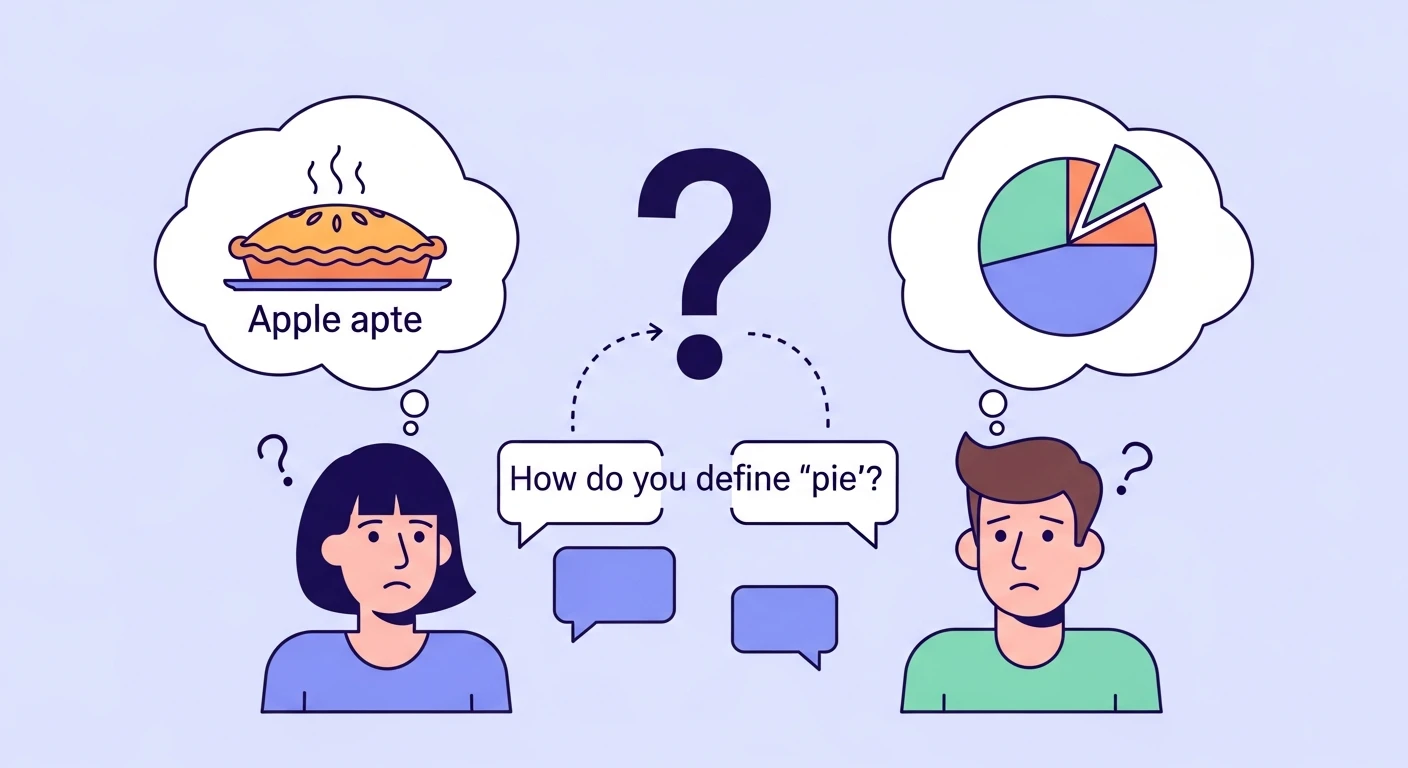
This is not a literacy problem. It is not a respondent quality problem. It is a fundamental gap between how question authors encode meaning and how diverse participants decode it. The words are the same; the mental operations participants perform to answer them are wildly different.
Cognitive interviewing is the systematic method for detecting these interpretation divergences before deployment. It asks participants to think aloud while answering your survey, revealing the mental processes behind their responses. Yet despite decades of validation research proving its value, most product teams and research organizations skip it entirely -- deploying surveys with untested assumptions about what their questions actually measure.
How Interpretation Diverges
Lexical Ambiguity
Single words carry different meanings for different populations. "Frequently" means daily to a power user and monthly to a casual one. "Recently" spans yesterday to six months depending on the respondent's reference frame. "Easy" means different things to an engineer and a non-technical user.
These seem obvious in isolation. In context, they are invisible to the question author because the author's own mental definition feels universal. Cognitive interviews surface exactly which terms participants interpret differently -- and how those differences produce systematically biased responses.
Temporal Reference Frame Mismatch
Questions like "How often do you use this feature?" seem straightforward. But participants must decide: am I thinking about this week? This month? Since I started using the product? The reference frame they choose determines their answer, and different participants choose different frames without the question providing guidance.
This creates data that looks quantitative but is actually measuring different temporal constructs across respondents. Your aggregated statistics combine incompatible measurements into a meaningless average. The cognitive load principles in survey design address response burden -- but temporal ambiguity is a construct validity problem, not a difficulty problem.
Response Scale Interpretation
Satisfaction scales assume shared understanding of what "satisfied" means and where the threshold between options falls. In cognitive interviews, participants regularly reveal that they never select extreme options regardless of actual experience ("I never give a 5 because nothing is perfect"), or that adjacent scale points represent fundamentally different constructs to them.
One participant's "4 out of 5" represents enthusiasm. Another's represents mild disappointment -- they expected to give a 5. Without cognitive interviewing, these responses look identical in your dataset while representing opposite experiences.
The Cognitive Interview Method
Think-Aloud Protocol
The core technique asks participants to verbalize everything they think while answering each question:
- What does this question mean to you?
- What are you thinking about as you formulate your answer?
- Why did you choose that particular response option?
- Was anything confusing or hard to answer?
This surfaces the cognitive steps between reading a question and selecting a response -- steps that are normally invisible but determine data quality. Unlike the concerns about think-aloud contamination in usability testing, think-aloud in survey pretesting does not contaminate the behavior being studied because the goal is understanding interpretation, not measuring natural response patterns.
Probing Techniques for Survey Validation
Beyond think-aloud, specific probing techniques target interpretation divergence:
- Paraphrasing probes: "Can you tell me in your own words what this question is asking?"
- Confidence probes: "How sure are you about your answer? What made it hard to decide?"
- Recall probes: "What specific instance were you thinking about when you answered?"
- Comprehension probes: "What does [specific term] mean to you in this context?"
These mirror the probing techniques used for depth in expert interviews but targeted specifically at measurement validity rather than experiential richness.
Sample Requirements
Cognitive interviewing does not require large samples. Research consistently shows that 8-12 participants drawn from your target population surface 85-95% of interpretation problems. The key is demographic and experiential diversity within this small sample -- ensuring representation of the interpretation variation that exists in your full deployment population.
What Cognitive Interviews Reveal That Reviews Cannot
Expert Review Blind Spots
Internal review processes (having colleagues read your survey) fail because they share your context. They know what the product does, they understand your terminology, they share your mental models. They cannot simulate the naive interpretation that actual respondents bring.
Cognitive interviews with actual participants routinely surface interpretation problems that survived multiple rounds of expert review. The gap between expert understanding and participant interpretation is systematic, not random -- experts consistently overestimate the clarity of domain-specific language.
Cultural and Contextual Variation
The same question interpreted in different cultural, organizational, or experiential contexts produces different constructs. "How supported do you feel by your team?" means something different in a collaborative culture versus a competitive one. "How easy was the onboarding process?" varies by what the respondent compares against.
Cognitive interviews surface these contextual frames explicitly. You discover that participants from different backgrounds are literally answering different questions -- even though the words on screen are identical. This connects to the interpretation challenges that cultural probing in global research addresses, but applies even within a single market when experiential diversity exists.
Integrating Cognitive Interviews Into Survey Development
The Three-Round Protocol
Round 1 (Exploratory): Test your draft survey with 4-5 participants using full think-aloud. Identify major interpretation problems, confusing structures, and questions that participants struggle to answer.
Round 2 (Revision Testing): Revise based on Round 1 findings. Test revised questions with 4-5 new participants. Verify fixes work and do not introduce new problems.
Round 3 (Verification): Final validation with 3-4 participants confirming that interpretation aligns with intent across demographic variation.
Total investment: 12-14 participant sessions of 30-45 minutes each. The cost is trivial compared to the cost of deploying a survey that produces uninterpretable data.
AI-Assisted Cognitive Interview Analysis
At scale, AI analysis can process cognitive interview transcripts to identify systematic interpretation patterns across participants. Rather than a single researcher reviewing each transcript, AI-assisted analysis flags:
- Questions where paraphrases diverge across participants
- Terms that trigger different mental models
- Response options that participants consistently hesitate between
- Temporal and contextual reference frame inconsistencies
This builds on how AI is reshaping qualitative analysis -- applying pattern detection to the meta-level question of measurement validity rather than substantive findings.
When to Skip Cognitive Interviewing
Not every survey needs full cognitive pretesting:
- Validated instruments: Published scales with established psychometric properties have already undergone cognitive validation
- Internal-only surveys: Quick pulse checks where interpretation variance is tolerable
- Repeat deployments: Surveys previously validated that are redeployed without modification
But any survey measuring new constructs, using novel question formats, targeting new populations, or informing high-stakes decisions should undergo cognitive pretesting. The cost of not pretesting is invisible -- you collect confident data that measures something other than what you think.
Common Findings From Cognitive Interviews
Double-Barreled Questions Survive Review
Questions asking about two things simultaneously ("How satisfied are you with the speed and accuracy of results?") consistently survive expert review but create impossible cognitive tasks for respondents. They must either pick one dimension to answer about or attempt an impossible average. Cognitive interviews catch these immediately because participants ask: "Which one do you want me to answer about?"
This echoes the compound question trap in interviews -- but in surveys, the problem is worse because there is no interviewer present to clarify.
Hypothetical Questions Produce Fiction
Questions asking what participants would do in hypothetical scenarios ("If we added X feature, would you use it?") reveal in cognitive interviews that respondents have no idea -- they construct plausible answers to be helpful. The gap between stated hypothetical intention and actual behavior is well-documented, and cognitive interviews make the construction process visible.
Frequency Estimation Is Mostly Guessing
Cognitive interviews consistently reveal that respondents answering frequency questions ("How often do you...") are not counting or estimating -- they are constructing an identity-consistent response. "I use it daily" often means "I think of myself as a daily user" rather than "I have verified I use it every day." The response reflects self-concept rather than behavior.
The Business Case for Pretesting
Organizations that skip cognitive pretesting save perhaps 2-3 weeks of survey development time. In exchange, they risk:
- Months of product decisions based on misinterpreted data
- Feature investments responding to problems that do not exist (because questions measured the wrong construct)
- Missed problems that surveys failed to detect (because questions did not mean what authors intended)
- Regulatory or compliance risk from surveys that cannot demonstrate measurement validity
The insight decay problem describes how research findings lose value over time. Invalid data -- data measuring something other than intended -- has negative value from the moment it is collected, actively degrading decision quality below what uninformed intuition would produce.
Practical Takeaways
- Never deploy a novel survey without cognitive pretesting. The interpretation gap between authors and respondents is systematic and invisible without testing.
- Budget 12-14 cognitive interviews across three rounds for any survey measuring new constructs or targeting new populations.
- Use paraphrasing probes ("What is this question asking in your own words?") as your primary detection tool for interpretation divergence.
- Pay special attention to temporal terms (recently, frequently, often) and subjective terms (easy, satisfied, useful) -- these diverge most.
- Compare participant paraphrases against each other to identify where the same words produce different mental operations across respondents.
- Treat cognitive interviewing as measurement insurance -- the cost is trivial relative to the cost of building product strategy on invalid data.
Survey data feels objective because it arrives as numbers. But those numbers represent whatever cognitive operation each participant performed when reading your questions -- and without cognitive pretesting, you have no idea whether 500 participants all performed the same operation or 500 different ones. Cognitive interviewing is how you find out before it matters.