The conversation about AI ethics in research tends to happen at the wrong altitude. Policy papers debate existential questions about algorithmic bias and societal harm. IRB guidelines were written for a world where data lived in filing cabinets and spreadsheets. Meanwhile, research teams are already using AI tools to analyze interview transcripts, generate survey instruments, and synthesize qualitative findings -- and the practical ethical framework for doing so responsibly is largely absent.
This gap is not theoretical. Every time a researcher pastes an interview transcript into an AI tool for analysis, they are making decisions about participant privacy, data sovereignty, and informed consent that most institutional frameworks have not caught up to address. The participant who consented to "having their interview recorded and analyzed" almost certainly did not envision their words being processed by a large language model trained on internet-scale data.
The solution is not to avoid AI in research. The benefits are too significant and the adoption too widespread for prohibition to be realistic. The solution is a practical ethical framework that research teams can implement today -- one that protects participants while allowing researchers to leverage AI's analytical capabilities.
The Consent Gap
Informed consent in qualitative research has always been built on a simple premise: participants should understand what will happen with their data. Traditional consent forms explain that interviews will be recorded, transcribed, and analyzed by the research team. Quotes may be used in reports with identifying information removed. Data will be stored securely and destroyed after a specified period.
AI analysis introduces at least four dimensions that traditional consent does not address.
First, data processing location and scope. When transcripts are processed through cloud-based AI services, participant data may traverse multiple jurisdictions and be processed on infrastructure the research team does not control. Even when providers promise not to train on customer data, the processing itself occurs outside the security perimeter the participant was implicitly promised.
Second, emergent analysis capabilities. AI can identify patterns in qualitative data that human analysts might miss -- including patterns that participants did not intend to reveal. Linguistic analysis can infer emotional states, personality traits, and demographic characteristics from speech patterns. A participant who consented to having their opinions about a product analyzed did not consent to having their anxiety levels inferred from their speech disfluencies.
Third, data persistence and model training. The question of whether participant data contributes to model training -- even indirectly through feedback loops and fine-tuning -- is one that most AI service providers answer ambiguously. Research teams using general-purpose AI tools often cannot guarantee that participant data will not influence future model behavior.
Fourth, re-identification risk. AI dramatically lowers the cost of re-identification attacks. Pseudonymized transcripts that would be effectively anonymous to human readers can potentially be linked to individuals when processed by models with access to broader data patterns. The standard practice of changing names and removing obvious identifiers may not provide adequate protection in an AI analysis context.
These gaps do not mean that existing consent practices are worthless. They mean that consent forms and procedures need to be updated to address the reality of AI-assisted analysis. Research teams that proactively close these gaps will be ahead of regulatory requirements that are inevitably coming.
Practical Privacy Architecture for AI-Assisted Research
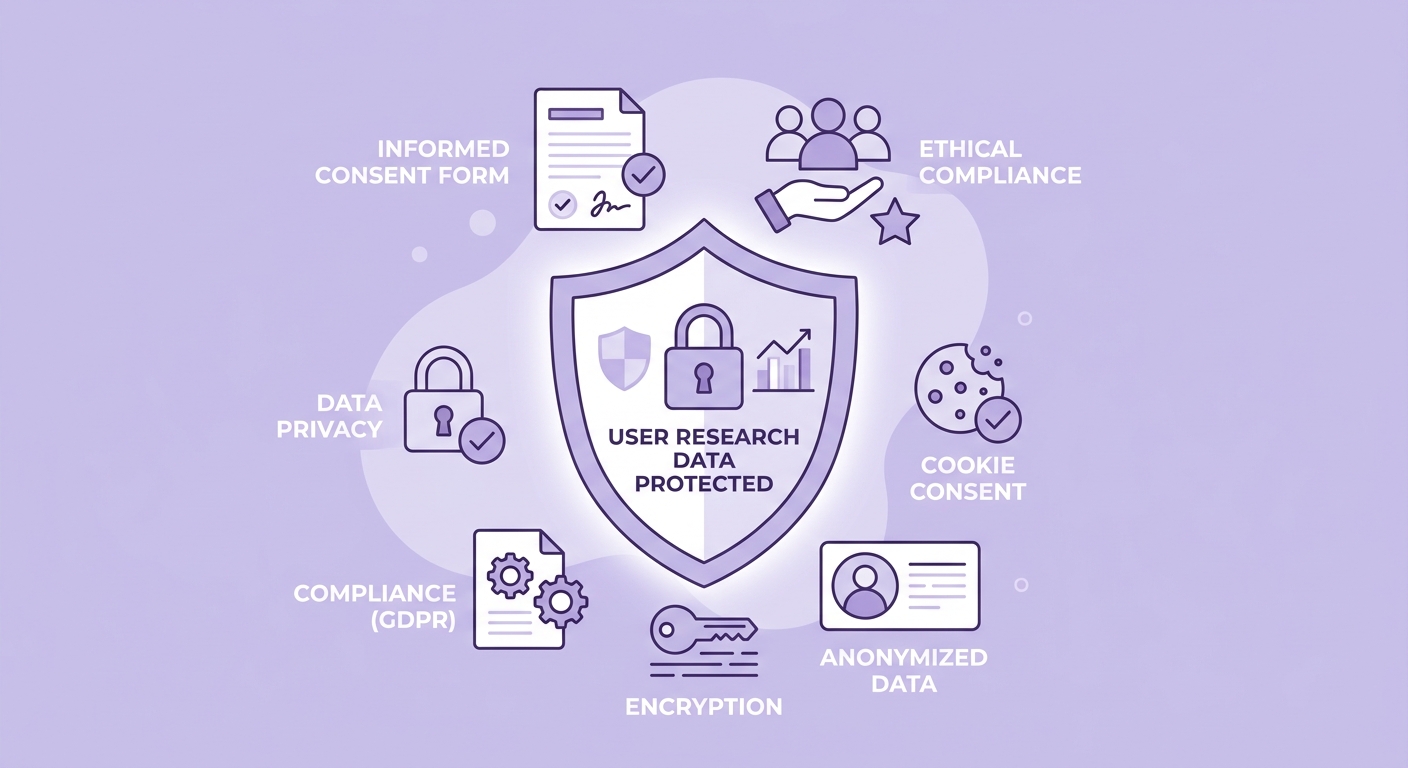
Protecting participant privacy in AI-assisted research requires architectural decisions, not just policy statements. Here is what a robust privacy architecture looks like in practice.
Data minimization before AI processing. Not every piece of participant data needs to go through AI analysis. Strip identifying information, location data, employer names, and other PII before any AI processing occurs. This should be an automated pipeline step, not a manual process that relies on individual researcher diligence. The principle aligns with what privacy engineers call "data minimization" -- process only the minimum data necessary for the analytical purpose.
Local processing where possible. The strongest privacy guarantee is that participant data never leaves the research team's infrastructure. Local AI models -- while less capable than cloud-based alternatives for some tasks -- eliminate the data sovereignty concerns entirely. For sensitive research populations (minors, medical patients, employees discussing workplace issues), local processing should be the default, not the exception.
Tiered consent frameworks. Instead of a single consent form that tries to cover every possible use, implement tiered consent that gives participants meaningful choices. Tier one: human-only analysis. Tier two: AI-assisted analysis with local processing. Tier three: AI-assisted analysis with cloud processing. Participants can opt into the level they are comfortable with, and the research team routes their data accordingly.
Audit trails for AI interactions. Every time participant data is processed by an AI system, log it. What data was sent, to which service, when, and what was returned. This audit trail serves both ethical accountability and practical quality assurance. If a participant later withdraws consent, the trail shows exactly what processing occurred and enables meaningful data deletion.
As enterprise teams building AI systems have learned, audit trails are not optional -- they are the foundation of trustworthy AI operations. The same principle applies to research.
Informed Consent That Actually Informs
The phrase "informed consent" contains a standard that most consent processes fail to meet. Participants sign forms they do not fully read, covering procedures they do not fully understand, for purposes that may evolve after the consent is given. AI analysis makes this existing problem worse.
Here is what genuinely informed consent looks like for AI-assisted research.
Plain language explanation of AI processing. Not "your data may be processed using artificial intelligence tools" but "after your interview, we will use an AI system similar to ChatGPT to help identify themes across all participant interviews. The AI will read your transcript and suggest patterns, but a human researcher will review and validate all findings."
Specific identification of AI tools. Name the tools. If you are using Qualz.ai, or GPT-4, or Claude for analysis, say so. Participants deserve to know which systems will process their data, just as they deserve to know which humans will have access.
Honest discussion of limitations. Explain that AI analysis might identify patterns the participant did not intend to convey. Explain that while you will take steps to protect their identity, AI systems interact with data differently than human analysts. This transparency builds trust and gives participants the information they need to make genuine decisions about participation.
Dynamic consent mechanisms. Give participants the ability to revisit their consent decisions as the research progresses. If the analysis approach changes -- for example, if you decide to use a different AI tool or to conduct a type of analysis not originally planned -- re-consent is not just ethical best practice, it is basic respect for participant autonomy.
The parallels to how organizations handle research democratization are instructive. Just as democratizing research access requires guardrails to maintain quality, democratizing AI analysis requires guardrails to maintain ethical standards.
The Vulnerable Population Challenge
Ethical considerations intensify when research involves vulnerable populations -- a category that includes far more groups than most researchers initially consider.
Children and adolescents cannot provide informed consent for AI data processing any more than they can for traditional research. Parental consent processes need to be updated to specifically address AI analysis, and assent processes for minors should explain AI involvement in age-appropriate terms.
Medical patients discussing health conditions face re-identification risks that are amplified by AI. Medical narratives contain unique combinations of symptoms, treatments, and circumstances that function as quasi-identifiers. Standard de-identification that removes names and dates may be insufficient when AI can cross-reference symptom combinations against public health data.
Employees discussing workplace experiences face retaliation risks if their identities are compromised. When organizations commission research about their own employees, the data governance architecture must ensure that AI-processed findings cannot be traced back to individuals -- even by the commissioning organization.
Indigenous and marginalized communities face additional concerns about data sovereignty. Who owns the insights generated by AI analysis of community members' narratives? How do communities maintain control over how their collective knowledge is used? These questions, already complex in traditional research, become more urgent when AI can extract and synthesize knowledge at scale.
For research teams working with patient-reported outcomes or healthcare populations, these considerations are not hypothetical -- they are the central challenge of ethical practice.
Building an Ethical Review Process for AI-Assisted Research
Most institutional review boards (IRBs) have not updated their review criteria to address AI-specific concerns. Research teams should not wait for institutions to catch up. Here is a practical review process to implement now.
AI impact assessment. Before beginning any AI-assisted analysis, document which AI tools will be used, what data they will process, where processing will occur, what data retention policies apply, and what the re-identification risks are. This assessment should be part of the research protocol, reviewed before data collection begins.
Red team your privacy measures. Before processing real participant data, test your de-identification and privacy architecture with synthetic data that mimics the characteristics of your actual dataset. Try to re-identify synthetic participants using the same AI tools you plan to use for analysis. If you succeed, your privacy measures are insufficient.
Ongoing monitoring. AI tools and their data policies change. A tool that did not train on customer data when you started your study might update its terms of service midway through. Assign someone on the research team to monitor the data practices of AI tools in use throughout the study period.
Participant advisory input. For sensitive research, consider involving participants or community representatives in decisions about AI use. This is not just ethical theater -- it often surfaces concerns and considerations that researchers embedded in AI culture fail to anticipate.
The rigor of this approach echoes what governance frameworks for AI in enterprise settings recommend, but adapted for the research context where the "data subjects" are voluntary participants who deserve the highest standard of care.
The Regulatory Horizon
Research teams making ethical decisions about AI today are operating in a regulatory environment that is rapidly evolving.
The EU AI Act classifies certain AI uses in research as high-risk, particularly when involving biometric data processing or profiling of natural persons. Research teams operating in or collecting data from EU jurisdictions need to be aware that their AI analysis pipelines may face regulatory scrutiny that goes beyond traditional research ethics requirements.
In the United States, the FTC has signaled increased attention to AI data practices, and state-level privacy laws (California, Colorado, Connecticut, and others) are beginning to address AI-specific concerns. Research teams should anticipate that consent requirements for AI processing will become legally mandated, not just ethically recommended.
Health research faces additional complexity under HIPAA, which does not currently address AI processing specifically but whose "minimum necessary" standard clearly applies to decisions about what participant data is sent to AI systems.
The research teams that build robust ethical practices now will face minimal disruption when regulations arrive. Those that treat AI analysis as ethically equivalent to traditional analysis will face costly retrofitting of their processes, and potentially, findings they cannot use because they were collected under inadequate consent.
A Framework for Ethical AI Research Practice
The goal is not to make AI in research impossible -- it is to make it trustworthy. Here is the framework distilled to principles that research teams can implement immediately.
One: consent must specifically address AI processing. Generic consent is insufficient.
Two: data minimization is non-negotiable. Strip what you do not need before AI processing.
Three: local processing is the default for sensitive data. Cloud processing requires justification.
Four: audit everything. Every AI interaction with participant data should be logged.
Five: participant autonomy includes the right to understand and refuse AI analysis.
Six: vulnerability assessment must consider AI-specific risks, not just traditional research risks.
Seven: regulatory compliance is a floor, not a ceiling. Ethical practice exceeds legal requirements.
Research has always depended on the trust of participants. AI tools introduce new capabilities and new risks. The teams that maintain that trust while leveraging AI's analytical power -- by being transparent, rigorous, and genuinely respectful of participant autonomy -- will produce better research and build more durable research programs.
The alternative -- cutting ethical corners for analytical convenience -- is a path toward regulatory backlash, participant distrust, and findings whose provenance does not survive scrutiny. For teams that have invested in understanding how to design interviews for research, extending that rigor to the AI analysis phase is a natural and necessary evolution.