The Promise and the Trap
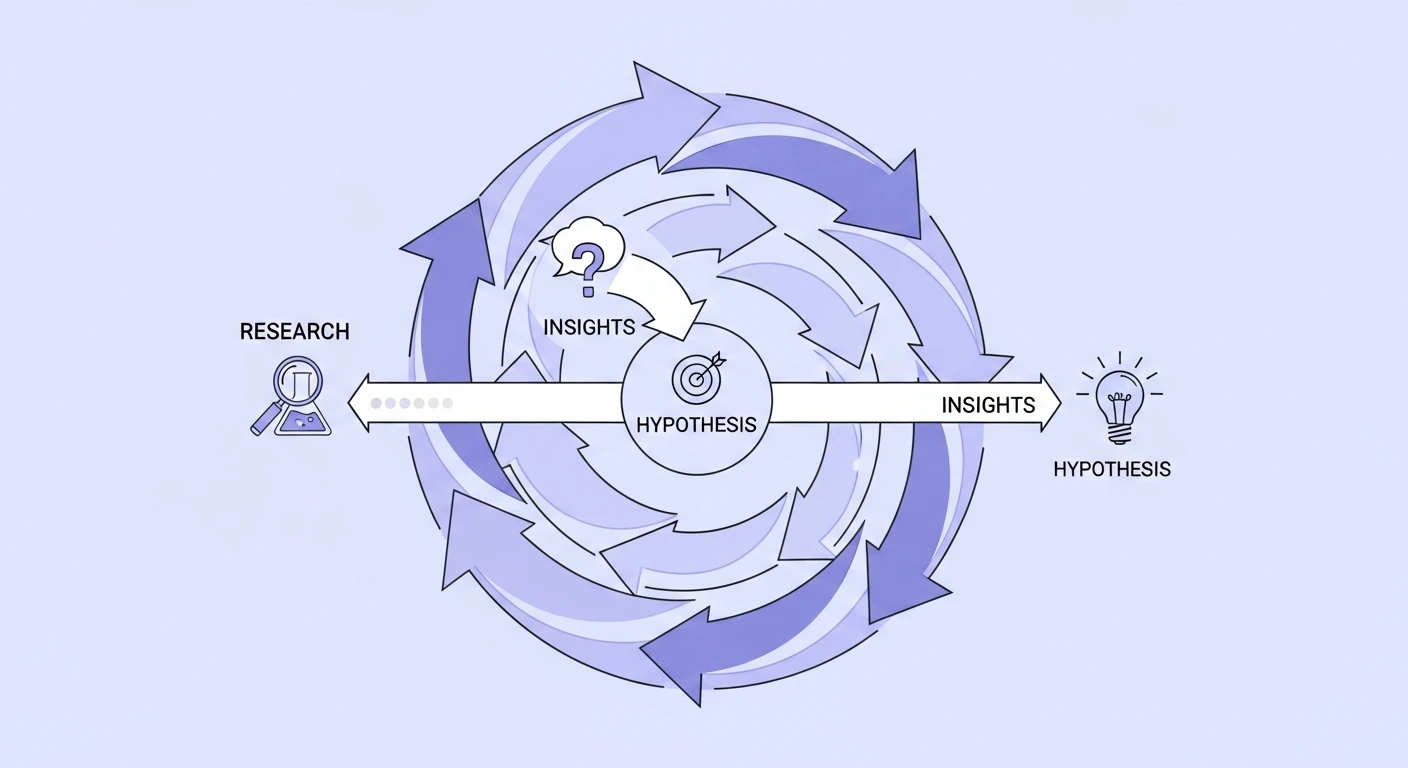
Continuous discovery is supposed to prevent the big-bang research failure: months of building without customer input followed by a devastating launch-day reality check. By embedding research into every sprint, teams maintain constant contact with user reality. In theory.
In practice, many continuous discovery programs degenerate into feedback loops where the same assumptions get validated week after week because the methodology is structurally incapable of disconfirming them. The cadence creates an illusion of learning while the team spirals deeper into its existing mental model.
The trap is subtle because it feels productive. Interviews happen. Insights get logged. Opportunity trees get updated. But when you examine the trajectory over six months, the team's understanding has not fundamentally shifted -- it has merely accumulated more evidence supporting whatever they already believed at month one.
The Confirmation Architecture
Recruitment Self-Selection
Weekly interviews require a steady participant pipeline. The path of least resistance is to recruit from existing users, existing panels, and channels that attract people already engaged with your product. These participants share a crucial characteristic: they have already opted into your product's framing of the problem.
Asking existing users to evaluate your product direction is like asking your employees if your company culture is good. They would not be there if they fundamentally disagreed. The participants you never recruit -- the ones who evaluated and rejected your product, the ones who solve the same problem differently, the ones who do not recognize the problem at all -- hold the disconfirming evidence. But continuous cadence pressures make it hard to recruit beyond easy channels.
This connects to a broader pattern where research panel fatigue creates conditioning effects that systematically skew findings toward what regular participants think researchers want to hear.
Question Framing Drift
When you interview weekly, each interview is influenced by what you heard last week. You ask follow-up questions about patterns you noticed. You probe deeper on themes emerging from recent sessions. This feels like proper iterative research -- but it creates a ratchet effect where questions increasingly explore within the existing frame rather than testing whether the frame is correct.
Week 1: "Tell me about your onboarding experience." Week 4: "Last week we heard that step 3 is confusing -- what specifically confused you?" Week 8: "We are redesigning step 3 -- which of these options feels clearer?"
The frame narrowed from open exploration to evaluative testing without anyone deliberately choosing to close the aperture. The question drift happened naturally because continuous cadence rewards building on previous findings. But the research question drift problem means you may be answering a question nobody asked while the actual question remains unexamined.
Opportunity Tree Anchoring
Teams using opportunity solution trees face a structural bias: once an opportunity is placed on the tree, it acquires gravity. Subsequent research gets interpreted through the lens of existing opportunities rather than evaluated for whether it reveals opportunities not yet captured. The tree becomes a confirmation framework rather than an evolving map.
New interview data gets sorted into existing branches because the branches exist. Evidence that does not fit gets treated as noise rather than signal. The anchoring cascade in multi-study programs operates continuously in teams that never reset their analytical frame.
Breaking the Loop
Scheduled Disconfirmation Sprints
Every fourth sprint, dedicate research explicitly to disconfirmation. Actively recruit participants who represent the opposite of your current assumptions. Ask questions designed to surface contradictions. Analyze specifically for evidence that your current direction is wrong.
This is uncomfortable but essential. Negative case analysis should not be an occasional practice -- it should be a structural component of any continuous program. The participants who contradict your emerging model are providing more information per session than those who confirm it.
Cross-Pollination From Adjacent Domains
The most powerful disconfirming evidence often comes from outside your product category. Interview people who solve adjacent problems differently. Study how other industries handle similar user needs. Import frameworks from disciplines that think about the same human behavior through different lenses.
This connects to the principle underlying research triangulation: single-perspective research, no matter how frequent, cannot see what only multiple perspectives reveal. Continuous discovery from a single vantage point produces continuous confirmation of that vantage point's assumptions.
Rotating Analytical Frameworks
Do not analyze every interview through the same lens. If you typically code for usability issues, try coding for emotional responses. If you usually look for pain points, try mapping moments of delight or indifference. If you categorize by feature area, try categorizing by job-to-be-done or by user's emotional state.
Different analytical frames surface different patterns in the same data. Teams that use a single framework consistently will consistently find what that framework is designed to find -- and nothing else. The cognitive load transfer in research synthesis means your framework is not neutral -- it actively shapes which insights survive the analysis process.
Outsider Audits
Quarterly, bring in someone with no context -- a researcher from another team, an external consultant, a junior team member with fresh eyes -- and have them review your last twelve weeks of data without seeing your current opportunity map. Ask them what they see.
The gap between what a fresh analyst sees and what the embedded team sees is a direct measure of how much confirmation bias has accumulated. Fresh eyes cannot be anchored to existing mental models because they do not have existing mental models. What they see as obvious that the team overlooked reveals the loop's blind spots.
The Velocity Trap
Continuous discovery's emphasis on speed compounds the confirmation problem. When you need participant insights by Thursday for sprint planning on Friday, you optimize recruitment for speed (existing panels), questions for efficiency (variations on proven guides), and analysis for clarity (themes that map to existing backlogs).
Every optimization that makes continuous research faster also makes it more confirmatory. Speed and novelty are inversely correlated in research -- genuinely new insights require slow, uncomfortable engagement with data that does not fit. Teams under cadence pressure cannot afford that discomfort, so they default to insights that confirm and move forward.
The research velocity traps described elsewhere apply with doubled force to continuous programs because the trap is not a one-time failure but a weekly reinforcement cycle. Each confirming session makes the next disconfirming session less likely because the team's confidence in their model grows with every consistent data point.
Recognizing the Loop
Several diagnostic signals indicate your continuous discovery has become a confirmation engine:
Declining surprise rate. Track how often a weekly interview produces a genuinely unexpected finding. If the rate trends toward zero over time, you are learning less despite researching more.
Stable opportunity maps. If your opportunity tree has not structurally changed in two months despite ongoing research, either your model is perfect (unlikely) or new data is being absorbed into existing categories without challenging them.
Recruitment homogeneity. If 80% of your participants share the same profile -- existing users, similar tenure, similar use cases -- your research cannot surface insights that require different perspectives.
Question convergence. If your discussion guides from month 1 and month 6 cover substantially the same territory with minor variations, your exploration has stalled without anyone noticing.
Stakeholder comfort. Counterintuitively, if stakeholders are always comfortable with research findings, the research may not be challenging enough. Genuine discovery should periodically produce findings that make people uncomfortable because they contradict plans already in motion.
The Organizational Incentive Problem
Continuous discovery confirmation loops persist because organizations reward consistency over disruption. A product manager who reports "our research consistently shows users want X" is more promotable than one who reports "our research keeps contradicting our roadmap." Teams that produce steady, confirmatory insights create organizational comfort. Teams that produce disruptive insights create organizational anxiety.
This incentive misalignment between research truth-seeking and organizational comfort-seeking is perhaps the deepest driver of the confirmation loop. Breaking the loop requires not just methodological changes but cultural permission to discover uncomfortable truths on a regular cadence -- which is far harder than it sounds when quarterly goals depend on the current direction being correct.
The teams that break free recognize that continuous discovery is only as valuable as its capacity to change direction. Discovery that only confirms is not discovery -- it is surveillance of a predetermined path, dressed up in the language of learning.