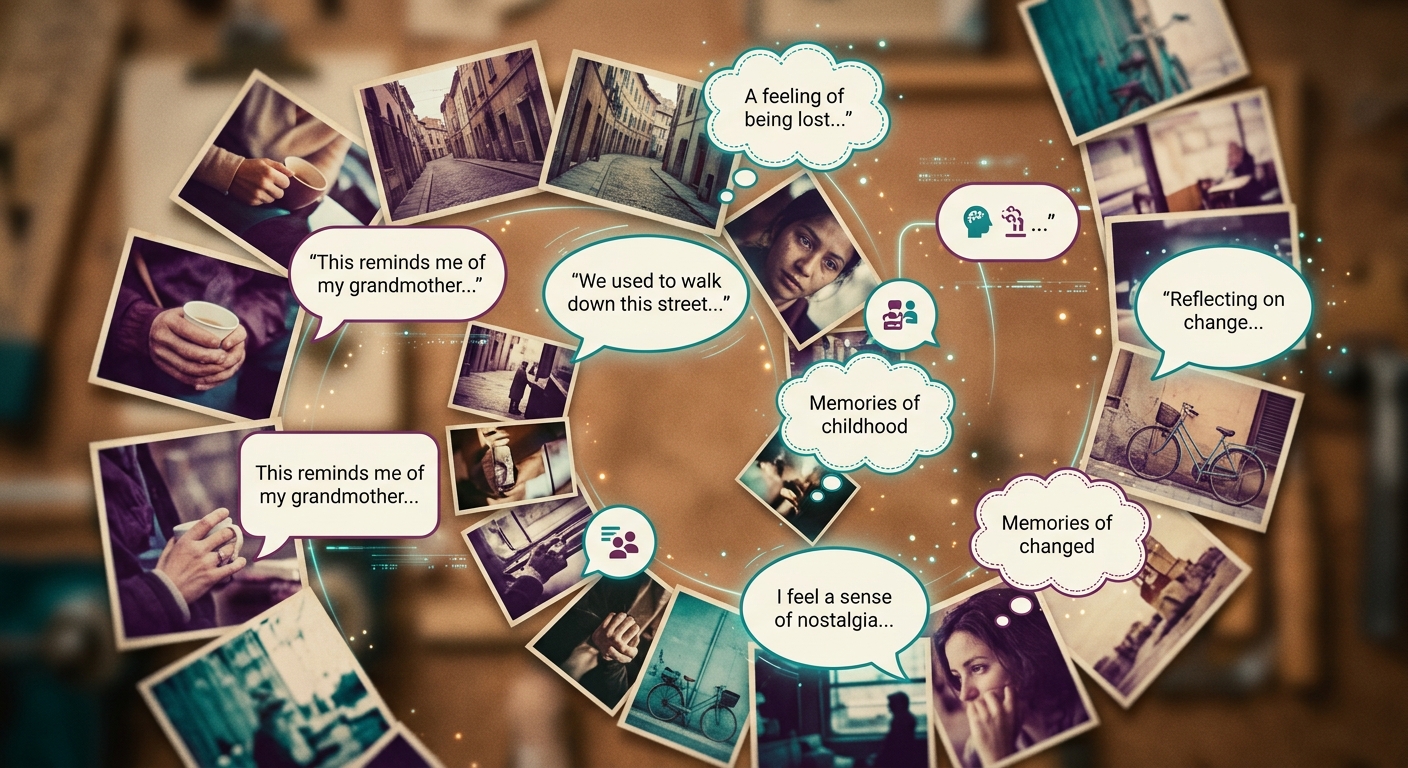
Why a Photograph Changes Everything in an Interview
Ask someone to describe their morning commute, and you get a predictable summary: traffic, duration, maybe a complaint about construction. Show them a photograph of a crowded subway platform, and something different happens. They don't just describe -- they relive. The sensory details emerge. The frustration becomes specific. The narrative takes on texture that no verbal prompt alone could produce.
This phenomenon is not anecdotal. It is one of the most robust findings in qualitative research methodology: images elicit fundamentally different cognitive and emotional responses than words. The technique built around this insight -- photo elicitation -- has been a cornerstone of visual research methodology for nearly seven decades. And yet, until recently, it remained confined to small-scale, resource-intensive studies.
That is changing. The convergence of AI-moderated interviewing and photo elicitation technique is making it possible to deploy image-based interviews at scale, without sacrificing the depth that makes the method so powerful. This article traces the foundations, explains the cognitive science, and lays out how researchers and practitioners can implement photo elicitation interviews using modern AI tools.
A Brief History: From Collier to Harper
The formal use of photographs in research interviews dates to John Collier Jr.'s 1957 study on mental health in changing communities in the Canadian Maritimes. Collier was working as a photographer for the Cornell University research team when he noticed something striking: when participants were shown photographs of their communities during interviews, their responses became longer, more detailed, and more emotionally engaged than responses to the same questions asked without images.
Collier's observation was straightforward but profound. The photograph served as a bridge between the researcher's abstract questions and the participant's lived experience. It anchored the conversation in something concrete, something the participant could see and react to rather than reconstruct from memory alone.
For decades, the technique remained somewhat niche -- practiced by visual sociologists and anthropologists but underutilized in mainstream qualitative research. That changed significantly with Douglas Harper's 2002 landmark article "Talking about pictures: A case for photo elicitation," published in Visual Studies. Harper synthesized the existing literature and made a compelling case that photo elicitation was not just a variation on standard interviewing but a fundamentally different method that accessed different parts of human consciousness.
Harper's key insight was that the difference was not merely methodological but neurological. Images and words are processed by different regions of the brain, and engaging visual processing alongside verbal processing produces responses that are, in his words, "not just more information, but a different kind of information."
Two Approaches: Researcher-Driven and Participant-Driven
Photo elicitation technique encompasses two distinct methodological approaches, each suited to different research objectives.
Researcher-Driven Photo Elicitation
In researcher-driven photo elicitation, the researcher selects and presents images to participants during the interview. These might be photographs of workplaces, products, advertisements, community spaces, or any visual stimulus relevant to the research question.
The advantage of this approach is standardization. Every participant responds to the same visual stimuli, making it possible to compare reactions across individuals, demographics, or conditions. This is particularly valuable in brand perception research, concept testing, and studies where the research question centers on reactions to specific environments or artifacts.
For example, a healthcare researcher studying patient experience might show photographs of different waiting room designs. A consumer researcher might present images of packaging prototypes. The image becomes a controlled stimulus that grounds the conversation while still allowing for open-ended, qualitative responses.
Auto-Driven (Participant-Driven) Photo Elicitation
In auto-driven photo elicitation -- sometimes called participant-driven or "autodriven" photo elicitation -- participants are asked to take or select their own photographs before the interview. They then bring these images to the interview session, where the photographs serve as the basis for discussion.
This approach, sometimes framed within the broader tradition of Photovoice (Wang & Burris, 1997), shifts the power dynamic. The participant becomes the visual narrator of their own experience. Rather than reacting to images chosen by the researcher, they are curating their own visual evidence and then explaining what it means.
Auto-driven photo elicitation is especially powerful for:
- Experience research where the researcher cannot observe the context firsthand (home environments, daily routines, emotional states)
- Community-based participatory research where participant agency and voice are central values
- Longitudinal studies where participants document change over time through photographs
- Sensitive topics where participants may find it easier to talk about an image they chose than to respond to direct questioning
The method pairs naturally with diary studies that reveal what interviews miss, as both approaches invite participants to document and reflect on their lived experience over time.
The Cognitive Science: Why Images Access What Words Cannot
The power of photo elicitation is not just methodological convenience. It is grounded in well-established cognitive science.
Dual-Coding Theory
Allan Paivio's dual-coding theory (1971, 1986) provides the foundational framework. Paivio demonstrated that the human cognitive system operates through two distinct but interconnected channels: a verbal system that processes language and a nonverbal (imaginal) system that processes visual and sensory information.
When information is encoded through both channels simultaneously -- as happens when a participant views an image while articulating a verbal response -- the resulting memory trace is richer, more elaborated, and more accessible than information encoded through either channel alone. This is not a small effect. Decades of experimental research have confirmed that dual-coded information produces significantly more detailed recall and more nuanced interpretation.
For qualitative researchers, the implication is direct: a photo elicitation interview does not just prompt more talk. It prompts qualitatively different talk -- responses that draw on visual memory, sensory associations, and embodied knowledge that verbal-only questioning struggles to reach.
Bypassing Verbal-Analytical Processing
Research in cognitive psychology and neuroscience has shown that images activate brain regions associated with emotional processing, spatial memory, and sensory experience in ways that verbal prompts do not. When a participant sees a photograph, they do not merely recognize what is depicted. They engage in a rapid, often preconscious process of pattern recognition, emotional evaluation, and memory association.
This means that photo elicitation can bypass the verbal-analytical filter that participants typically apply when formulating responses to interview questions. In a standard interview, participants receive a verbal question, process it through their linguistic-analytical system, and construct a verbal response. The result is often a rationalized, socially desirable, or abstractly summarized account.
When an image is introduced, the processing pathway changes. The visual stimulus activates emotional and embodied responses before the verbal-analytical system fully engages. Participants frequently report reactions they did not anticipate -- memories surface, emotions arise, and associations emerge that they would not have accessed through verbal questioning alone.
This is why researchers consistently find that photo elicitation generates what the Sage Handbook of Visual Research Methods describes as "different and richer" data compared to text-only methods. The difference is not just quantitative (more words) but qualitative (different kinds of knowing).
Embodied Cognition and Visual Stimulus
The embodied cognition framework further explains photo elicitation's power. Our knowledge is not stored as abstract propositions but is grounded in sensory and motor experience. A photograph of a hospital corridor does not just convey information about hospitals -- it activates the smells, sounds, emotional states, and physical sensations associated with the participant's hospital experiences.
This embodied activation is precisely what makes stimulus images in interviews so effective at generating authentic, detailed participant responses. The image does the cognitive heavy lifting of retrieval, freeing the participant to articulate rather than search.
The Traditional Limitation: Depth Without Scale
Despite its demonstrated power, photo elicitation has faced a persistent practical constraint. The method has traditionally required a skilled human interviewer working in one-on-one settings, often in person. The interviewer must:
- Present images at appropriate moments in the conversation
- Read participant reactions in real time (verbal and nonverbal)
- Probe effectively based on what the image elicits
- Manage the balance between letting the participant lead and maintaining focus on the research question
- Handle the emotional responses that images frequently trigger
This creates significant cost and scalability barriers. A typical photo elicitation study might involve 15-30 interviews, each lasting 60-90 minutes, conducted by a trained qualitative researcher. The per-participant cost is high, the timeline is long, and the practical ceiling on sample size is low.
For applied research contexts -- consumer insights, employee experience, healthcare quality improvement -- these constraints have often made photo elicitation impractical despite its methodological superiority. Teams default to text-based surveys or standard interview protocols, sacrificing depth for feasibility.
As we explored in our stimulus-based qualitative research guide, the challenge has always been finding the right balance between methodological rigor and practical scalability. Until recently, photo elicitation sat firmly on the "rigorous but unscalable" end of that spectrum.
AI Moderation: Making Photo Elicitation Scalable
AI-moderated interviewing changes the equation fundamentally. By combining large language model capabilities with structured interview protocols, AI moderation addresses each of the traditional barriers to scaling photo elicitation.
Consistent Probing Without Fatigue
A human interviewer conducting their eighth photo elicitation interview of the week will inevitably experience fatigue. Their probing becomes less sharp, their attention to subtle reactions diminishes, and the consistency of the interview experience degrades.
An AI moderator maintains identical attentiveness on the 500th interview as on the first. It follows the probe protocol with precision, asks follow-up questions calibrated to the participant's specific response, and never rushes because it has another session in 30 minutes.
24/7 Availability Across Time Zones
Photo elicitation interviews can now happen whenever and wherever participants are available. A global employee experience study can collect image-based interview data from London, Lagos, and Los Angeles simultaneously, with each participant completing their session at a time convenient to them.
Structured Flexibility
The best photo elicitation interviews balance structure with responsiveness -- the interviewer has a protocol but adapts based on what the image elicits from each participant. AI moderators can be configured to do exactly this: follow a defined flow while branching dynamically based on participant responses, probing deeper on unexpected themes, and ensuring all key areas are covered.
Multimodal Processing
Modern AI systems can process both the images and the participant's verbal responses, enabling probing that references specific elements within the photograph. "You mentioned that corner of the office feels isolating -- can you tell me more about what happens in that space?" This kind of image-aware follow-up, which previously required a human interviewer physically viewing the image alongside the participant, can now happen automatically.
The research on why stimulus-driven interviews produce better data becomes even more compelling when the interviewer -- human or AI -- can sustain that stimulus-responsive dialogue consistently across hundreds of sessions.
Practical Applications: Where Photo Elicitation Delivers
The combination of photo elicitation technique and AI moderation opens the method to applications that were previously impractical at scale.
Healthcare and Patient Experience
Patients photograph their care environments, medication routines, or recovery spaces. AI-moderated interviews explore what these images reveal about unmet needs, emotional experiences, and barriers to adherence. The visual method is especially valuable for pediatric patients, elderly populations, and participants who may struggle with literacy-dependent methods.
Employee Experience and Workplace Culture
Employees photograph aspects of their work environment that represent their experience -- their desk, their commute, a meeting room, the break area they avoid. The images surface environmental and cultural factors that standard engagement surveys never capture.
Community-Based Research
Participants document their neighborhoods, gathering places, infrastructure challenges, or environmental concerns. The autodriven approach gives community members direct authorship over the visual narrative, and AI moderation ensures every voice is heard with equal attention.
Consumer Behavior and Brand Perception
Researchers present product images, packaging designs, store layouts, or advertising concepts. Participants react to what they see, generating authentic emotional and associative responses that go far beyond what a Likert scale can measure.
Design Research and UX
Participants photograph moments of friction or delight in their interaction with products, services, or spaces. The images provide concrete evidence that verbal descriptions alone would render abstract.
Implementing Photo Elicitation on Qualz.ai
Qualz.ai supports both researcher-driven and participant-driven photo elicitation within its AI-moderated interview platform. Here is a practical workflow for each approach.
Researcher-Driven Implementation
- Upload stimulus images to your study. These can be product concepts, environmental photographs, advertisements, design prototypes, or any visual relevant to your research question.
- Configure display timing in your interview flow. Images can be presented at specific points in the conversation -- after warm-up questions, at transition points between topics, or as the primary stimulus for an entire interview section.
- Write image-specific probes. For each stimulus image, define the primary question and anticipated probe directions. The AI moderator will use these as a foundation while adapting to each participant's unique response.
- Set comparison logic if you are testing multiple stimuli. The platform can randomize image order, present A/B pairs, or sequence images to test progression effects.
Participant-Driven Implementation
- Create a pre-interview photo task. Invite participants to photograph specific aspects of their experience before the interview. Provide clear but open-ended prompts: "Photograph three things that represent your morning routine" or "Take a photo of the space where you feel most productive."
- Participants upload images through the platform before or at the start of their interview session.
- The AI moderator references uploaded images during the interview, asking participants to describe what they photographed, why they chose it, and what it represents.
- Combine with diary methods for longitudinal photo elicitation, where participants document and discuss visual evidence over multiple sessions.
Both approaches produce transcripts that pair participant responses with the specific images discussed, making analysis straightforward and preserving the visual-verbal connection that gives the method its power.
From Niche Method to Standard Practice
Photo elicitation has always been one of qualitative research's most powerful techniques. The evidence base is deep: images produce different cognitive processing, activate embodied knowledge, bypass verbal-analytical filters, and generate richer data than words alone. The research community has known this since Collier's observations in 1957, and Harper's 2002 synthesis made the case unambiguous.
What held the method back was never a question of validity or value. It was a question of practicality. The requirement for skilled human interviewers in one-on-one settings made photo elicitation expensive, slow, and limited in scale.
AI moderation removes that bottleneck. The same cognitive advantages that make photo elicitation powerful -- dual coding, embodied activation, emotional accessibility -- are fully preserved when the moderator is an AI system trained to probe effectively around visual stimuli. What changes is the scale, consistency, and accessibility of the method.
For researchers and practitioners who have relied on text-only methods because photo elicitation felt impractical, the calculus has shifted. Visual methods qualitative research is no longer a luxury reserved for small, well-funded academic studies. It is a scalable approach available to any team that recognizes the limits of language-only data collection.
The question is no longer whether images produce better interview data. The evidence settled that decades ago. The question is whether your research design is taking advantage of it.
Ready to run photo elicitation interviews at scale? Qualz.ai makes it easy to integrate stimulus images into AI-moderated interviews -- whether you bring the images or your participants do. Book a demo to see how visual methods can transform your qualitative research.