The Uncomfortable Truth About Traditional Interviews
Here is a scenario most researchers know too well. You have spent weeks crafting a discussion guide. Your questions are open-ended, carefully sequenced, and free of leading language. The moderator is experienced. The participants are well-recruited. And yet, the transcripts come back thin. Responses hover at the surface level. Participants repeat each other. The "insights" feel like common sense dressed up in quotation marks.
The problem is not your questions. The problem is that you are asking people to do something extraordinarily difficult: articulate complex, often subconscious preferences, emotions, and associations using nothing but words, on the spot, in front of a stranger.
Traditional Q&A interviews treat language as both the input and the output of research. The moderator speaks. The participant speaks back. Everything lives in the verbal channel. But human cognition does not work that way. Our thoughts, memories, and preferences are encoded across multiple sensory and conceptual systems. When we limit research to a single channel, we leave most of the signal on the table.
Stimulus-driven interviews — where participants react to images, concepts, prototypes, videos, or other visual and tangible materials — unlock the rest. And the evidence for their superiority is not anecdotal. It is grounded in decades of cognitive science, validated across thousands of studies, and increasingly confirmed by modern qualitative research practice.
This is the case for stimulus. Not as a nice-to-have add-on, but as a fundamental upgrade to how we collect qualitative data.
Dual-Coding Theory: Why Two Channels Beat One
In 1971, cognitive psychologist Allan Paivio proposed dual-coding theory, one of the most influential and well-replicated frameworks in memory research. The core idea is straightforward: humans process information through two distinct but interconnected systems — a verbal system (for language and abstract concepts) and a non-verbal system (for images, sensory experiences, and spatial relationships).
When information is encoded through both systems simultaneously, it creates richer cognitive representations. These representations are more detailed, more durable, and more accessible during recall. This is why you remember a vivid photograph from a news story long after you have forgotten the headline text. It is why directions with a map are easier to follow than directions given verbally. And it is why showing a participant an image while asking a question produces fundamentally different — and better — data than asking the question alone.
In a traditional interview, participants encode the question verbally and retrieve their response verbally. The entire interaction lives in one cognitive channel. In a stimulus-driven interview, the visual material activates the non-verbal system while the question activates the verbal system. The participant now has two access points to their own knowledge, memories, and associations. They can draw on visual memory, emotional reactions, and sensory associations that a purely verbal prompt would never reach.
The practical impact is measurable. Research consistently shows that dual-coded information is recalled with 40-60% greater accuracy than information encoded through a single channel. In qualitative research, this translates directly to richer, more specific, and more emotionally grounded responses.
The "Something to React To" Effect
Ask someone to describe their ideal kitchen, and you will get a generic answer: "modern, clean, lots of counter space." Show them five different kitchen designs and ask what they think, and you will get specificity: "I love the open shelving in the third one, but the countertop material looks cheap — it reminds me of my aunt's house in the 90s. The lighting in the first one is gorgeous, though. I want that warmth but with more storage."
This is what researchers call the "something to react to" effect, and it is one of the most practically significant advantages of stimulus-driven interviews. Humans are far better at evaluating concrete options than generating abstract descriptions. We struggle to articulate what we want from a blank slate, but we are remarkably precise when we can point to something and say "like this, but not like that."
The cognitive explanation is simple. Abstract description requires participants to hold a mental model in working memory, translate it into language, and communicate it — all simultaneously. Evaluation, by contrast, offloads the representation to the external stimulus. The participant's cognitive resources are freed to focus on judgment, comparison, and articulation. The result is faster, more detailed, and more specific responses.
This effect is particularly powerful in research domains where participants lack specialized vocabulary. A consumer may not know the term "mid-century modern" but can immediately identify and react to the aesthetic when shown an image. A patient may struggle to describe their pain experience in words but can select from visual pain scales with precision. Stimulus bridges the vocabulary gap without dumbing down the data.
Reduced Social Desirability Bias
Every qualitative researcher battles social desirability bias — the tendency of participants to give answers they believe the moderator (or society) wants to hear, rather than what they truly think. In traditional Q&A interviews, this bias is baked into the format. The participant is on the spot. The moderator is watching. Every answer feels like a self-portrait.
Stimulus-driven interviews reduce this bias through a subtle but powerful psychological shift. When participants react to external objects, the conversation moves from introspection to evaluation. Instead of "Tell me about yourself," the implicit question becomes "Tell me about this thing." The participant is no longer the subject — the stimulus is.
This matters enormously. Introspection triggers self-monitoring. People edit their responses, suppress socially undesirable opinions, and perform the version of themselves they want the moderator to see. Evaluation, on the other hand, feels lower-stakes. Criticizing a product concept does not feel like revealing a personal flaw. Ranking images does not feel like confessing a preference. The external object provides psychological cover for honest reactions.
Research in photo elicitation studies has documented this effect repeatedly. Participants shown photographs during interviews disclose more personal information, express more nuanced opinions, and contradict social norms more freely than participants in traditional verbal-only interviews. The stimulus acts as a safe intermediary — a third party in the conversation that absorbs the vulnerability of honest expression.
This effect compounds with AI-moderated interviews, where the absence of a human moderator further reduces social pressure. When a participant is reacting to stimulus in a conversation with an AI interviewer, both the social desirability trigger (human judgment) and the introspection trigger (self-as-subject) are reduced simultaneously. The result is qualitative data that is measurably more honest.
Anchoring and Moderator Bias Reduction
In traditional qualitative research, the moderator has enormous influence over the direction and content of the conversation. The questions asked, the follow-ups pursued, the topics emphasized — all of these reflect the moderator's assumptions, training, and unconscious biases. Even experienced moderators inadvertently lead participants toward certain themes and away from others.
Stimulus provides a shared reference point that partially decouples the conversation from the moderator's framing. When both moderator and participant are looking at the same image, concept, or prototype, the stimulus anchors the discussion. The participant can direct their own attention within the stimulus — noticing details, making connections, and raising topics that the moderator might never have thought to ask about.
This anchoring effect reduces what methodologists call moderator demand characteristics — the cues (often subtle and unintentional) that communicate what the moderator expects or wants to hear. With stimulus present, the participant has a richer information environment to draw from. They are less dependent on the moderator's questions for direction and more empowered to contribute their own observations and reactions.
In practice, this means stimulus-driven interviews surface more unexpected insights. When participants are anchored to an image rather than a question, they frequently raise themes, associations, and concerns that were not in the discussion guide. These unprompted observations are often the most valuable data points in the entire study — precisely because they reflect the participant's authentic priorities rather than the researcher's hypotheses.
Richer Data Metrics: The Numbers Behind Stimulus
The qualitative advantages of stimulus are compelling, but the quantitative evidence is equally persuasive. Across multiple methodological studies comparing stimulus-driven and traditional interview approaches, the data consistently favors stimulus:
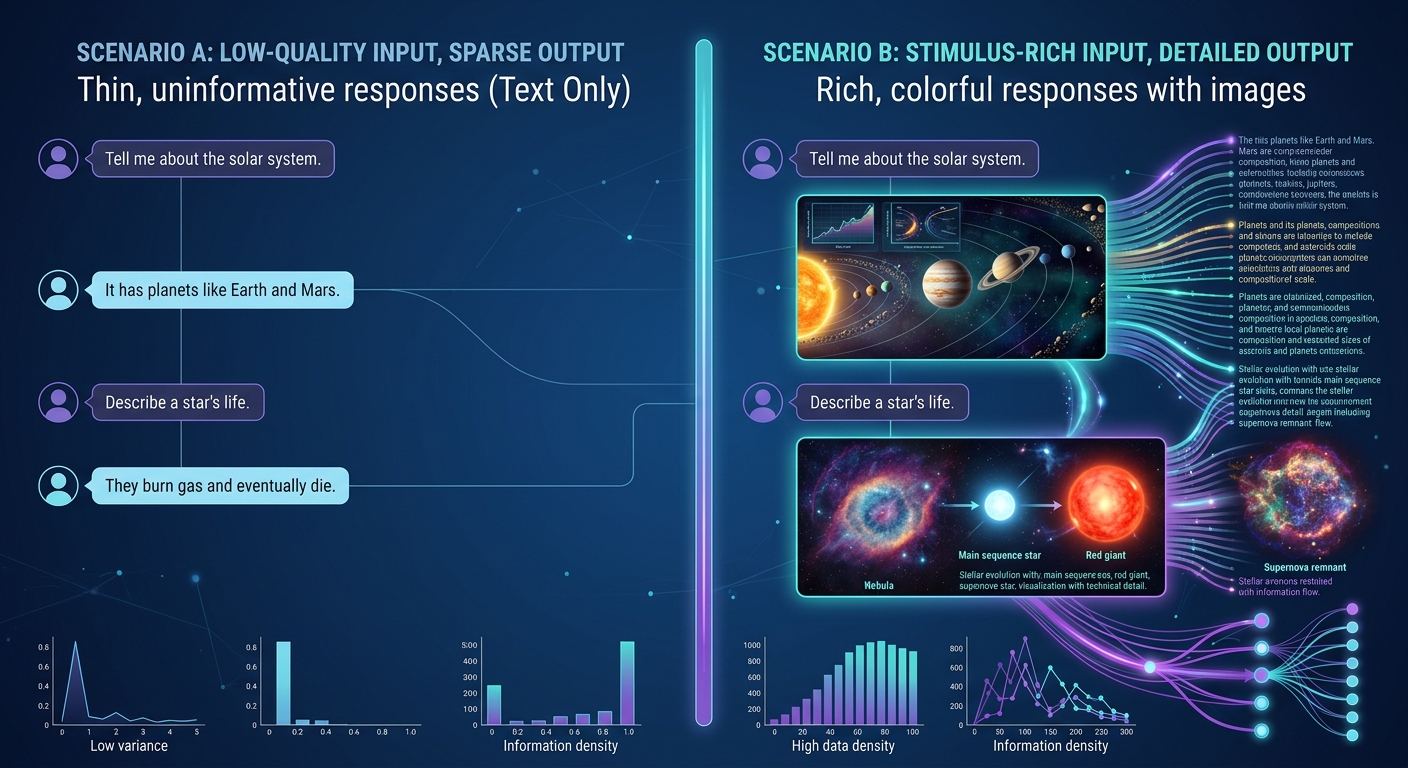
Response detail and length. Studies comparing stimulus-present and stimulus-absent conditions in otherwise identical interviews report 30-40% more detailed responses when stimulus is used. Participants provide more specific references, more descriptive language, and more elaborated explanations. Response length increases not because participants ramble, but because they have more to say.
Response latency and processing depth. Participants in stimulus-driven interviews take slightly longer to respond — but this is a feature, not a bug. Longer response latencies indicate deeper cognitive processing. The participant is not struggling to understand the question; they are engaging more deeply with the material before formulating their answer. This deeper processing produces responses that are more considered, more nuanced, and more reflective of genuine opinion.
Emotional language. Stimulus-driven responses contain significantly more emotional language — both positive and negative. Participants use more affective descriptors, more metaphorical language, and more personal anecdotes. This emotional richness is critical for research domains like brand perception, user experience, and healthcare, where emotional responses are often more informative than rational evaluations.
Specificity of references. In traditional interviews, participants tend to speak in generalities. In stimulus-driven interviews, they reference specific elements, make specific comparisons, and provide specific examples. This specificity makes the data far more actionable. Instead of "I like clean design," you get "I like how the navigation is tucked away in that hamburger menu — it makes the page feel less cluttered, but I worry I would not find what I need."
Contradiction and complexity. One of the most underappreciated benefits of stimulus is that it surfaces contradiction. When participants react to multiple stimuli, they frequently express conflicting preferences — "I prefer the look of A but the functionality of B." These contradictions are not noise; they are signal. They reveal the trade-offs and tensions that drive real-world decision-making. Traditional Q&A interviews rarely surface this complexity because participants can maintain a coherent (but oversimplified) narrative when speaking in the abstract.
Memory and Context Activation
Stimulus unlocks a cognitive pathway that verbal-only prompts cannot reach: associative memory activation. When a participant sees an image, it triggers a cascade of associated memories, experiences, and contextual knowledge. A photograph of a grocery store aisle does not just activate abstract knowledge about grocery shopping — it activates specific memories of specific trips, specific frustrations, specific moments of delight or disappointment.
This associative activation is automatic and largely unconscious. The participant does not decide to remember a specific shopping trip; the image triggers the memory, which surfaces naturally in the conversation. These triggered memories are more vivid, more emotionally rich, and more detailed than memories retrieved through verbal cues alone.
The implications for qualitative research are significant. In a traditional interview about grocery shopping habits, a participant might report their typical behavior — a rationalized, averaged-out summary of many trips. When shown an image of a crowded checkout line, the same participant might recall a specific frustrating experience, complete with emotional detail and contextual factors ("It was the week before Thanksgiving, the self-checkout was broken, and I had my kids with me — I almost left the cart and walked out"). This specific, emotionally grounded narrative is far more valuable for understanding real behavior than the sanitized average.
Photo elicitation researchers have documented this effect extensively. Participants shown photographs consistently produce longer, more detailed, and more emotionally expressive narratives than participants responding to equivalent verbal prompts. The images serve as memory keys — they open doors to experiences that verbal questions cannot reach. For a deeper exploration of this methodology, see our comprehensive guide to stimulus-based qualitative research.
Equalizing Participant Dynamics
Every researcher knows the pattern: in any group or even in one-on-one interviews, some participants are naturally articulate, confident, and verbose. Others are quieter, more thoughtful, and struggle to put their ideas into words. Traditional Q&A interviews disproportionately reward verbal fluency, creating a systematic bias toward participants who are comfortable speaking at length in unstructured conversations.
Stimulus levels the playing field. When a participant has a concrete image, concept, or prototype to reference, they no longer need to generate the entire structure of their response from scratch. They can point. They can compare. They can say "this part" or "that element" without needing to describe it from memory. The stimulus provides a shared vocabulary that reduces the advantage of verbal fluency.
This equalization effect is particularly important in cross-cultural research, research with non-native speakers, research with children or adolescents, and research with participants who have lower formal education. In all of these contexts, traditional Q&A interviews systematically underweight the perspectives of less verbally fluent participants. Stimulus-driven approaches give these participants concrete anchors for their ideas, resulting in data that is more representative and more equitable.
The effect also operates in group interview settings. In traditional focus groups, dominant speakers set the agenda and quieter participants defer. When stimulus is introduced, quieter participants gain an independent entry point into the conversation. They can react to the stimulus on their own terms, without needing to compete for conversational space. The result is more balanced participation and a broader range of perspectives in the data.
The Logistics Barrier: Why Stimulus Was Underused
If stimulus is so clearly superior, why has traditional Q&A dominated qualitative research for decades? The answer is not theoretical — it is logistical.
Historically, using stimulus in interviews was a hassle. For in-person research, materials had to be printed, laminated, shipped, or physically presented. For remote research, stimulus meant screen sharing (which broke conversational flow), mailing physical materials in advance (expensive and unreliable), or emailing files and hoping participants could open them. Every additional piece of stimulus added complexity, cost, and opportunities for things to go wrong.
Discussion guides with stimulus were harder to write, harder to moderate, and harder to standardize across multiple moderators and sessions. The result was predictable: researchers used stimulus when the project specifically demanded it (concept testing, packaging research, ad testing) and defaulted to verbal-only Q&A for everything else.
This is the real reason traditional interviews persist — not because they produce better data, but because they are easier to execute. The method is optimized for researcher convenience, not data quality.
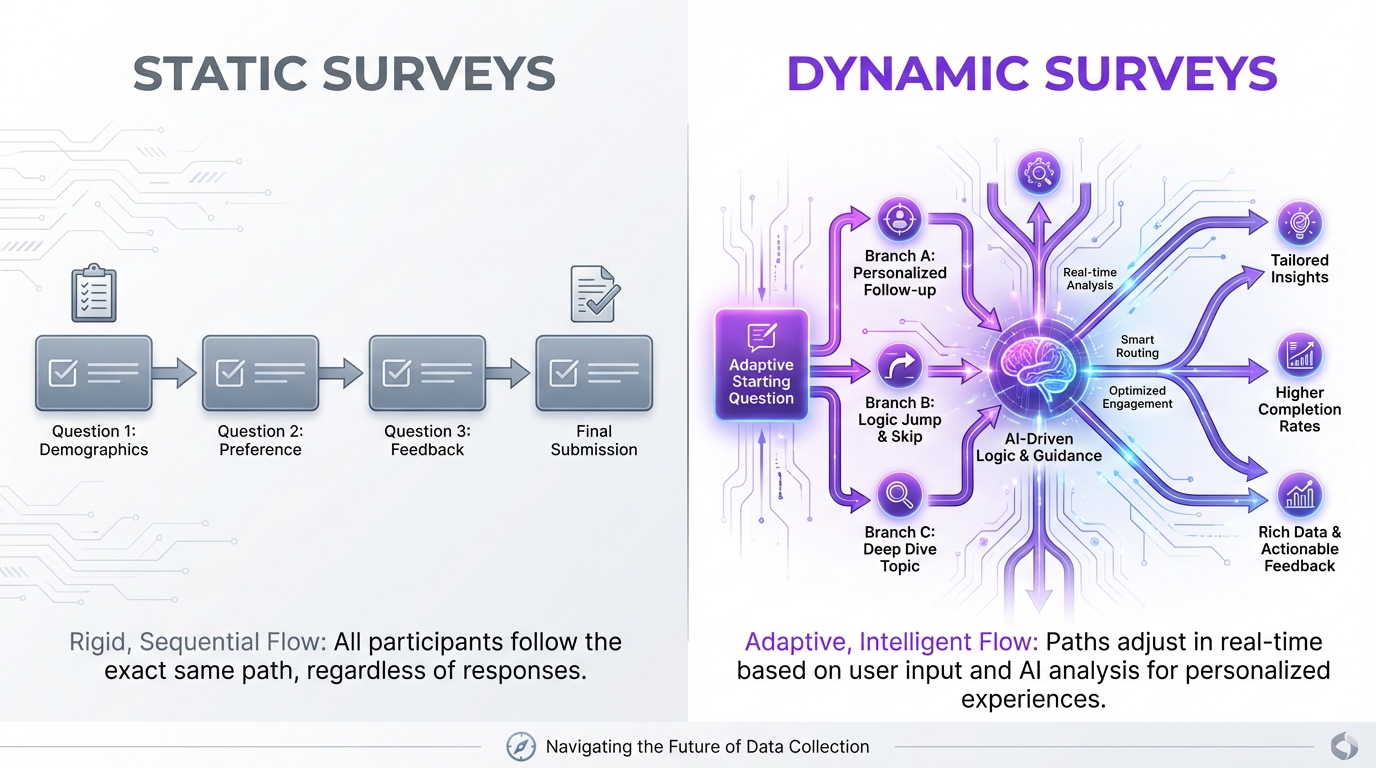
AI-powered research platforms are eliminating this barrier entirely. When interviews are conducted digitally through an AI-moderated platform, stimulus becomes trivially easy to integrate. Images, videos, concepts, and prototypes can be presented inline within the conversation flow. There is no printing, no mailing, no screen-sharing awkwardness. The stimulus appears naturally as part of the interview, and the AI moderator can adapt its follow-up questions based on the participant's specific reactions.
This logistical revolution means that the choice between stimulus-driven and verbal-only interviews is no longer a trade-off between data quality and operational feasibility. The friction is gone. The only question left is: why would you collect data without stimulus when you do not have to?
Real-World Evidence: Stimulus Across Research Domains
The evidence for stimulus-driven interviews spans every major qualitative research domain:
Brand research. A consumer packaged goods company compared traditional verbal-only brand perception interviews with stimulus-driven sessions where participants reacted to brand imagery, packaging, and competitive shelf sets. The stimulus-driven sessions produced 37% more specific brand associations, surfaced three previously unidentified competitive threats, and revealed emotional connections to legacy packaging that verbal interviews had missed entirely.
Product development. A technology company conducting early-stage concept exploration showed participants low-fidelity wireframes during interviews rather than describing features verbally. Participants in the stimulus condition identified usability concerns at twice the rate of the verbal-only condition and suggested specific design improvements that directly influenced the product roadmap. The verbal-only participants tended to express general approval or disapproval without actionable specifics.
Healthcare research. A pharmaceutical company studying patient experience showed participants visual journey maps of the treatment process. Patients who viewed stimulus reported more specific emotional and logistical barriers, disclosed more about their actual (vs. prescribed) behavior, and identified more moments of confusion or distress in the treatment journey. The stimulus reduced the social desirability pressure that typically causes patients to underreport non-adherence.
Social research. In studies of community perceptions and social attitudes, researchers using photo elicitation found that participants confronted with images of their local environment provided more nuanced and less ideologically filtered responses than participants answering equivalent verbal questions. The images grounded abstract opinions in concrete reality, making it harder for participants to retreat into rehearsed talking points.
From Evidence to Practice: Making Stimulus the Default
The case for stimulus-driven interviews rests on converging evidence from cognitive science, methodological research, and applied practice:
- Dual-coding theory tells us that multimodal encoding produces richer, more accessible cognitive representations
- The evaluation effect shows that reacting to concrete stimuli produces more specific and detailed responses than abstract verbal prompts
- Social desirability research demonstrates that external objects reduce self-censorship and increase honesty
- Anchoring studies confirm that shared reference points reduce moderator bias and surface unexpected insights
- Quantitative comparisons document 30-40% improvements in response detail, emotional richness, and specificity
- Memory research shows that images activate associative memories that verbal cues cannot reach
- Participation studies demonstrate that stimulus equalizes dynamics across different levels of verbal fluency
No single advantage makes the case on its own. Together, they form an overwhelming argument: stimulus-driven interviews produce fundamentally better data than traditional Q&A, across virtually every research context and participant population.
The historical barrier was logistics. That barrier no longer exists. Modern AI-powered research platforms make stimulus integration seamless, scalable, and cost-neutral. The question is no longer "Can we afford to use stimulus?" but "Can we afford not to?"
Moving Beyond Words
Qualitative research exists because human experience is too complex for surveys and too nuanced for analytics. But traditional verbal-only interviews — the backbone of qualitative practice for half a century — capture only a fraction of that complexity. They ask participants to translate their rich, multimodal, emotionally layered experience into words alone. The result is data that is thinner, more generic, and more biased than it needs to be.
Stimulus-driven interviews respect how human cognition actually works. They provide the visual, concrete, and tangible anchors that enable participants to access deeper memories, express more honest reactions, and articulate more specific preferences. They produce data that is richer, more actionable, and more representative of real human experience.
The evidence is not ambiguous. The logistics barrier is gone. The tools exist today.
Ready to see how stimulus-driven interviews can transform your research quality? Book a demo with Qualz.ai and experience the difference that evidence-based methodology makes — powered by AI that makes stimulus integration effortless.