The Translation Trap
Every research team hits this moment. You've got a validated survey instrument — maybe 40 items, carefully constructed scales, solid psychometrics. Now leadership wants "deeper insights." Someone suggests: "Can't we just turn those survey questions into an interview guide?"
It sounds logical. Efficient, even. You already know what you want to ask. Why not just ask it in a conversational format?
This instinct is wrong. Not slightly wrong — fundamentally wrong. And teams that follow it waste months collecting qualitative data that tells them nothing their survey didn't already reveal, while missing the emergent insights that justified the qualitative investment in the first place.
Different Tools, Different Epistemologies
The core problem isn't methodological — it's epistemological. Surveys and interviews don't just collect data differently; they assume different things about how knowledge works.
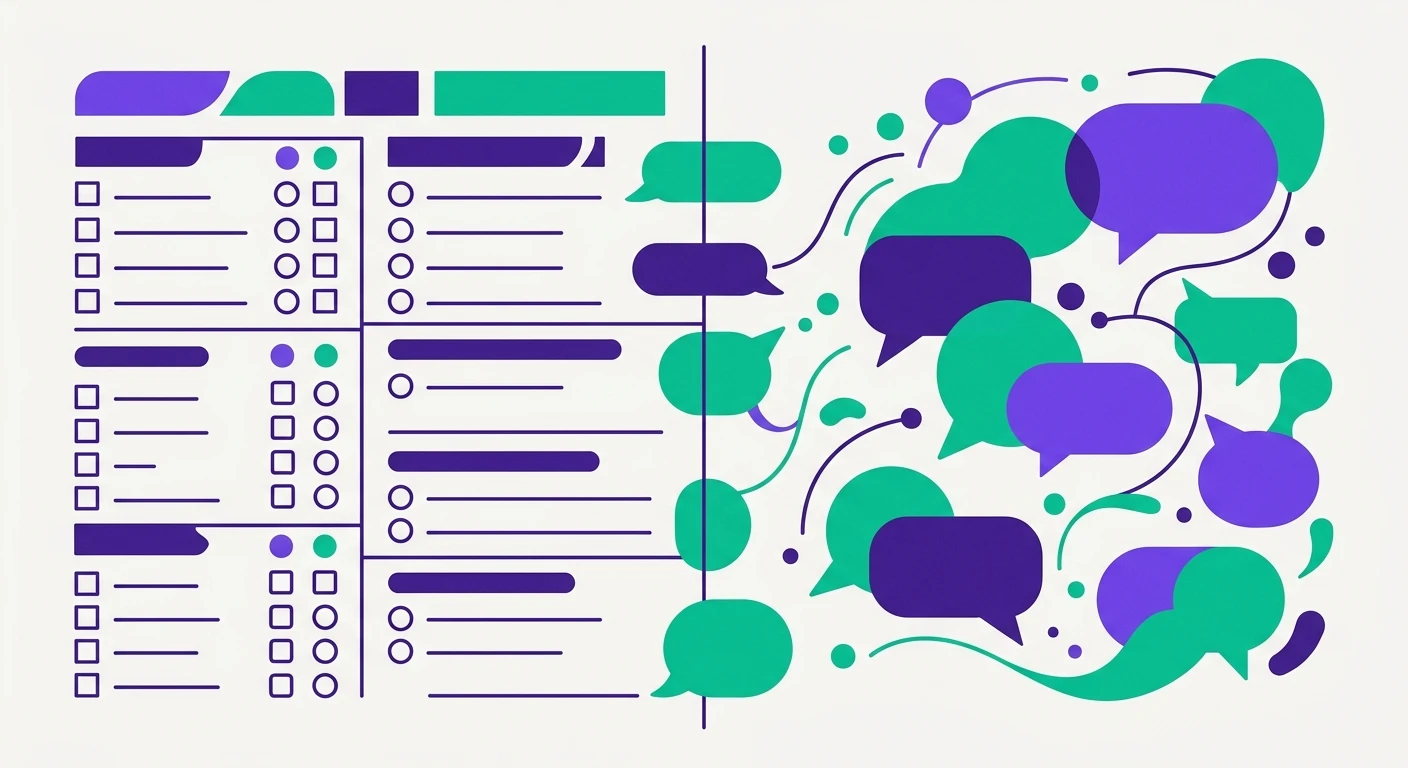
Surveys operate on a confirmation logic. You hypothesize that certain constructs matter, operationalize them into items, and measure their distribution across a population. The researcher defines the conceptual terrain before a single respondent touches the instrument. That's the point. That's what makes surveys powerful for measurement.
Interviews operate on a discovery logic. You enter with sensitizing concepts — loose orienting frameworks — but the participant defines what matters, how concepts relate, and what language describes their experience. The researcher's job is to follow, probe, and build understanding from the participant's frame of reference.
When you "translate" a survey into an interview guide, you import confirmation logic into a discovery context. You've predetermined the conceptual terrain. You've told the participant what matters by the questions you ask. You've closed the very doors you're paying to open.
What Gets Lost in Translation
Let's be specific about the damage. When teams convert survey items into interview questions, they systematically lose four things:
1. Emergent Themes
A survey about employee engagement might measure autonomy, belonging, purpose, and growth. Convert those into interview questions and you'll hear about autonomy, belonging, purpose, and growth. Congratulations — you've confirmed your own framework.
What you won't hear: the thing you didn't think to ask about. Maybe the real driver is micro-recognition patterns. Maybe it's schedule predictability. Maybe it's something so contextual to this organization that no validated scale has ever measured it. Qualitative research exists to surface what you don't know you don't know. Survey-derived guides eliminate that possibility by design.
2. Participant Framing
Survey response options don't just constrain answers — they constrain *how participants think about the question*. A 5-point agreement scale tells respondents: this is a dimension with a midpoint and two poles. An open interview question says: tell me about this in whatever terms make sense to you.
The difference matters enormously. When participants frame their own experience, they reveal the mental models, metaphors, and causal logics they actually use. These framings are often the most valuable qualitative findings — and they're impossible to access when you've pre-structured the conceptual space with survey-derived questions.
3. Contextual Richness
Survey items are deliberately decontextualized. "I feel supported by my manager" works precisely because it abstracts away the specific interactions, settings, and temporal dynamics that constitute "feeling supported." That abstraction enables measurement across contexts.
But qualitative research needs that context. The story of one specific moment when support was felt (or wasn't) reveals mechanism — the *how* and *why* beneath the *what*. Interview guides derived from surveys tend to produce responses at the same abstraction level as the survey itself: general, decontextualized, analytically thin.
4. Relational Meaning
Surveys measure constructs independently. Each item maps to one factor. But lived experience doesn't partition neatly into independent constructs. In interviews, you discover how concepts *relate* for this participant — how autonomy enables purpose, how belonging undermines growth, how contextual factors create unique configurations. Survey-derived guides, structured around individual constructs, fragment the relational fabric that gives qualitative data its explanatory power.
Why Teams Keep Making This Mistake
If the translation approach is so flawed, why do smart research teams keep doing it? Three reasons:
Efficiency pressure. Designing a proper qualitative protocol takes expertise and time. Converting existing items feels like a shortcut. It's not — it's a shortcut to useless data — but the time savings are visible upfront while the quality loss only becomes apparent during analysis.
Comparability illusion. Teams believe that asking "the same questions" in both formats enables direct comparison. But methodological commensurability doesn't work that way. A survey item and an interview question about "the same topic" are measuring fundamentally different things through fundamentally different processes. The apparent alignment is superficial.
Construct anxiety. Researchers trained in quantitative methods feel uncomfortable entering an interview without a predetermined conceptual structure. The survey provides that structure like a security blanket. The discomfort of genuine openness — of not knowing what you'll find — feels like poor preparation rather than appropriate qualitative practice.
How to Actually Design Complementary Protocols
The right approach isn't translation — it's complementary design. Your interview protocol should be built *around* your survey, not *from* it. Here's the framework:
Start With What the Survey Can't Tell You
Review your quantitative findings and ask: *Where do I have measurement without understanding?* Common examples:
- Surprising patterns: Why did Group A score high on satisfaction but low on retention intent? The survey measured both; the interview explores the mechanism.
- Unexplained variance: What's driving the residual in your model? The survey captured your hypothesized predictors; the interview surfaces what you missed.
- Construct boundaries: Where do participants' experiences spill beyond your operationalized constructs? The survey measured what you defined; the interview discovers what you didn't.
This approach — using quantitative findings to generate qualitative questions rather than translating quantitative items into qualitative format — is genuine mixed-methods design rather than method duplication.
Design for Progressive Depth
Effective interview protocols move from broad to specific, from participant-framed to researcher-probed. The structure should look like:
- Grand tour questions — wide-open invitations for participants to describe their experience in their own terms and categories
- Structural questions — prompts that explore how participants organize and relate the concepts they've introduced
- Contrast questions — probes that clarify distinctions participants have made and surface the criteria they use
- Targeted probes — specific follow-ups informed by your quantitative findings, introduced only after participants have established their own framework
This progressive disclosure approach ensures you don't frontload researcher assumptions while still eventually connecting qualitative findings to quantitative patterns.
Write Questions That Open Rather Than Close
Compare these approaches to exploring the same terrain:
Survey-translated (wrong): "On a scale of 1-5, how much autonomy do you feel you have? ... OK, can you tell me more about why you chose that number?"
Complementary design (right): "Walk me through a recent decision you made about how to approach your work. What did that process look like?"
The first question imports the survey's conceptual frame (autonomy as a unidimensional quantity) and asks the participant to annotate their survey response. The second question accesses the same experiential domain but lets the participant reveal their own categories — which might include autonomy, or might surface something entirely different.
Build in Adaptive Capacity
Here's where most static interview guides fail: they can't respond to what participants actually say. A participant mentions something unexpected in question 2, but the guide marches on to question 3. The emergent signal — the whole reason you're doing qualitative research — gets acknowledged with a "that's interesting" and then abandoned.
Effective protocols need built-in decision points: *If participant raises X, probe in this direction. If participant's framing conflicts with survey constructs, explore the discrepancy.* This adaptive logic is what separates a genuine qualitative protocol from a survey in disguise.
AI-Adaptive Probing: Solving the Fatigue Problem
The adaptive capacity problem has historically been constrained by researcher fatigue. Human interviewers conducting their eighth interview of the day inevitably default to the script. They miss the subtle linguistic cues that signal emergent themes. They stop probing at exactly the moments when probing matters most.
This is where AI-moderated interviews change the equation — not by replacing qualitative logic with quantitative logic, but by maintaining qualitative attentiveness at scale.
An AI interviewer designed with proper qualitative logic can:
- Detect novel framing — recognize when a participant's language doesn't map to the existing codebook and probe deeper rather than redirecting to pre-planned questions
- Maintain adaptive focus — follow emergent threads across the full conversation without fatigue-induced reversion to the script
- Calibrate probe depth — distinguish between tangents (redirect gently) and discoveries (explore aggressively) based on relevance signals
- Track cross-participant emergence — identify when multiple participants independently surface similar unexpected themes, increasing probe investment in subsequent interviews
The key insight: AI-adaptive probing works *because* the protocol wasn't derived from the survey. If your interview guide is just survey items restated conversationally, there's nothing to adapt to — you've already determined what you'll find. Adaptivity only has value when the protocol leaves genuine space for discovery.
Practical Frameworks for Mixed-Methods Design
For teams ready to abandon the translation approach, here's a decision framework for designing complementary mixed-methods research:
The Complementarity Matrix
Map each research question to its appropriate method:
| Question Type | Method | Example |
|---|---|---|
| How much? How many? | Survey | What % report high burnout? |
| What predicts? | Survey | Does workload predict burnout controlling for support? |
| How does it work? | Interview | What does the burnout experience feel like day-to-day? |
| Why this pattern? | Interview | Why do high-support teams still show burnout? |
| What's missing? | Interview | What factors outside our model matter to participants? |
No question appears in both columns. That's the point. Each method answers what the other cannot.
Sequential Design Principles
Quan → Qual (Explanatory Sequential):
- Analyze survey data fully before designing interview protocol
- Identify findings that need mechanistic explanation
- Design interview questions that explore *mechanisms*, not measures
- Sample interview participants based on interesting survey response patterns
Qual → Quan (Exploratory Sequential):
- Conduct open interviews first — no predetermined framework
- Identify emergent themes and participant categories
- Develop survey items that operationalize *participant-derived* constructs
- Validate at scale what emerged in depth
Both sequences require that the second method be designed *after* the first is analyzed. You cannot design both instruments simultaneously without defaulting to translation logic.
Managing Cognitive Load Across Methods
One underappreciated aspect of mixed-methods design: participant cognitive load differs dramatically between methods, and protocols must account for this.
Survey fatigue is about volume and repetition — participants disengage when items feel redundant. Interview fatigue is about depth and emotional labor — participants disengage when questions require sustained introspective effort without adequate rapport.
When the same participants encounter both instruments, sequence and framing matter:
- Don't interview immediately after survey administration (frame contamination)
- Don't reference specific survey items during interviews (priming effects)
- Do explain why both methods exist in terms participants understand ("the survey tells us what's happening broadly; this conversation helps us understand what it's actually like")
The Role of AI in Getting This Right
Modern AI-assisted research design can help teams avoid the translation trap entirely — but only if the AI is designed around qualitative principles rather than simply scaling quantitative logic.
The worst implementation: an AI that takes your survey and generates "open-ended versions" of each item. This is automated translation — faster, but just as wrong.
The right implementation: an AI that analyzes your quantitative findings, identifies the explanatory gaps, and generates interview protocols designed to surface what the survey structurally cannot access. This requires the system to understand epistemological complementarity, not just linguistic transformation.
At Qualz.ai, this distinction is foundational to how we've built our platform. The AI doesn't convert surveys into interviews — it designs research systems where each method does what it does best, and the integration happens at the insight level rather than the instrument level.
The Bottom Line
The instinct to translate surveys into interview guides is natural, efficient-seeming, and wrong. It produces qualitative data without qualitative value — responses that confirm what you already measured without revealing what you haven't imagined.
Genuine mixed-methods research requires:
- Epistemological clarity — understanding that surveys and interviews answer different kinds of questions
- Complementary design — building each instrument to access what the other cannot
- Adaptive protocols — interview guides with built-in capacity to follow emergent signals
- Sequential discipline — designing the second method after analyzing the first
The payoff is research that actually generates new understanding rather than expensive confirmation of existing frameworks. Your survey tells you what's happening. Your interviews should tell you something your survey never could.
*Designing mixed-methods research that generates genuine complementarity between quantitative and qualitative instruments? Book an information session to explore how Qualz.ai's adaptive interview platform fits into your research design.*