The Tidy Transcript That Lies
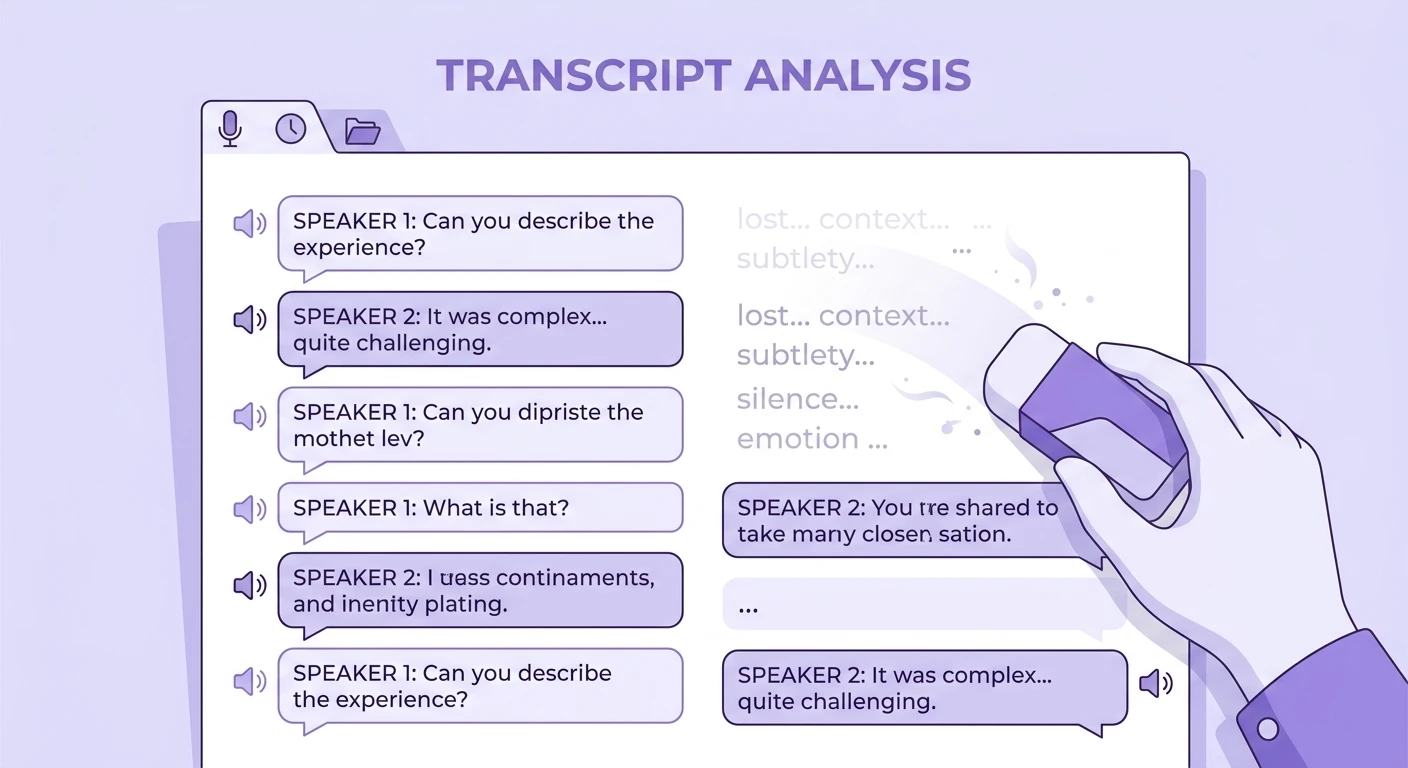
You finish an interview, the AI transcript lands in your inbox, and it looks messy. There are half-sentences, repeated words, "like" and "um" scattered everywhere, and a dozen places where the participant started to say one thing and swerved into another. So you clean it up -- or you accept the tool's "smart" cleaned version. The result reads beautifully: crisp, grammatical, quotable. And it is quietly wrong.
The transcript cleanup trap is the belief that disfluencies are noise to be removed rather than data to be read. When you delete the hesitations, the self-corrections, and the trailing qualifiers, you do not just tidy the text. You erase the participant's real relationship to what they were saying -- and you replace a hesitant, ambivalent human with a fluent, confident one who never sat in your session.
Why Disfluencies Are the Signal, Not the Static
Every filler and false start is doing work. Strip it out and you lose the work with it.
Hesitation marks uncertainty. When a participant says "it's... I mean, I guess it's fine?" the pauses and hedges are the finding. The cleaned version -- "It's fine." -- reports confidence the person never had. This is the same failure mode as the confidence calibration gap, where certain-sounding participants are often the least accurate; cleanup manufactures that false certainty on the page.
Self-correction reveals the real thought. "I love it -- well, I don't love it, but I use it every day" is a participant revising in real time toward something truer. Tidy it into "I use it every day" and you have thrown away the ambivalence that was the whole point. Flattening that tension is exactly the sentiment flattening problem, where analysis collapses ambivalence into false clarity.
Prosody and pauses carry meaning text cannot. A three-second silence before "yeah, it works" means the opposite of an immediate "yeah, it works." Reading a cleaned transcript instead of listening strips that entirely -- the core of the transcription substitution effect, where reading transcripts erases the paralinguistic meaning you needed most.
The Downstream Damage
The cleaned transcript does not just misrepresent one quote -- it corrupts everything built on top of it. When you pull a polished sentence into a readout, you strip its surrounding hedges and context, the decontextualization problem where interview quotes lose the meaning their context supplied. And a fluent, quotable line is precisely the kind of sentence that hijacks a synthesis, the verbatim overweighting effect where one quotable sentence hijacks an entire research readout. Cleanup makes the most dangerous quotes even more seductive.
How to Preserve the Signal
Keep a verbatim layer. Never destroy the raw transcript. Clean copies for sharing are fine, but analysis must happen against the unedited text, with disfluencies intact.
Treat hesitations as codes. Tag pauses, hedges, and self-corrections as analyzable features, not typos. They are evidence of uncertainty and revision.
Return to the audio for anything that matters. Any quote headed for a decision-driving readout should be re-heard, not just re-read, to recover the prosody the page cannot hold.
Distrust the fluent quote. When a line reads too cleanly, ask whether the tool -- or you -- smoothed away the very ambivalence that was the finding. Triangulate it against behavior before you trust it, the discipline behind research triangulation for product decisions.
The Takeaway
A transcript is not a document to be perfected. It is a recording of a human thinking out loud, hesitating, and revising. The mess is the meaning. Clean it away and you are left with a confident stranger's words in your participant's mouth -- and every insight you draw from them inherits a certainty that was never there. Qualz.ai preserves the full fidelity of what participants actually said, so your analysis reflects real hesitation and ambivalence instead of the tidy version that reads well and means nothing.
*Ready to analyze what participants actually said -- pauses, hedges, and all? See how Qualz.ai preserves interview fidelity.*