The Seduction of Clean Text
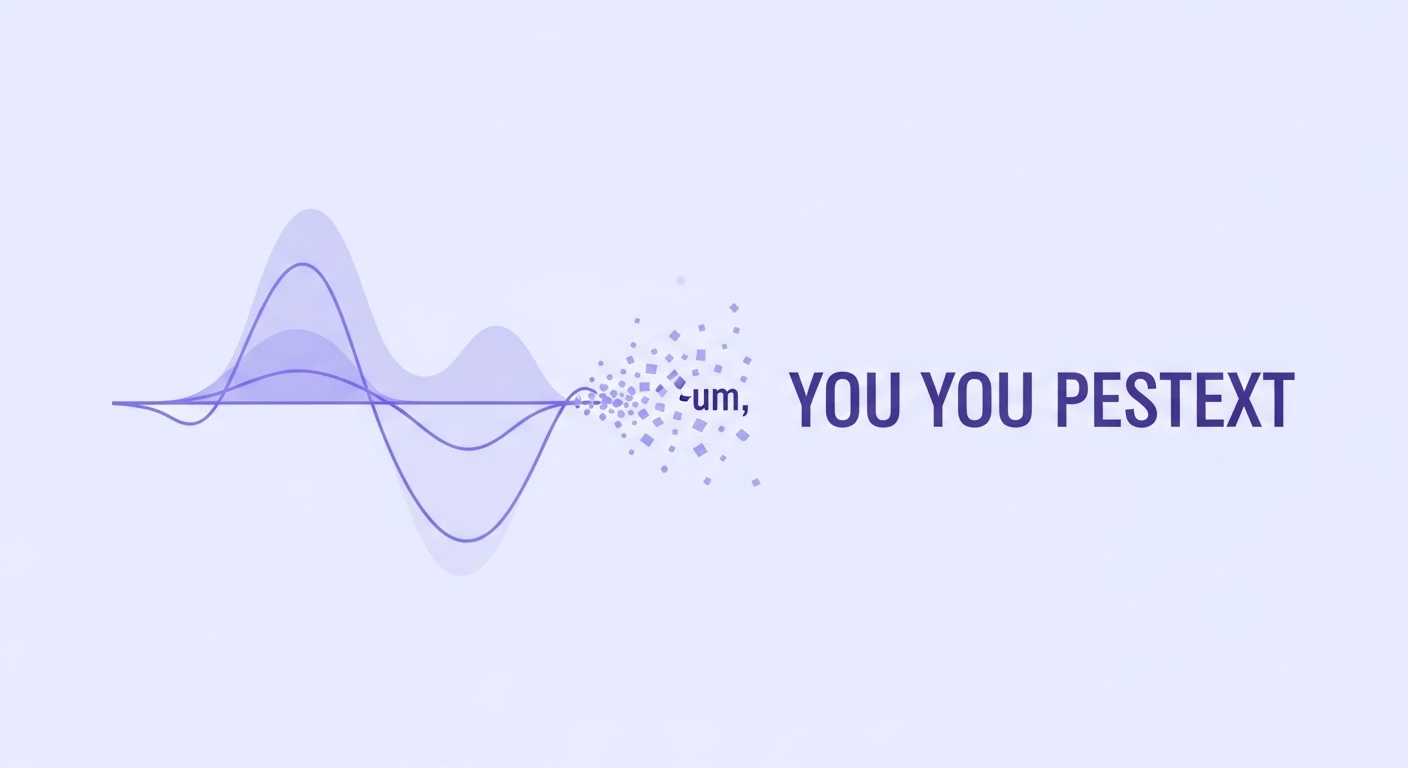
Modern speech-to-text is astonishingly good at producing something readable. You upload an hour of messy human conversation and receive back tidy paragraphs, punctuation intact, "ums" removed, false starts smoothed over, repeated words collapsed into a single clean phrase. It looks like a transcript. It reads like a transcript. Researchers treat it as the transcript.
But the readability is manufactured. To produce clean output, transcription models make thousands of tiny editorial decisions about what to keep and what to discard. And the things they discard most aggressively -- disfluencies, pauses, self-interruptions, reformulations -- are frequently the highest-information events in the entire recording.
The transcription fidelity gap is the distance between what a participant actually did with their voice and what the transcript says they said. That gap is not random. It systematically removes exactly the linguistic features that signal uncertainty, discomfort, and real-time thought construction.
Disfluencies Are Data, Not Noise
Decades of psycholinguistic research establish that disfluencies are meaningful. They are not verbal litter to be swept away. They mark cognitive and emotional states with remarkable reliability.
Filled pauses ("um," "uh") mark planning difficulty. A speaker who says "I would, um, probably choose the second option" is signaling something different from one who says "I would definitely choose the second option." The filled pause is evidence of retrieval difficulty or genuine uncertainty. Delete it and the two utterances become identical on the page.
Self-corrections mark abandoned truths. When a participant says "I love it -- well, I don't hate it," the abandoned first formulation is often more honest than the revised one. The repair reveals the gap between the socially easy answer and the accurate one. Clean transcription frequently keeps only the repaired version, silently discarding the more revealing false start.
Prolongations and restarts mark conflict. "The onboarding was... it was... fine" is a participant working hard to stay diplomatic about something they found frustrating. The struggle is the finding. On a clean transcript it reads as "The onboarding was fine" -- the exact opposite of the truth.
This connects directly to what we have called the articulation gap: the reality that users often cannot cleanly explain their own behavior. Disfluencies are the audible trace of the articulation gap in action. Erasing them erases your best evidence that a participant is reaching for something they cannot quite name.
The Silence Problem, Automated
We have written before about the silence problem in user interviews -- how pauses carry meaning that skilled interviewers learn to read. AI transcription weaponizes the opposite instinct. Where a good interviewer treats silence as significant, transcription tools treat silence as empty space to be compressed or dropped entirely.
Most transcription pipelines do not represent pause duration at all. A three-second pause before answering a sensitive question -- a pause that any human would read as loaded -- appears in the transcript as an ordinary sentence break, indistinguishable from a natural breath. The temporal texture of the conversation, which is where much of its emotional meaning lives, is flattened into uniform prose.
Why This Gets Worse Downstream
The fidelity gap does not stay contained at the transcription step. It compounds through the analysis pipeline.
AI analysis inherits the cleaned input. When you feed a scrubbed transcript into an AI analysis tool, the model never sees the disfluencies. It cannot weight uncertainty it was never shown. It confidently codes "The onboarding was fine" as positive sentiment because the evidence of struggle was deleted two steps earlier. The analysis is only as faithful as its most lossy upstream transformation -- a principle that enterprise data teams formalize through data contracts that make pipeline transformations explicit and auditable. Qualitative pipelines almost never have such contracts. Nobody documents what the transcription layer threw away.
Quotes get laundered. A researcher pulls a supporting quote from the clean transcript. The quote reads crisp and confident. But the participant did not say it crisply or confidently -- they stumbled through it. The clean quote misrepresents the participant's actual epistemic state to every stakeholder who reads the final report.
Structured extraction amplifies false precision. Teams increasingly pipe transcripts into structured extraction to populate databases and dashboards. As we have argued about structured output engineering in production LLM systems, forcing messy reality into clean schemas is powerful but lossy. A hesitant, hedged answer and a firm one collapse into the same categorical field. The structure records the words and discards the confidence with which they were spoken.
What Faithful Transcription Would Preserve
You do not need a phonetics lab. You need to stop optimizing purely for readability. Faithful research transcription should retain:
Filled pauses, at least flagged. Even a simple marker showing that a filled pause occurred preserves the signal without cluttering the read.
False starts and self-corrections verbatim. Keep both the abandoned and the repaired formulation. The delta between them is analyzable data.
Pause duration above a threshold. Marking pauses longer than, say, two seconds restores the temporal texture that signals hesitation or discomfort.
A confidence layer. Where the transcription model itself was uncertain, that uncertainty should surface -- not be hidden behind fabricated fluency.
Practical Guidance for Research Teams
Audit what your tool removes. Take one recording, transcribe it with your standard tool, then transcribe a two-minute segment by hand verbatim. Compare. The delta is your fidelity gap, and it is usually larger than teams expect.
Keep the audio in the loop. Never treat the transcript as the sole record. For any quote or theme that will drive a decision, return to the audio to hear how it was actually said.
Separate verbatim from readable modes. Use clean transcripts for skimming and navigation, but preserve a verbatim version for analysis of anything emotionally or decisionally significant.
Document your transcription settings as part of your method. If your report depends on transcripts, your readers deserve to know how those transcripts were produced and what was stripped -- the same transparency standard we advocate throughout AI-assisted research.
The Larger Point
Cleanliness is a value that serves the reader, not the truth. A transcript optimized for easy reading is optimized to hide the very features that distinguish a confident answer from a reluctant one, a held belief from a constructed one. The disfluencies your tool politely removes are the participant telling you where the real story is.
The most dangerous transcript is not the one full of errors. It is the one that is perfectly clean and quietly wrong -- because no one thinks to question text that reads so well.
Qualz.AI is built to keep the signal that generic transcription discards, preserving the texture of how participants actually speak so your analysis reflects what they meant, not just what they said. Book a demo to see the difference fidelity makes.