The Politeness That Silences Your Data
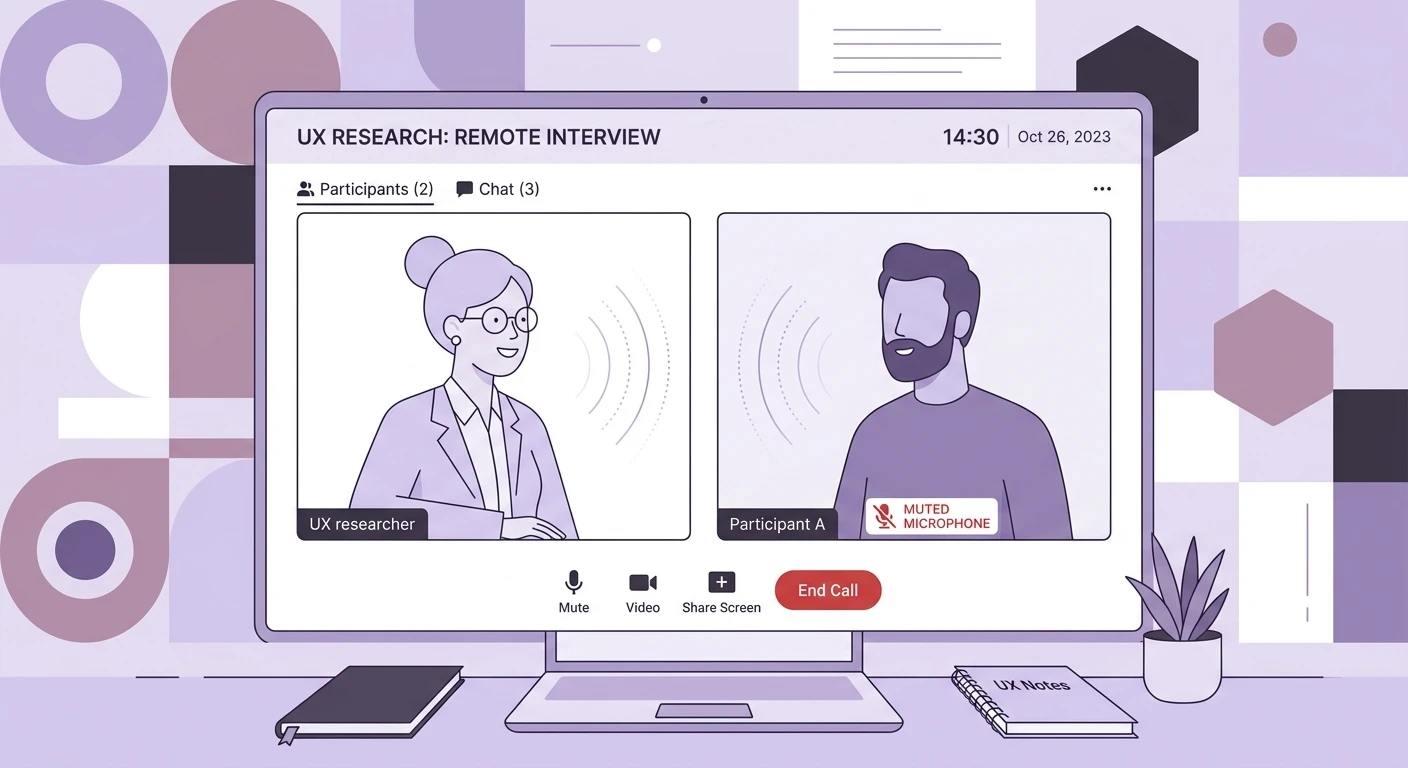
Somewhere along the way, muting yourself became the default courtesy of remote research. It keeps the recording clean. It hides the fact that you are typing notes. It spares the participant your background noise. Every instinct says it is the professional thing to do. And it is quietly wrecking your interviews.
Human conversation does not run on turns alone. It runs on a constant stream of listener feedback -- the "mm-hmm," the "right," the small in-breath that signals you are about to speak, the laugh that says you got the joke. Linguists call this backchannel: the near-continuous, low-cost signaling a listener sends to a speaker to say *keep going, I am with you, that mattered.* When you mute, you delete all of it. What the participant experiences is not a clean channel. It is a void.
The backchannel suppression effect is the systematic degradation of participant disclosure that happens when the interviewer removes the audible cues a speaker depends on to calibrate how much to say. It does not announce itself. Participants do not complain that you are muted. They just start giving you less.
Why Silence Reads as Disinterest
A speaker with no backchannel cannot tell the difference between rapt attention and total absence. Faced with that ambiguity, people assume the worse of the two. Silence gets read as boredom, disagreement, or a signal that they have said enough. So they wrap up early, hedge, and retreat to safe generalities.
This is the same underlying machinery behind the articulation gap, where the distance between what users do and what they can say out loud swallows your best insights. Backchannel is the scaffolding that helps a participant push through that gap -- the encouragement that says *the half-formed thing you are reaching for is worth finishing.* Remove the scaffolding and the half-formed thought never gets built. The participant defaults to the fluent, rehearsed surface answer instead of the messy, valuable one underneath.
It compounds with the confidence calibration gap, where certain-sounding participants are often the least accurate. Without your feedback to tell them which threads land, participants over-index on the answers that come out cleanest -- not the ones that are truest. You end up rewarding fluency and starving nuance.
The Failure Modes You Won't Hear
Premature closure. The most common casualty is depth. A participant reaches the end of their easy answer, hits a wall of silence, and reads it as a cue to stop rather than an invitation to continue. The richest material -- the part that comes after "...well, actually" -- never arrives.
Answer shrinkage. Across a muted session, answers get progressively shorter. The participant is starved of the reinforcement that tells them their detail is welcome, so they ration it. You mistake this for a topic running dry when it is really a channel running cold.
Compensatory agreement. Deprived of read on the interviewer, some participants tilt toward agreement to reduce the social risk of the void, an amplification of the acquiescence bias that already runs hotter in video interviews than in person. Saying yes feels safer than talking into silence.
Interviewer over-talk. The mirror-image failure: interviewers who mute often overcorrect by interjecting loudly and frequently when they do unmute, filling the void with their own words and steering the participant -- close cousin to the reassurance reflex, where softening the moment erases the signal you needed.
How to Keep Your Backchannel Alive
Stay unmuted by default; manage noise at the source. Use a decent headset, work in a quiet room, and switch to a mechanical-quiet or touch keyboard if note-typing is the concern. The goal is to make being unmuted sustainable rather than treating mute as the fix.
Verbalize your minimal encouragers deliberately. A soft "mm-hmm," "go on," or "say more about that" every few beats does the work a nod does in person. Keep them short and content-free so you are encouraging, not steering.
Separate encouragement from evaluation. Backchannel should signal *I am listening,* not *I approve.* Warmth that reads as approval creates its own distortion, the interviewer warmth overcorrection where being too likable kills honest feedback. Neutral continuers -- "okay," "I hear you" -- keep the channel open without tilting the answer.
Let silence be intentional, not accidental. There is a difference between a deliberate pause you are holding to invite depth and a dead void created by your mute button. Master the strategic use of silence in interviews -- but make it a choice you can end with a warm word, not a wall the participant cannot see past.
Audit your own channel. Review a recording and mark every point where the participant trailed off. If those moments cluster around your silences, your channel is the variable, not the participant.
Why This Belongs in Your Research Ops Standards
Backchannel discipline is not a soft skill you either have or lack -- it is a measurable, teachable part of interview quality that belongs in your team's protocols. Just as production AI teams treat observability as a first-class discipline for monitoring the signals a system emits, research teams should treat the interviewer's audible feedback as an instrument that needs calibration and review, not an afterthought muted for convenience. And because these micro-behaviors are exactly the paralinguistic cues that get flattened in analysis, teams leaning on automated tooling should heed the risk that AI transcription strips the meaning that lived in the sound.
The next time your instinct says to mute, remember what you are actually turning off. Not the noise -- the connection. In a remote interview, your presence is audible or it is nothing. Keep it audible.
Run Better Remote Interviews With Qualz.AI
Qualz.AI helps research teams capture, analyze, and interrogate interview data without losing the nuance that lives between the words. If your remote sessions are quietly leaking depth, book a demo and see how richer signal capture changes what you learn.