The Front-Loading Mistake
You have 45 minutes. Your stakeholders want answers to three critical questions. So you put those questions in the first ten minutes — right after the warm-up — because what if you run out of time? This logic makes sense on a project plan. It fails catastrophically in practice.
Front-loaded interview guides produce surface-level answers to important questions and detailed answers to unimportant ones. The participant is still warming up, still calibrating how honest they can be, still figuring out what kind of conversation this is. You ask "What frustrates you most about this workflow?" and get a diplomatic non-answer because the participant has not yet decided you are safe to be honest with.
Ten minutes later, when trust is established and they are mid-flow describing a tangential process, they casually mention the real frustration — the one they would have never offered as a direct answer to a direct question asked too soon.
Progressive Disclosure as Conversational Architecture
In interaction design, progressive disclosure means revealing complexity gradually — showing users simple options first and advanced options only when they signal readiness. The same principle transforms interview guides.
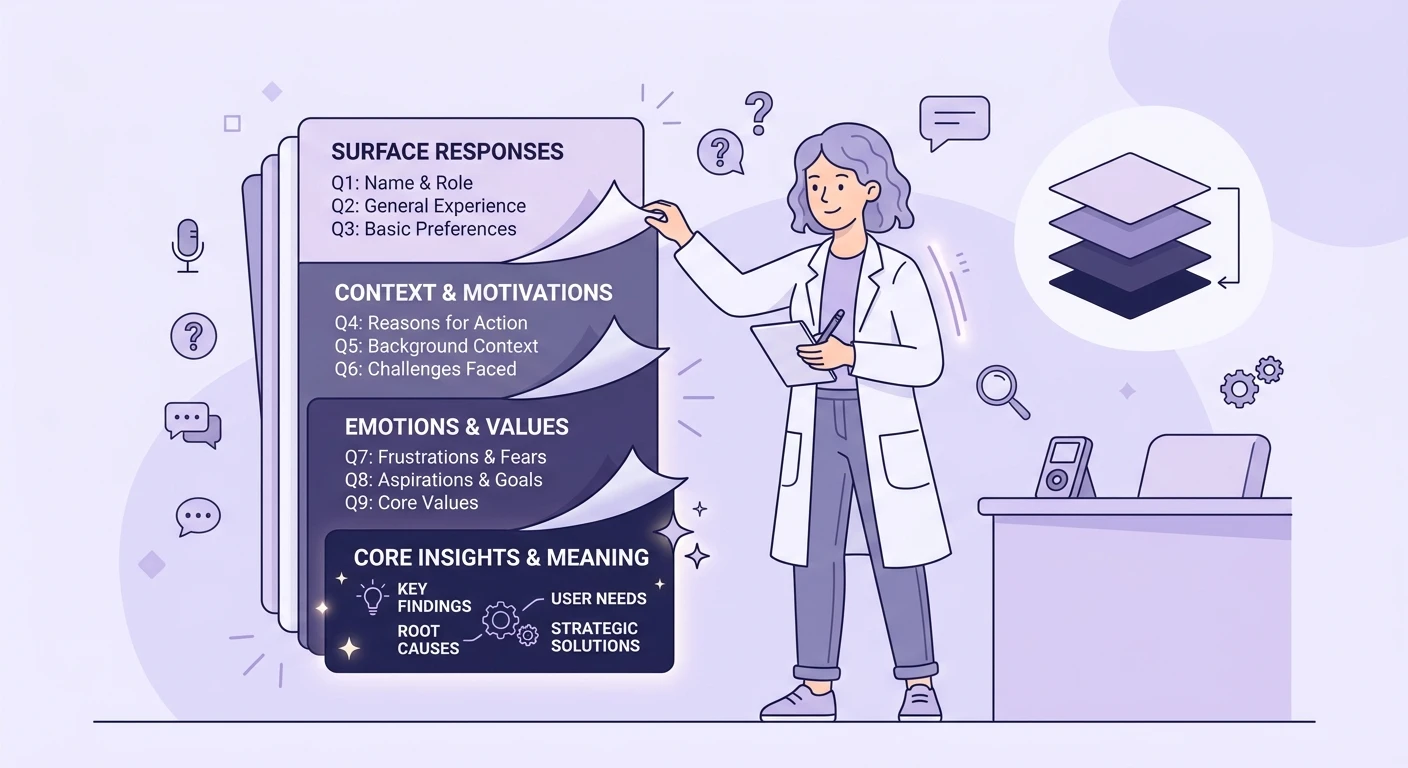
A progressively disclosed interview moves through four layers:
Layer 1: Orientation (minutes 1-5). Establish context without asking for evaluation. "Walk me through your typical Monday morning" not "What is broken about your morning routine?" The participant describes their world without feeling judged. You learn vocabulary, rhythm, and context you will need later.
Layer 2: Process (minutes 5-15). Follow their described workflow with curiosity, not challenge. "You mentioned you check three dashboards — what are you looking for in each one?" Still descriptive, still safe. But now you are building a shared map of their reality that makes later questions precise rather than abstract.
Layer 3: Evaluation (minutes 15-30). Only now do you invite judgment. "You described checking those three dashboards every morning — how does that feel?" The participant has already told you what they do. Now they can tell you how they feel about it without fear of sounding incompetent, because you clearly already understand their context. This is where the silence problem in user interviews reverses — participants who feel understood become expansive rather than guarded.
Layer 4: Abstraction (minutes 30-45). Now you can ask the big questions: "If you could redesign this from scratch, what would change?" or "What would this look like if it actually worked for you?" They have spent 30 minutes demonstrating expertise about their own experience. They have earned (in their own mind) the authority to make bold claims. Front-loading this question gets you "I do not know, it is fine I guess." Earning it through progressive layers gets you product roadmap gold.
Why This Works: The Psychology
Commitment and consistency. Once participants have invested 15 minutes describing their process in detail, they feel committed to giving you equally detailed evaluations. Shallow answers to deep questions feel inconsistent with the depth they have already demonstrated.
Cognitive warming. Describing concrete recent experiences activates episodic memory. By the time you ask evaluative questions, the participant is drawing from vivid specific memories rather than constructed generalizations. This directly addresses the recall bias problem — participants who have been walking through concrete episodes give more accurate retrospective evaluations.
Social proof of safety. Each question you ask that does not judge them builds evidence that you are safe. By layer 3, they have observed 15 minutes of non-judgmental curiosity. This is far more powerful than any verbal reassurance about confidentiality you offer in your consent script.
The Stakeholder Challenge
Stakeholders review interview guides and immediately ask: "Why is our key question at minute 25? What if the interview runs short?" Two responses:
1. Reframe the guide as infrastructure. Layers 1-2 are not filler — they are the foundation that makes layer 3-4 answers trustworthy and detailed. Without them, you get answers. With them, you get insights. The distinction matters for research findings that actually change product decisions.
2. Build in time buffers, not question buffers. If you have 45 minutes, design for 35. Use the extra 10 as overflow for moments when participants go deep. Never sacrifice depth architecture to add more questions.
Designing Progressive Guides in Practice
Map your question hierarchy. List all questions, then rank them by emotional difficulty and abstraction level. Low-difficulty concrete questions form layers 1-2. High-difficulty abstract questions form layers 3-4. If your guide alternates difficulty randomly, restructure it.
Build bridges between layers. Transitions should feel natural: "You mentioned X in your workflow — I am curious how that compares to what you expected when you first started." The bridge connects their descriptive answer (layer 2) to an evaluative prompt (layer 3) using their own words.
Use participant language as leverage. When a participant uses a specific term in layer 1-2 ("my workaround stack" or "the Monday scramble"), adopt it in layer 3-4 questions. This signals deep listening and gives them permission to be specific rather than generic.
The approach mirrors how AI adaptive interviews maintain engagement — both human and AI interviewers produce better data when they respect the natural arc of human disclosure rather than treating interviews as questionnaire delivery mechanisms.
Common Progressive Disclosure Failures
The premature probe. Asking "Why?" in layer 1 before you have earned it. "You check email first thing — why?" feels interrogative before trust is built. Replace with "Tell me more about that" in early layers.
The reset. Jumping from a deep layer-3 discussion back to a layer-1 factual question. This signals the conversation is transactional, not relational. Once you have gone deep, stay deep or go deeper.
The reveal. Showing participants what you already know too early. "We have heard from other users that the dashboard is confusing — do you agree?" collapses all four layers into a single leading question. Your knowledge should inform your listening, not your asking.
Progressive disclosure is not about being indirect or manipulative. It is about respecting the natural architecture of human conversation — where trust, depth, and insight build through time rather than arriving on demand. The same recognition that context engineering drives AI development quality applies to research: the right context, layered correctly, produces fundamentally better outputs.