The Quiet Reversal Nobody Announced
There was no press release, no analyst report declaring the shift. But talk to heads of research at mid-market and enterprise product organizations right now and you hear the same thing: the qualitative work they spent years pushing out to agencies is coming back inside. Not because the agencies got worse -- because the math changed. The cost of running rigorous, moderated, well-synthesized qualitative research in-house fell off a cliff in the last eighteen months, and the strategic cost of not owning your customer understanding became impossible to ignore.
This is the insourcing reversal, and it is one of the most consequential structural shifts in the research industry since remote testing went mainstream. The teams that read it correctly are turning research from a procured deliverable back into a core competency. The ones that miss it are about to discover that their most important knowledge asset lives on someone else's server.
Why Companies Outsourced in the First Place
The original logic was sound. Qualitative research is labor-intensive: recruiting participants, moderating sessions, transcribing, coding, synthesizing. For a product team that needed insights twice a quarter, staffing all of that internally made no sense. Agencies offered elastic capacity, methodological expertise, and panels you did not have to maintain. Outsourcing bought speed without the fixed cost of a standing research org.
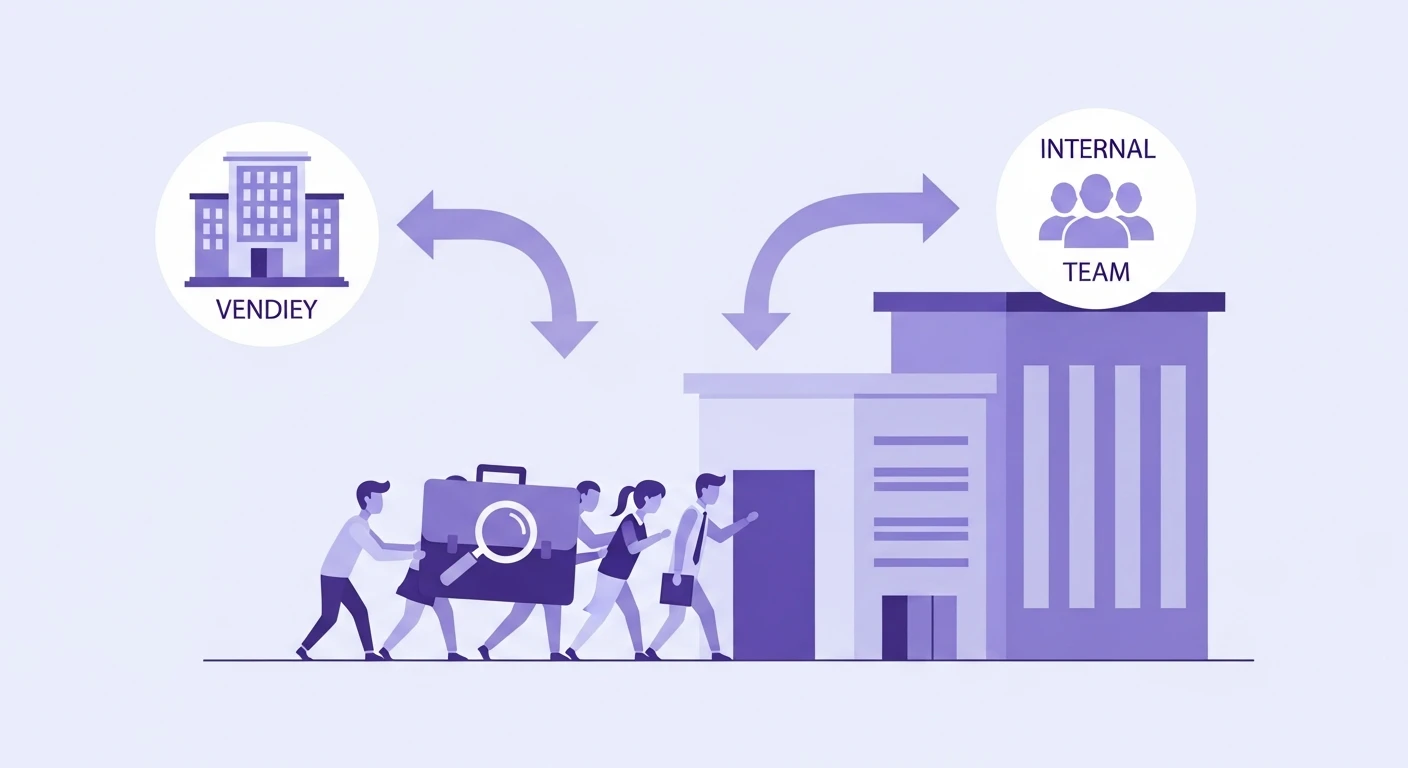
But it also introduced a hidden tax. Every handoff to an external vendor is a translation problem between research design and execution, and every layer of translation loses nuance. The agency does not carry your product context in their heads. They deliver a deck, the deck gets shared across teams, and context collapse destroys the nuance that made the research valuable by the time it reaches the people making decisions. You bought speed and paid in understanding.
What Actually Changed in 2026
The labor arithmetic inverted
The biggest input cost in qualitative research was always human time -- moderating, transcribing, coding, synthesizing. AI-assisted tooling collapsed the marginal cost of the mechanical parts. Transcription is free and instant. First-pass coding is automated. A single internal researcher can now run and synthesize the volume that used to require a small agency team. The fixed cost of insourcing that made no sense in 2020 is now lower than the per-project agency invoice.
But cheaper tooling is a double-edged reason to insource. It only works if the internal team avoids the research automation paradox, where faster data collection creates slower organizational learning. Pulling work in-house to run it faster and worse is not a win. The reversal pays off only when the recovered speed is reinvested in depth.
Customer understanding became a defensible moat
The strategic argument matured. In an AI-saturated market where every competitor has access to the same models, proprietary understanding of your specific customers is one of the few durable advantages left. Shipping that understanding to an agency -- which serves your competitors too -- started to look like outsourcing your R&D. The incentive misalignment that rewards research volume over impact is worse with vendors, whose business model rewards billable projects, not your accumulated institutional knowledge.
Data governance stopped being optional
Regulated industries and privacy-conscious enterprises are increasingly unwilling to send raw customer conversations to third-party processors. Owning the pipeline end-to-end is now a compliance requirement, not a preference. This mirrors the broader enterprise move toward keeping sensitive workloads inside a governed boundary -- the same logic behind AI governance frameworks that even smaller organizations now need. When your interview data is a governed asset, you cannot outsource custody of it.
The Trap: Insourcing the Bottleneck Along With the Work
The naive version of insourcing fails predictably. A team pulls research in-house, hires one or two researchers, and immediately recreates the agency bottleneck internally -- a small central team that everyone queues behind. Now you have the fixed cost and the bottleneck. The whole point of the reversal is to distribute research capacity, not relocate the queue.
Doing this well requires treating internal research as a platform, not a service desk. That means empowering product teams to run their own studies with guardrails, which raises the perennial risk of research democratization done wrong, where empowering non-researchers degrades rigor. The reversal succeeds when the central team shifts from doing all the research to owning the methodology, the tooling, and the quality bar -- and lets execution distribute.
There is also a hard infrastructure reality underneath. Insourcing research means owning a data pipeline: capture, storage, processing, retrieval. Teams that treat this casually recreate the mess that data contracts in AI pipelines were invented to prevent. Your interview corpus is a production data asset. Treat it like one from day one, or the repository will rot within six months.
Who Should Insource and Who Should Not
Insourcing is not universally correct. If your organization runs research a handful of times a year on genuinely one-off questions, the fixed cost still does not pencil out -- keep buying it. If research is continuous, tied to core product decisions, and touches sensitive customer data, the reversal almost certainly applies to you. The dividing line is whether customer understanding is a recurring strategic input or an occasional project. For the former, owning it is no longer a luxury; it is table stakes.
The Bottom Line
The insourcing reversal is not nostalgia for the way research used to be done. It is a rational response to two facts that both became true in 2026: the cost of running rigorous qual internally collapsed, and the cost of not owning your customer understanding became strategically unacceptable. The enterprises reading this correctly are not just bringing work back inside -- they are rebuilding research as a distributed, governed, AI-accelerated capability that compounds over time instead of evaporating into vendor decks.
Qualz.ai was built for exactly this reversal: rigorous qualitative research, run in-house, at agency scale without the agency handoff. See how it works.